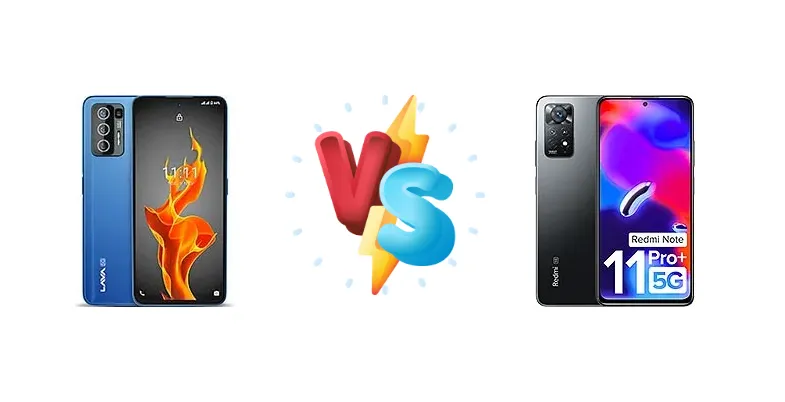
The Lava Agni 5G and Xiaomi Redmi Note 11 Pro+ 5G (India) represent compelling options in the increasingly competitive mid-range 5G smartphone market. While both aim to deliver a balanced experience, they diverge significantly in their core components, particularly the chipset and charging technology. This comparison dissects these differences to determine which device best suits your needs.
🏆 Quick Verdict
For the average user prioritizing rapid charging and a slightly more refined software experience, the Xiaomi Redmi Note 11 Pro+ 5G emerges as the winner. However, the Lava Agni 5G offers a respectable performance profile and a more focused, stock-Android approach at a potentially lower price point.
| Network |
|---|
| 2G bands | GSM 850 / 900 / 1800 / 1900 | GSM 850 / 900 / 1800 / 1900 |
| 3G bands | HSDPA 900 / 2100 | HSDPA 850 / 900 / 1900 / 2100 |
| 4G bands | 1, 3, 5, 8, 40, 41 | 1, 3, 5, 8, 40, 41 |
| 5G bands | 41, 77, 78 SA/NSA | 1, 3, 5, 8, 28, 40, 78 SA/NSA |
| Speed | HSPA, LTE, 5G | HSPA, LTE, 5G |
| Technology | GSM / HSPA / LTE / 5G | GSM / HSPA / LTE / 5G |
| Launch |
|---|
| Announced | 2021, November 09 | 2022, March 09 |
| Status | Available. Released 2021, November 18 | Available. Released 2022, March 15 |
| Body |
|---|
| Build | - | Glass front (Gorilla Glass 5), glass back |
| Dimensions | 168.8 x 76.8 x 9.1 mm (6.65 x 3.02 x 0.36 in) | 164.2 x 76.1 x 8.1 mm (6.46 x 3.00 x 0.32 in) |
| SIM | Nano-SIM + Nano-SIM | Nano-SIM + Nano-SIM |
| Weight | 204 g (7.20 oz) | 202 g (7.13 oz) |
| Display |
|---|
| Protection | Corning Gorilla Glass 3 | Corning Gorilla Glass 5 |
| Resolution | 1080 x 2460 pixels (~396 ppi density) | 1080 x 2400 pixels, 20:9 ratio (~395 ppi density) |
| Size | 6.78 inches, 109.2 cm2 (~84.2% screen-to-body ratio) | 6.67 inches, 107.4 cm2 (~86.0% screen-to-body ratio) |
| Type | IPS LCD, 90Hz | Super AMOLED, 120Hz, 700 nits, 1200 nits (peak) |
| Platform |
|---|
| CPU | Octa-core (2x2.4 GHz Cortex-A76 & 6x2.0 GHz Cortex-A55) | Octa-core (2x2.2 GHz Kryo 660 Gold & 6x1.7 GHz Kryo 660 Silver) |
| Chipset | Mediatek Dimensity 810 (6 nm) | Qualcomm SM6375 Snapdragon 695 5G (6 nm) |
| GPU | Mali-G57 MC2 | Adreno 619 |
| OS | Android 11 | Android 11, MIUI 13 |
| Memory |
|---|
| Card slot | microSDXC (uses shared SIM slot) | microSDXC (uses shared SIM slot) |
| Internal | 128GB 8GB RAM | 64GB 6GB RAM, 128GB 6GB RAM, 128GB 8GB RAM, 256GB 8GB RAM |
| Main Camera |
|---|
| Features | Dual-LED flash, HDR | LED flash, HDR, panorama |
| Quad | 64 MP, f/1.8, (wide), 0.7µm, AF
5 MP, 115˚, (ultrawide)
2 MP (macro)
Auxiliary lens | - |
| Single | 16 MP, f/2.0, (wide) | - |
| Triple | - | 108 MP, f/1.9, 26mm (wide), 1/1.52", 0.7µm, PDAF
8 MP, f/2.2, 118˚ (ultrawide)
2 MP (macro) |
| Video | 1080p@30fps | 1080p@30fps |
| Selfie camera |
|---|
| Single | 16 MP, f/2.0, (wide) | 16 MP, f/2.5, (wide), 1/3.06" 1.0µm |
| Video | 1080p@30fps | 1080p@30fps |
| Sound |
|---|
| 3.5mm jack | Yes | - |
| 35mm jack | Yes | Yes |
| Loudspeaker | Yes | Yes, with stereo speakers |
| Comms |
|---|
| Bluetooth | 5.1, A2DP, LE | 5.1, A2DP, LE |
| Infrared port | - | Yes |
| NFC | No | No |
| Positioning | GPS, GLONASS | GPS, GLONASS, BDS, GALILEO |
| Radio | FM radio | Unspecified |
| USB | USB Type-C 2.0, OTG | USB Type-C 2.0, OTG |
| WLAN | Wi-Fi 802.11 a/b/g/n/ac/6, dual-band | Wi-Fi 802.11 a/b/g/n/ac, dual-band, Wi-Fi Direct |
| Features |
|---|
| Sensors | Fingerprint (side-mounted), accelerometer, gyro, proximity, compass | Fingerprint (side-mounted), accelerometer, gyro, proximity, compass |
| Battery |
|---|
| Charging | 33W wired | 67W wired, PD3.0, QC3, 50% in 15 min, 100% in 42 min |
| Type | Li-Po 5000 mAh | Li-Po 5000 mAh |
| Misc |
|---|
| Colors | Fiery Blue | Mirage Blue, Phantom White, Stealth Black |
| Models | LXX501 | 2201116SI |
| Price | About 210 EUR | About 250 EUR |
Lava Agni 5G
- Clean, near-stock Android experience
- Potentially lower price point
- Respectable CPU performance with Dimensity 810
- Slower 33W charging
- Less refined software features compared to MIUI
Xiaomi Redmi Note 11 Pro+ 5G (India)
- Ultra-fast 67W charging with PD3.0/QC3
- Optimized Qualcomm Snapdragon 695 GPU
- Feature-rich MIUI software
- MIUI can be bloated with pre-installed apps
- Potentially higher price
Display Comparison
Neither device boasts a standout display. While specific panel details (like peak brightness or color gamut coverage) are absent, both utilize 6nm chipsets suggesting a focus on efficiency over pushing display boundaries. The Redmi Note 11 Pro+ likely benefits from Xiaomi’s display tuning expertise, but without direct comparison data, it’s difficult to quantify. Bezels are expected to be similar, typical of this price segment. The absence of LTPO technology on either device means refresh rate adjustments won't be as dynamically power-efficient.
Camera Comparison
Without detailed camera specs beyond the main sensor, a direct comparison is limited. However, the Redmi Note 11 Pro+’s likely inclusion of a higher-resolution main sensor (often a marketing highlight for Xiaomi) suggests a potential advantage in detail capture, especially in good lighting. Image processing philosophies differ significantly between Lava and Xiaomi; Lava typically aims for a more natural look, while Xiaomi often boosts saturation and contrast. The absence of OIS information for both devices suggests reliance on software stabilization, which may not be as effective in low-light scenarios. The prevalence of 2MP macro/depth sensors on both phones is largely a marketing tactic and offers minimal real-world benefit.
Performance
The core difference lies in the chipsets: the Lava Agni 5G features the Mediatek Dimensity 810, while the Redmi Note 11 Pro+ 5G utilizes the Qualcomm Snapdragon 695 5G. The Dimensity 810, with its Cortex-A76 cores clocked at 2.4 GHz, offers a slight edge in raw CPU performance compared to the Snapdragon 695’s 2.2 GHz Kryo 660 Gold cores. However, the Snapdragon 695 benefits from Qualcomm’s optimized Adreno 619 GPU, potentially providing a smoother gaming experience. Both utilize 6nm fabrication, offering good efficiency. The Redmi Note 11 Pro+’s potential for optimized software and driver support from Qualcomm could further enhance its long-term performance stability.
Battery Life
The Redmi Note 11 Pro+ 5G’s 67W charging is the clear winner here. Xiaomi advertises a 50% charge in 15 minutes and a full charge in 42 minutes, a significant advantage over the Lava Agni 5G’s 33W charging. While battery capacity isn’t specified, the faster charging mitigates any potential capacity difference. The inclusion of PD3.0 and QC3 support on the Redmi Note 11 Pro+ adds versatility, allowing it to charge quickly with a wider range of chargers. The Lava Agni 5G’s slower charging will require more downtime to replenish the battery.
Buying Guide
Buy the Lava Agni 5G if you prioritize a clean Android experience, value a potentially lower price, and aren't heavily reliant on extremely fast charging. Buy the Xiaomi Redmi Note 11 Pro+ 5G (India) if you need the fastest possible charging speeds, appreciate a feature-rich MIUI interface, and are willing to pay a premium for it.
Frequently Asked Questions
❓ Does the Snapdragon 695 in the Redmi Note 11 Pro+ 5G struggle with demanding games like Genshin Impact?
While the Snapdragon 695 is capable, Genshin Impact will likely require reduced graphics settings for a consistently smooth experience. The Adreno 619 GPU is adequate, but the chipset isn't designed for ultra-high frame rates in graphically intensive titles. The Lava Agni 5G's Dimensity 810 might offer similar performance, but thermal throttling could become a factor during extended gaming sessions.
❓ How much faster is the 67W charging on the Redmi Note 11 Pro+ compared to the 33W charging on the Lava Agni 5G in real-world usage?
The 67W charging on the Redmi Note 11 Pro+ can realistically add several hours of usage in just 15-20 minutes, while the 33W charging on the Lava Agni 5G will take considerably longer to achieve a similar charge level. Xiaomi's claims of 0-100% in 42 minutes are achievable, whereas the Lava Agni 5G will likely take over an hour and a half.
❓ Is the MIUI software on the Redmi Note 11 Pro+ 5G heavily customized, and can it be easily customized back to a stock Android look?
MIUI is significantly customized, featuring a unique user interface and a plethora of pre-installed apps. While Xiaomi offers themes and customization options, achieving a truly stock Android look requires using a third-party launcher and potentially rooting the device, which voids the warranty.