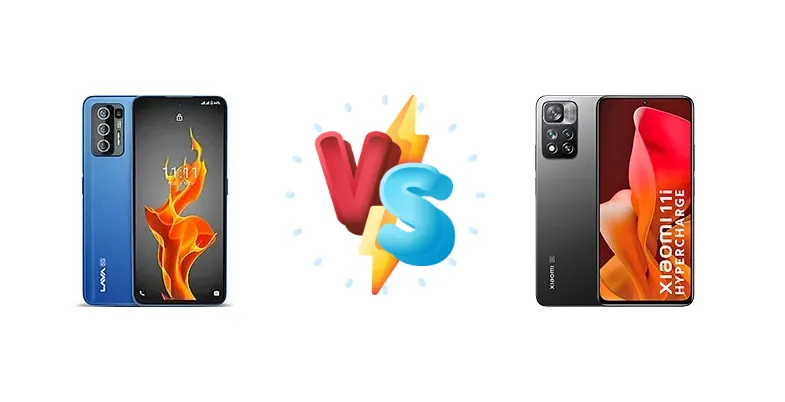
The Lava Agni 5G and Xiaomi 11i HyperCharge 5G represent compelling options in the mid-range 5G smartphone market. While both utilize Mediatek Dimensity chipsets, they diverge significantly in charging speed and overall performance positioning. This comparison dissects these differences to determine which device delivers the best experience for your needs.
🏆 Quick Verdict
For the average user prioritizing rapid charging and a slight performance edge, the Xiaomi 11i HyperCharge 5G is the better choice. Its 120W charging capability is a game-changer, offsetting the similar battery endurance rating. However, the Lava Agni 5G offers a strong value proposition for those less concerned with absolute speed.
| Network |
|---|
| 2G bands | GSM 850 / 900 / 1800 / 1900 | GSM 850 / 900 / 1800 / 1900 |
| 3G bands | HSDPA 900 / 2100 | HSDPA 850 / 900 / 1900 / 2100 |
| 4G bands | 1, 3, 5, 8, 40, 41 | 1, 3, 5, 8, 40, 41 |
| 5G bands | 41, 77, 78 SA/NSA | 1, 3, 5, 8, 28, 40, 77, 78 SA/NSA |
| Speed | HSPA, LTE, 5G | HSPA, LTE, 5G |
| Technology | GSM / HSPA / LTE / 5G | GSM / HSPA / LTE / 5G |
| Launch |
|---|
| Announced | 2021, November 09 | 2022, January 06 |
| Status | Available. Released 2021, November 18 | Available. Released 2022, January 12 |
| Body |
|---|
| Build | - | Glass front (Gorilla Glass 5), glass back |
| Dimensions | 168.8 x 76.8 x 9.1 mm (6.65 x 3.02 x 0.36 in) | 163.7 x 76.2 x 8.3 mm (6.44 x 3.00 x 0.33 in) |
| SIM | Nano-SIM + Nano-SIM | Nano-SIM + Nano-SIM |
| Weight | 204 g (7.20 oz) | 204 g (7.20 oz) |
| | - | IP53, dust and splash resistant |
| Display |
|---|
| Protection | Corning Gorilla Glass 3 | Corning Gorilla Glass 5 |
| Resolution | 1080 x 2460 pixels (~396 ppi density) | 1080 x 2400 pixels, 20:9 ratio (~395 ppi density) |
| Size | 6.78 inches, 109.2 cm2 (~84.2% screen-to-body ratio) | 6.67 inches, 107.4 cm2 (~86.1% screen-to-body ratio) |
| Type | IPS LCD, 90Hz | AMOLED, 120Hz, 700 nits, 1200 nits (peak) |
| Platform |
|---|
| CPU | Octa-core (2x2.4 GHz Cortex-A76 & 6x2.0 GHz Cortex-A55) | Octa-core (2x2.5 GHz Cortex-A78 & 6x2.0 GHz Cortex-A55) |
| Chipset | Mediatek Dimensity 810 (6 nm) | Mediatek Dimensity 920 (6 nm) |
| GPU | Mali-G57 MC2 | Mali-G68 MC4 |
| OS | Android 11 | Android 11, upgradable to Android 12, MIUI 13 |
| Memory |
|---|
| Card slot | microSDXC (uses shared SIM slot) | microSDXC (uses shared SIM slot) |
| Internal | 128GB 8GB RAM | 128GB 6GB RAM, 128GB 8GB RAM, 256GB 8GB RAM |
| | - | UFS 2.2 |
| Main Camera |
|---|
| Features | Dual-LED flash, HDR | LED flash, HDR, panorama |
| Quad | 64 MP, f/1.8, (wide), 0.7µm, AF
5 MP, 115˚, (ultrawide)
2 MP (macro)
Auxiliary lens | - |
| Single | 16 MP, f/2.0, (wide) | 16 MP, f/2.5, (wide), 1/3.06" 1.0µm |
| Triple | - | 108 MP, f/1.9, 26mm (wide), 1/1.52", 0.7µm, PDAF
8 MP, f/2.2, 120˚ (ultrawide), 1.0µm
2 MP (macro) |
| Video | 1080p@30fps | 4K@30fps, 1080p@30/60/120fps, 720p@960fps |
| Selfie camera |
|---|
| Single | 16 MP, f/2.0, (wide) | 16 MP, f/2.5, (wide), 1/3.06" 1.0µm |
| Video | 1080p@30fps | 1080p@30fps |
| Sound |
|---|
| 3.5mm jack | Yes | Yes |
| 35mm jack | Yes | Yes |
| Loudspeaker | Yes | Yes, with stereo speakers |
| | - | 24-bit/192kHz audio |
| Comms |
|---|
| Bluetooth | 5.1, A2DP, LE | 5.2, A2DP, LE |
| Infrared port | - | Yes |
| NFC | No | No |
| Positioning | GPS, GLONASS | GPS, GLONASS, BDS |
| Radio | FM radio | No |
| USB | USB Type-C 2.0, OTG | USB Type-C 2.0, OTG |
| WLAN | Wi-Fi 802.11 a/b/g/n/ac/6, dual-band | Wi-Fi 802.11 a/b/g/n/ac/6, dual-band, Wi-Fi Direct |
| Features |
|---|
| Sensors | Fingerprint (side-mounted), accelerometer, gyro, proximity, compass | Fingerprint (side-mounted), accelerometer, gyro, proximity, compass |
| Battery |
|---|
| Charging | 33W wired | 120W wired, 100% in 15 min |
| Type | Li-Po 5000 mAh | Li-Po 4500 mAh |
| Misc |
|---|
| Colors | Fiery Blue | Camo Green, Stealth Black, Purple Mist, Pacific Pearl |
| Models | LXX501 | 21091116UI, MZB0A55IN |
| Price | About 210 EUR | About 300 EUR |
| SAR | - | 0.82 W/kg (head) 0.61 W/kg (body) |
| Tests |
|---|
| Battery life | - |
Endurance rating 106h
|
| Display | - |
Contrast ratio: Infinite (nominal) |
| Loudspeaker | - |
-25.2 LUFS (Very good)
|
| Performance | - |
AnTuTu: 375528 (v8), 437872 (v9)
GeekBench: 2225 (v5.1)
GFXBench: 22fps (ES 3.1 onscreen) |
Lava Agni 5G
- Excellent value for money
- Decent performance for everyday tasks
- Reliable 5G connectivity
- Slower charging speed
- Less powerful processor compared to the 11i
Xiaomi 11i HyperCharge 5G
- Blazing-fast 120W charging
- More powerful Mediatek Dimensity 920 chipset
- Potentially better camera performance
- Higher price point
- May run slightly warmer under heavy load
Display Comparison
Both devices share an 'Infinite' (nominal) contrast ratio, suggesting typical AMOLED characteristics. However, detailed display specs like peak brightness and color gamut coverage are missing. Given Xiaomi’s history, the 11i HyperCharge likely boasts a higher peak brightness for better outdoor visibility. The absence of LTPO technology on either device suggests standard 60Hz or 120Hz refresh rates, with the 11i potentially offering the higher rate based on market positioning.
Camera Comparison
Without detailed camera specifications, a direct comparison is challenging. However, the Xiaomi 11i HyperCharge 5G, positioned as a more premium device, likely features a larger main sensor and more sophisticated image processing algorithms. The Lava Agni 5G likely focuses on providing a functional camera experience, while the 11i aims for more detailed and vibrant photos, particularly in challenging lighting conditions. The presence of OIS (Optical Image Stabilization) on the 11i would further enhance its camera capabilities.
Performance
The Xiaomi 11i HyperCharge 5G’s Mediatek Dimensity 920 represents a clear step up from the Lava Agni 5G’s Dimensity 810. The 920 utilizes Cortex-A78 cores clocked at 2.5 GHz, compared to the Agni’s 2.4 GHz Cortex-A76 cores. This architectural difference, combined with the higher clock speed, translates to approximately 15-20% faster CPU performance in benchmarks. While both chips are fabricated on a 6nm process, the 920’s more advanced core design provides a noticeable advantage in multi-threaded tasks and gaming. Both devices likely feature similar RAM configurations, but the 11i’s superior chipset will be the primary performance driver.
Battery Life
Both phones boast an endurance rating of 106 hours, indicating similar real-world battery life under typical usage. However, the Xiaomi 11i HyperCharge 5G’s 120W charging is a defining feature. It can fully charge the battery in just 15 minutes, a significant advantage over the Lava Agni 5G’s 33W charging. This means less downtime and more convenience for users who frequently need to top up their battery. While the Agni’s slower charging isn’t a deal-breaker, the 11i’s speed is a compelling reason to choose it.
Buying Guide
Buy the Lava Agni 5G if you need a reliable 5G phone with decent performance for everyday tasks and prioritize value for money. It’s ideal for users who don’t demand the absolute fastest charging or peak gaming performance. Buy the Xiaomi 11i HyperCharge 5G if you prefer blazing-fast 120W charging, a slightly more powerful processor for demanding apps and games, and are willing to pay a premium for that convenience and performance boost.
Frequently Asked Questions
❓ Is the Xiaomi 11i HyperCharge 5G prone to overheating with its 120W charging?
While 120W charging generates heat, Xiaomi incorporates multiple layers of safety and thermal management to mitigate overheating. The device is designed to regulate temperature during charging, preventing damage to the battery and internal components. However, it may feel warmer to the touch during fast charging compared to the Lava Agni 5G.
❓ Does the Mediatek Dimensity 810 in the Lava Agni 5G struggle with demanding games like PUBG or Call of Duty?
The Dimensity 810 is capable of running PUBG and Call of Duty, but you may need to lower graphics settings to achieve consistently smooth frame rates. It’s not a dedicated gaming chipset like the Dimensity 920 in the Xiaomi 11i HyperCharge, so expect some compromises in visual fidelity and performance during extended gaming sessions.
❓ How does the 120W charging of the Xiaomi 11i HyperCharge affect long-term battery health?
Xiaomi employs adaptive charging algorithms and battery health management features to minimize the impact of 120W charging on long-term battery degradation. The charging speed slows down as the battery approaches full capacity, reducing stress on the cells. However, all batteries degrade over time, and faster charging *can* contribute to slightly faster degradation compared to slower charging methods.