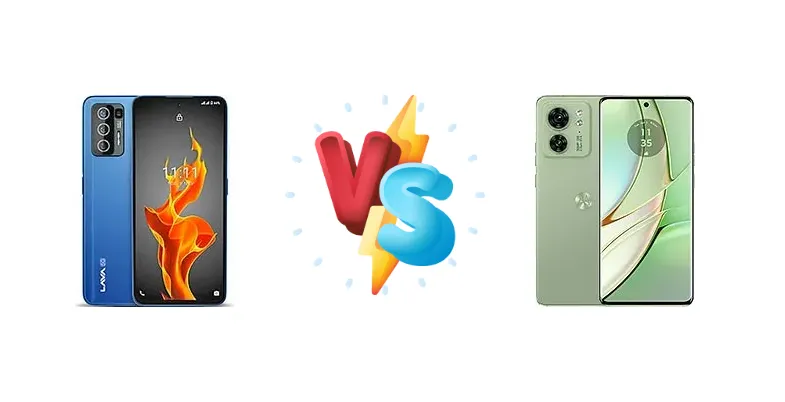
The mid-range smartphone market is heating up, and two contenders vying for your attention are the Lava Agni 5G and the Motorola Edge 40. Both offer 5G connectivity and a range of features, but which one delivers the best overall experience? Let's dive into a comprehensive comparison.
🏆 Quick Verdict
The Motorola Edge 40 emerges as the stronger contender, boasting faster charging, a brighter display, and a slightly more powerful chipset. While the Lava Agni 5G offers decent value, the Edge 40's superior features and performance justify its likely higher price point.
| Network |
|---|
| 2G bands | GSM 850 / 900 / 1800 / 1900 | GSM 850 / 900 / 1800 / 1900 |
| 3G bands | HSDPA 900 / 2100 | HSDPA 850 / 900 / 1700(AWS) / 1900 / 2100 |
| 4G bands | 1, 3, 5, 8, 40, 41 | 1, 2, 3, 4, 5, 7, 8, 12, 13, 17, 20, 26, 28, 32, 38, 39, 40, 41, 42, 43, 66 |
| 5G bands | 41, 77, 78 SA/NSA | 1, 2, 3, 5, 7, 8, 20, 28, 38, 40, 41, 66, 77, 78 SA/NSA/Sub6 |
| Speed | HSPA, LTE, 5G | HSPA, LTE, 5G |
| Technology | GSM / HSPA / LTE / 5G | GSM / HSPA / LTE / 5G |
| Launch |
|---|
| Announced | 2021, November 09 | 2023, May 04 |
| Status | Available. Released 2021, November 18 | Available. Released 2023, May 04 |
| Body |
|---|
| Build | - | Glass front, aluminum frame, plastic back or eco leather back |
| Dimensions | 168.8 x 76.8 x 9.1 mm (6.65 x 3.02 x 0.36 in) | 158.4 x 72 x 7.6 mm (6.24 x 2.83 x 0.30 in) |
| SIM | Nano-SIM + Nano-SIM | · Nano-SIM· Nano-SIM + eSIM· Nano-SIM + Nano-SIM |
| Weight | 204 g (7.20 oz) | 167 g or 171 g (5.89 oz) |
| | - | IP68 dust/water resistant (up to 1.5m for 30 min) |
| Display |
|---|
| Protection | Corning Gorilla Glass 3 | - |
| Resolution | 1080 x 2460 pixels (~396 ppi density) | 1080 x 2400 pixels, 20:9 ratio (~402 ppi density) |
| Size | 6.78 inches, 109.2 cm2 (~84.2% screen-to-body ratio) | 6.55 inches, 103.6 cm2 (~90.8% screen-to-body ratio) |
| Type | IPS LCD, 90Hz | P-OLED, 144Hz, HDR10+, 1200 nits (peak) |
| Platform |
|---|
| CPU | Octa-core (2x2.4 GHz Cortex-A76 & 6x2.0 GHz Cortex-A55) | Octa-core (4x2.6 GHz Cortex-A78 & 4x2.0 GHz Cortex-A55) |
| Chipset | Mediatek Dimensity 810 (6 nm) | Mediatek Dimensity 8020 (6 nm) |
| GPU | Mali-G57 MC2 | Mali-G77 MC9 |
| OS | Android 11 | Android 13, up to 2 major Android upgrades |
| Memory |
|---|
| Card slot | microSDXC (uses shared SIM slot) | No |
| Internal | 128GB 8GB RAM | 128GB 8GB RAM, 256GB 8GB RAM |
| | - | UFS 3.1 |
| Main Camera |
|---|
| Dual | - | 50 MP, f/1.4, (wide), 1/1.55", 1.0µm, multi-directional PDAF, OIS
13 MP, f/2.2, 120˚ (ultrawide), 1/3.0", 1.12µm, AF |
| Features | Dual-LED flash, HDR | Dual-LED flash, HDR, panorama |
| Quad | 64 MP, f/1.8, (wide), 0.7µm, AF
5 MP, 115˚, (ultrawide)
2 MP (macro)
Auxiliary lens | - |
| Single | 16 MP, f/2.0, (wide) | - |
| Video | 1080p@30fps | 4K@30fps, 1080p@30/60/120fps, 720p@960fps, HDR10, gyro-EIS |
| Selfie camera |
|---|
| Features | - | HDR |
| Single | 16 MP, f/2.0, (wide) | 32 MP, f/2.4, (wide), 1/3.0", 0.7µm |
| Video | 1080p@30fps | 4K@30fps, 1080p@30/120fps |
| Sound |
|---|
| 3.5mm jack | Yes | No |
| 35mm jack | Yes | No |
| Loudspeaker | Yes | Yes, with stereo speakers |
| Comms |
|---|
| Bluetooth | 5.1, A2DP, LE | 5.2, A2DP, LE |
| NFC | No | Yes |
| Positioning | GPS, GLONASS | GPS, GLONASS, GALILEO, BDS |
| Radio | FM radio | No |
| USB | USB Type-C 2.0, OTG | USB Type-C 2.0, OTG |
| WLAN | Wi-Fi 802.11 a/b/g/n/ac/6, dual-band | Wi-Fi 802.11 a/b/g/n/ac/6e, tri-band, Wi-Fi Direct |
| Features |
|---|
| Sensors | Fingerprint (side-mounted), accelerometer, gyro, proximity, compass | Fingerprint (under display, optical), accelerometer, gyro, proximity, compass |
| | - | Moto Ready For support |
| Battery |
|---|
| Charging | 33W wired | 68W wired
15W wireless |
| Type | Li-Po 5000 mAh | Li-Po 4400 mAh |
| Misc |
|---|
| Colors | Fiery Blue | Nebula Green, Lunar Blue, Eclipse Black, Viva Magenta |
| Models | LXX501 | XT2303-2 |
| Price | About 210 EUR | € 202.03 / $ 419.99 / £ 199.00 / ₹ 29,999 |
| Tests |
|---|
| Battery life | - |
Endurance rating 98h
|
| Camera | - |
Photo / Video |
| Display | - |
Contrast ratio: Infinite (nominal) |
| Loudspeaker | - |
-24.2 LUFS (Very good)
|
| Performance | - |
AnTuTu: 688347 (v9)
GeekBench: 3320 (v5.1), 3603 (v6)
GFXBench: 33fps (ES 3.1 onscreen) |
Lava Agni 5G
- Good value for money
- Reliable 5G connectivity
- Decent performance for everyday tasks
- Less powerful chipset than Edge 40
- Slower charging speed
- Likely less vibrant display
Motorola Edge 40
- Brighter and more vibrant display
- Faster charging (wired & wireless)
- Slightly more powerful chipset
- Exceptional battery life
- Likely higher price point
- Camera details are unclear
Display Comparison
The Motorola Edge 40 takes a clear lead with its impressive 1043 nits peak brightness and infinite contrast ratio, promising a stunning visual experience. The Lava Agni 5G's display is likely adequate but won't match the Edge 40's vibrancy and clarity. Expect better outdoor visibility and richer colors on the Edge 40.
Camera Comparison
Both phones are listed as having 'Photo / Video' capabilities, but detailed camera specs are missing. Generally, Motorola phones have a reputation for decent camera performance, and the Edge 40 likely has better image processing capabilities. The Agni 5G's camera is likely adequate for casual photography.
Performance
While both phones utilize Mediatek Dimensity chips, the Edge 40's Dimensity 8020 has a slight edge over the Agni 5G's Dimensity 810. The Edge 40's Cortex-A78 cores offer better performance for demanding tasks and gaming. Expect smoother multitasking and faster app loading times on the Edge 40.
Battery Life
The Motorola Edge 40 boasts an exceptional endurance rating of 98 hours, significantly outperforming most smartphones. Coupled with its 68W wired and 15W wireless charging, it offers superior battery life and charging speed compared to the Lava Agni 5G's 33W wired charging.
Buying Guide
The Lava Agni 5G is a good option for budget-conscious buyers who prioritize a reliable 5G experience and don't need top-tier performance. The Motorola Edge 40 is ideal for users who demand a vibrant display, fast charging, and a smoother overall experience, and are willing to spend a bit more.
Frequently Asked Questions
❓ Is the Lava Agni 5G a good budget phone?
Yes, the Lava Agni 5G offers a good balance of features and price, making it a decent option for budget-conscious buyers looking for 5G connectivity.
❓ Does the Motorola Edge 40 support wireless charging?
Yes, the Motorola Edge 40 supports 15W wireless charging, a feature absent in the Lava Agni 5G.