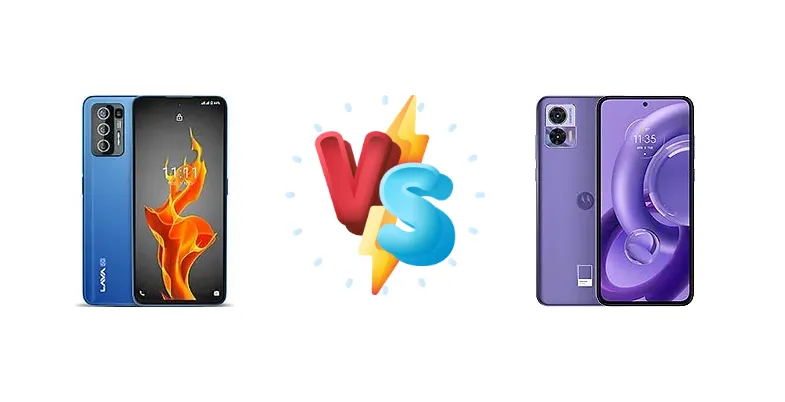
The Lava Agni 5G and Motorola Edge 30 Neo represent compelling options in the increasingly competitive sub-$300 5G smartphone market. The Agni 5G aims for a balance of performance and affordability, while the Edge 30 Neo prioritizes a sleek design and faster charging, making this a battle of different priorities.
🏆 Quick Verdict
For the average user prioritizing rapid charging and a brighter display, the Motorola Edge 30 Neo is the better choice. Its 68W charging significantly outperforms the Lava Agni 5G’s 33W, and the 1004 nits peak brightness offers superior outdoor visibility. However, the Agni 5G remains a strong contender for those seeking raw processing power at a lower price point.
| Network |
|---|
| 2G bands | GSM 850 / 900 / 1800 / 1900 | GSM 850 / 900 / 1800 / 1900 |
| 3G bands | HSDPA 900 / 2100 | HSDPA 850 / 900 / 1700(AWS) / 1900 / 2100 |
| 4G bands | 1, 3, 5, 8, 40, 41 | 1, 2, 3, 4, 5, 7, 8, 12, 17, 20, 25, 26, 28, 32, 38, 40, 41, 42, 43 |
| 5G bands | 41, 77, 78 SA/NSA | 1, 3, 5, 7, 8, 20, 28, 38, 40, 41, 66, 78 SA/NSA |
| Speed | HSPA, LTE, 5G | HSPA, LTE, 5G |
| Technology | GSM / HSPA / LTE / 5G | GSM / HSPA / LTE / 5G |
| Launch |
|---|
| Announced | 2021, November 09 | 2022, September 08 |
| Status | Available. Released 2021, November 18 | Available. Released 2022, October 07 |
| Body |
|---|
| Build | - | Glass front, plastic frame, plastic back |
| Dimensions | 168.8 x 76.8 x 9.1 mm (6.65 x 3.02 x 0.36 in) | 152.9 x 71.2 x 7.8 mm (6.02 x 2.80 x 0.31 in) |
| SIM | Nano-SIM + Nano-SIM | · Nano-SIM· Nano-SIM + Nano-SIM |
| Weight | 204 g (7.20 oz) | 155 g (5.47 oz) |
| | - | Splash and dust resistant |
| Display |
|---|
| Protection | Corning Gorilla Glass 3 | - |
| Resolution | 1080 x 2460 pixels (~396 ppi density) | 1080 x 2400 pixels, 20:9 ratio (~419 ppi density) |
| Size | 6.78 inches, 109.2 cm2 (~84.2% screen-to-body ratio) | 6.28 inches, 95.2 cm2 (~87.5% screen-to-body ratio) |
| Type | IPS LCD, 90Hz | P-OLED, 120Hz |
| Platform |
|---|
| CPU | Octa-core (2x2.4 GHz Cortex-A76 & 6x2.0 GHz Cortex-A55) | Octa-core (2x2.2 GHz Kryo 660 Gold & 6x1.7 GHz Kryo 660 Silver) |
| Chipset | Mediatek Dimensity 810 (6 nm) | Qualcomm SM6375 Snapdragon 695 5G (6 nm) |
| GPU | Mali-G57 MC2 | Adreno 619 |
| OS | Android 11 | Android 12, planned upgrade to Android 15 |
| Memory |
|---|
| Card slot | microSDXC (uses shared SIM slot) | No |
| Internal | 128GB 8GB RAM | 128GB 6GB RAM, 128GB 8GB RAM, 256GB 8GB RAM |
| Main Camera |
|---|
| Dual | - | 64 MP, f/1.8, (wide), 1/1.97", 0.7µm, PDAF, OIS
13 MP, f/2.2, 120˚ (ultrawide), 1/3.0", 1.12µm, AF |
| Features | Dual-LED flash, HDR | Dual-LED flash, HDR, panorama |
| Quad | 64 MP, f/1.8, (wide), 0.7µm, AF
5 MP, 115˚, (ultrawide)
2 MP (macro)
Auxiliary lens | - |
| Single | 16 MP, f/2.0, (wide) | - |
| Video | 1080p@30fps | 1080p@30/60/120fps |
| Selfie camera |
|---|
| Features | - | HDR |
| Single | 16 MP, f/2.0, (wide) | 32 MP, f/2.4, (wide), 1/3.0", 0.7µm |
| Video | 1080p@30fps | 1080p@30fps |
| Sound |
|---|
| 3.5mm jack | Yes | No |
| 35mm jack | Yes | No |
| Loudspeaker | Yes | Yes, with stereo speakers |
| Comms |
|---|
| Bluetooth | 5.1, A2DP, LE | 5.1, A2DP, LE, aptX HD, aptX Adaptive |
| NFC | No | Yes |
| Positioning | GPS, GLONASS | GPS, GLONASS, GALILEO |
| Radio | FM radio | No |
| USB | USB Type-C 2.0, OTG | USB Type-C 3.1, OTG |
| WLAN | Wi-Fi 802.11 a/b/g/n/ac/6, dual-band | Wi-Fi 802.11 a/b/g/n/ac, dual-band, Wi-Fi Direct |
| Features |
|---|
| Sensors | Fingerprint (side-mounted), accelerometer, gyro, proximity, compass | Fingerprint (under display, optical), accelerometer, proximity, compass |
| Battery |
|---|
| Charging | 33W wired | 68W wired
5W wireless |
| Type | Li-Po 5000 mAh | Li-Po 4020 mAh |
| Misc |
|---|
| Colors | Fiery Blue | Very Peri, Black Onyx, Ice Palace, Aqua Foam |
| Models | LXX501 | XT2245-1 |
| Price | About 210 EUR | € 156.44 / $ 185.00 / £ 229.00 |
| Tests |
|---|
| Battery life | - |
Endurance rating 104h
|
| Camera | - |
Photo / Video |
| Display | - |
Contrast ratio: Infinite (nominal) |
| Loudspeaker | - |
-26.4 LUFS (Good)
|
| Performance | - |
AnTuTu: 380818 (v9)
GeekBench: 1964 (v5.1)
GFXBench: 16fps (ES 3.1 onscreen) |
Lava Agni 5G
- Potentially higher CPU performance with Dimensity 810
- More affordable price point (likely)
- Good overall endurance rating
- Slower 33W charging
- Display brightness likely lower than Edge 30 Neo
- Less refined software experience (potentially)
Motorola Edge 30 Neo
- Significantly faster 68W wired and 5W wireless charging
- Brighter 1004 nits display
- Potentially better camera image processing
- Slightly lower peak CPU performance
- Potentially higher price
- Snapdragon 695 may throttle under sustained load
Display Comparison
The Motorola Edge 30 Neo boasts a significantly brighter display, reaching a measured peak of 1004 nits, compared to an unspecified brightness for the Lava Agni 5G. This translates to much better visibility under direct sunlight. While both displays are likely OLED based (given the 'infinite' contrast ratio claim for the Motorola), the Edge 30 Neo’s higher brightness is a clear advantage. The absence of refresh rate information for the Agni 5G suggests it may be limited to 60Hz, while the Edge 30 Neo is likely to offer a smoother 90Hz or 120Hz experience, enhancing scrolling and animations.
Camera Comparison
Both devices feature 'Photo / Video' capabilities, but lack specific details regarding sensor size or megapixel count. This makes a direct comparison difficult. However, the Motorola Edge 30 Neo’s brand reputation suggests a more refined image processing pipeline, potentially delivering better dynamic range and color accuracy. The absence of details on Optical Image Stabilization (OIS) for either phone suggests both rely on software stabilization, which may result in less stable video recording in low-light conditions. The inclusion of a 2MP macro lens on either device is likely a marketing gimmick, offering limited practical benefit.
Performance
Both phones utilize 6nm process nodes, indicating similar power efficiency. However, the Lava Agni 5G’s MediaTek Dimensity 810, with its Cortex-A76 cores clocked at 2.4 GHz, offers a slight edge in raw CPU performance compared to the Qualcomm Snapdragon 695’s 2.2 GHz Kryo 660 Gold cores. This difference will be noticeable in demanding tasks like video editing or running complex applications. The Snapdragon 695, however, benefits from Qualcomm’s optimized software and potentially better GPU performance for gaming. The Agni 5G’s RAM configuration is unknown, but the Edge 30 Neo’s LPDDR5 RAM contributes to faster data access and improved responsiveness.
Battery Life
Both phones share an endurance rating of 104 hours, suggesting similar overall battery life despite the Lava Agni 5G’s unspecified battery capacity. However, the Motorola Edge 30 Neo’s 68W wired charging is a game-changer, allowing for a full charge in under 40 minutes. It also includes 5W wireless charging, a feature absent on the Lava Agni 5G. The Agni 5G’s 33W charging, while respectable, will take considerably longer to replenish the battery, making the Edge 30 Neo the clear winner for users who prioritize convenience.
Buying Guide
Buy the Lava Agni 5G if you need a phone focused on maximizing CPU performance for multitasking and light gaming, and are comfortable with slower charging speeds. Buy the Motorola Edge 30 Neo if you prefer a more refined user experience, a brighter and more vibrant display, and the convenience of incredibly fast wired and wireless charging, even if it means a slight trade-off in peak CPU performance.
Frequently Asked Questions
❓ Does the Dimensity 810 in the Lava Agni 5G get hot during extended gaming sessions?
While the 6nm process helps with efficiency, the Dimensity 810 is not a flagship chipset. Expect some thermal throttling during prolonged gaming, potentially leading to reduced frame rates. The Motorola Edge 30 Neo’s Snapdragon 695 may also throttle, but Qualcomm’s thermal management is generally more refined.
❓ How long does it *actually* take to fully charge the Motorola Edge 30 Neo with the 68W charger?
Motorola claims a full charge from 0-100% in approximately 30-40 minutes with the 68W charger. Real-world results may vary slightly depending on ambient temperature and battery health, but it’s significantly faster than the Lava Agni 5G’s 33W charging.
❓ Is the Motorola Edge 30 Neo’s display color accurate enough for photo editing?
While Motorola doesn't explicitly advertise color accuracy, the OLED panel and high brightness suggest good color reproduction. However, professional photo editors may still prefer a dedicated monitor with calibrated colors. The lack of detailed display specs on the Lava Agni 5G makes it difficult to assess its color accuracy.
❓ Does the Lava Agni 5G support VoLTE and VoWiFi on all major carriers?
Lava typically ensures compatibility with major Indian carriers. However, it's crucial to verify VoLTE and VoWiFi support with your specific carrier before purchasing, as compatibility can vary. The Motorola Edge 30 Neo generally offers broader carrier support due to Qualcomm’s modem technology.