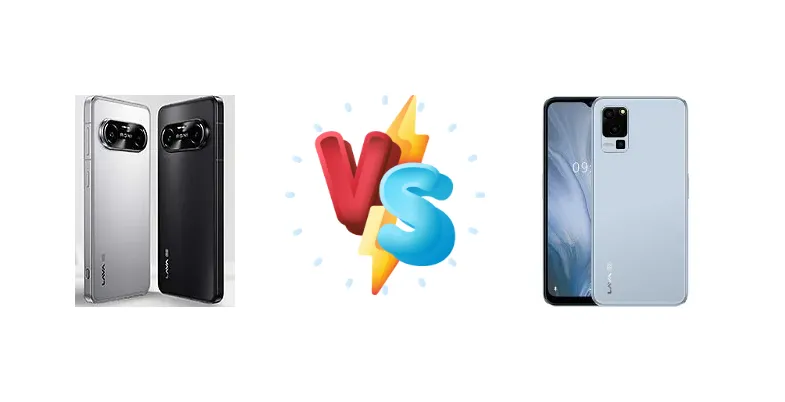
Lava is making waves with its aggressive pricing and feature sets. The Agni 4 and Blaze 5G represent two distinct approaches: the Agni 4 aims for near-flagship performance, while the Blaze 5G focuses on accessible 5G connectivity. This comparison dissects their core differences to help you choose the right Lava phone for your needs.
🏆 Quick Verdict
For users prioritizing performance and fast charging, the Lava Agni 4 is the clear winner. Its Dimensity 8350 chipset delivers significantly faster processing and gaming capabilities. However, the Lava Blaze 5G remains a compelling option for budget-conscious users who primarily need 5G access and basic smartphone functionality.
| Network |
|---|
| 2G bands | GSM 850 / 900 / 1800 / 1900 | GSM 900 / 1800 |
| 3G bands | HSDPA 850 / 900 / 1900 / 2100 | HSDPA 900 / 2100 |
| 4G bands | 1, 3, 5, 7, 8, 20, 28, 38, 40, 41 | 1, 3, 5, 8, 40, 41 |
| 5G bands | 1, 2, 3, 5, 7, 8, 20, 28, 38, 40, 41, 66, 77, 78 SA/NSA | SA/NSA |
| Speed | HSPA, LTE, 5G | HSPA, LTE, 5G |
| Technology | GSM / HSPA / LTE / 5G | GSM / HSPA / LTE / 5G |
| Launch |
|---|
| Announced | 2025, November 20 | 2022, October 3 |
| Status | Available. Released 2025, November 25 | Available. Released 2022, October 24 |
| Body |
|---|
| Build | Glass front (Gorilla Glass 5), aluminum frame | - |
| Dimensions | 160.7 x 75.3 x 8.6 mm (6.33 x 2.96 x 0.34 in) | 165.3 x 76.4 x 8.9 mm (6.51 x 3.01 x 0.35 in) |
| SIM | Nano-SIM + Nano-SIM | Nano-SIM + Nano-SIM |
| Weight | 208 g (7.34 oz) | 207 g (7.30 oz) |
| Display |
|---|
| Protection | Corning Gorilla Glass 5 | - |
| Resolution | 1220 x 2712 pixels, 20:9 ratio (~446 ppi density) | 720 x 1600 pixels, 20:9 ratio (~269 ppi density) |
| Size | 6.67 inches, 107.4 cm2 (~88.7% screen-to-body ratio) | 6.52 inches, 102.6 cm2 (~81.3% screen-to-body ratio) |
| Type | AMOLED, 1B colors, 120Hz, HDR, 2400 nits (peak) | IPS LCD, 90Hz |
| Platform |
|---|
| CPU | Octa-core (1x3.35 GHz Cortex-A715 & 3x3.20 GHz Cortex-A715 & 4x2.20 GHz Cortex-A510) | Octa-core (2x2.2 GHz Cortex-A76 & 6x2.0 GHz Cortex-A55) |
| Chipset | Mediatek Dimensity 8350 (4 nm) | Mediatek Dimensity 700 (7 nm) |
| GPU | Mali G615-MC6 | Mali-G57 MC2 |
| OS | Android 15, up to 3 major Android upgrades | Android 12 |
| Memory |
|---|
| Card slot | No | microSDXC (uses shared SIM slot) |
| Internal | 256GB 8GB RAM | 128GB 4GB RAM, 128GB 6GB RAM |
| | - | eMMC 5.1 |
| Main Camera |
|---|
| Dual | 50 MP, f/1.9, (wide), 1/1.55", 1.0µm, PDAF, OIS
8 MP, 112˚ (ultrawide) | - |
| Features | Dual-LED flash, HDR, panorama | LED flash, HDR, panorama |
| Single | - | 8 MP, f/2.0, (wide) |
| Triple | - | 50 MP, (wide), 0.64µm, AF
2 MP (macro)
0.3 MP |
| Video | 4K@30/60fps, 1080p@30fps | 1080p@30fps |
| Selfie camera |
|---|
| Single | 50 MP, (wide), 1/2.76", 0.64µm | 8 MP, f/2.0, (wide) |
| Video | 4K@30/60fps, 1080p@30fps | Yes |
| Sound |
|---|
| 3.5mm jack | - | Yes |
| 35mm jack | No | Yes |
| Loudspeaker | Yes, with stereo speakers | Yes |
| Comms |
|---|
| Bluetooth | 5.4, A2DP, LE | 5.0, A2DP, LE |
| Infrared port | Yes | - |
| NFC | No | No |
| Positioning | GPS, GLONASS | GPS |
| Radio | FM radio | FM radio |
| USB | USB Type-C 3.2, OTG | USB Type-C 2.0, OTG |
| WLAN | Wi-Fi 802.11 a/b/g/n/ac/6e, dual-band | Wi-Fi 802.11 b/g/n/ac |
| Features |
|---|
| Sensors | Fingerprint (under display, optical), accelerometer, gyro, proximity, compass | Fingerprint (side-mounted), accelerometer, proximity |
| Battery |
|---|
| Charging | 66W wired, 50% in 19 min, 100% in 51 min | 10W wired |
| Type | Li-Po 5000 mAh | Li-Po 5000 mAh |
| Misc |
|---|
| Colors | Phantom Black, Lunar Mist | Green, Blue |
| Models | - | LXX503 |
| Price | ₹ 24,998 | About 130 EUR |
Lava Agni 4
- Significantly faster processor (Dimensity 8350)
- Ultra-fast 66W charging
- Potentially better camera image processing
- Likely higher price point
- May generate more heat under sustained load
Lava Blaze 5G
- More affordable price
- 5G connectivity
- Decent battery life for basic usage
- Slow 10W charging
- Less powerful processor (Dimensity 700)
- Limited gaming performance
Display Comparison
While display specifications are missing, the Agni 4's positioning suggests a higher-quality panel. The focus on performance implies a display capable of higher refresh rates to complement the Dimensity 8350. The Blaze 5G, targeting a lower price point, likely utilizes a standard 60Hz panel. Bezels are expected to be wider on the Blaze 5G to reduce manufacturing costs. Color accuracy is also likely to be superior on the Agni 4, given its higher tier.
Camera Comparison
Camera details are limited, but the chipset difference hints at superior image processing capabilities in the Agni 4. The Dimensity 8350 includes a more advanced Image Signal Processor (ISP) enabling faster processing, better noise reduction, and improved dynamic range. While both phones likely feature a primary camera, the Agni 4 can leverage its processing power to deliver sharper, more detailed images, especially in low-light conditions. Expect the Blaze 5G to rely more on software enhancements to compensate for its less powerful ISP.
Performance
The core difference lies in the chipsets. The Lava Agni 4’s Mediatek Dimensity 8350 (4nm) is a substantial upgrade over the Blaze 5G’s Dimensity 700 (7nm). The 8350 features a more modern CPU architecture – Cortex-A715 cores versus the A76 in the 700 – resulting in significantly improved single-core and multi-core performance. The 4nm process node further enhances efficiency and reduces thermal throttling. The Agni 4’s CPU configuration (1x3.35 GHz Cortex-A715, 3x3.20 GHz Cortex-A715, 4x2.20 GHz Cortex-A510) is optimized for both peak performance and sustained workloads, unlike the Blaze 5G’s (2x2.2 GHz Cortex-A76 & 6x2.0 GHz Cortex-A55). Gamers and power users will see a dramatic difference in responsiveness and frame rates.
Battery Life
The Lava Agni 4’s 66W wired charging is a game-changer, achieving 50% charge in just 19 minutes and a full charge in 51 minutes. This drastically reduces downtime compared to the Blaze 5G’s slow 10W charging. While battery capacity isn’t specified, the Agni 4’s more efficient chipset and faster charging mitigate the impact of a potentially smaller battery. The Blaze 5G’s 10W charging will require significantly longer to reach a full charge, making it less convenient for users who frequently need to top up their battery.
Buying Guide
Buy the Lava Agni 4 if you need a phone capable of handling demanding games, multitasking, and benefit from significantly faster charging speeds. This is for the power user. Buy the Lava Blaze 5G if you prioritize affordability and 5G connectivity for basic tasks like browsing, social media, and occasional video streaming. It's the ideal choice for first-time smartphone buyers or those on a tight budget.
Frequently Asked Questions
❓ Will the Lava Agni 4 get noticeably hotter during extended gaming sessions compared to the Blaze 5G?
Yes, the Dimensity 8350 in the Agni 4 is a more powerful chip and will generate more heat under sustained load. However, Lava likely implemented thermal management solutions to mitigate throttling. The Blaze 5G’s Dimensity 700 will run cooler, but at the cost of performance.
❓ Is the 10W charging on the Lava Blaze 5G practical for daily use?
The 10W charging on the Blaze 5G is quite slow. Expect several hours to fully charge the device. It's best suited for overnight charging or topping up when the phone is not in active use. Users who frequently need a quick charge will find it very inconvenient.
❓ Can the Lava Agni 4 handle graphically demanding games like Genshin Impact or Call of Duty Mobile?
The Dimensity 8350 is capable of running these games at medium to high settings with playable frame rates. However, sustained performance will depend on the phone's thermal management. Expect some frame drops during extended gaming sessions, but overall, the experience will be significantly better than on the Blaze 5G.