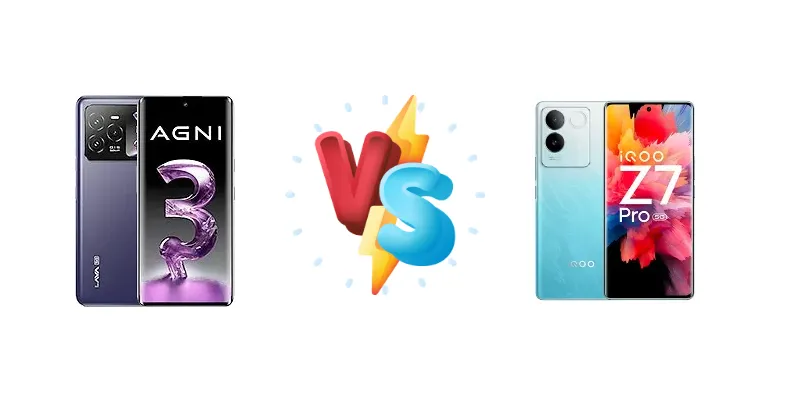
The Lava Agni 3 and vivo iQOO Z7 Pro represent compelling options in the increasingly competitive mid-range smartphone market. Both leverage Mediatek's Dimensity series, but with distinct chipsets and approaches to performance and charging. This comparison dissects the key differences to help you determine which device delivers the best value for your needs.
🏆 Quick Verdict
For most users, the Lava Agni 3 emerges as the stronger contender. Its Dimensity 7300X chipset, while not drastically faster on paper, offers a more modern CPU architecture and potentially better sustained performance. The slightly slower charging time is a minor trade-off for the overall performance advantage.
| Network |
|---|
| 2G bands | GSM 850 / 900 / 1800 / 1900 | GSM 850 / 900 / 1800 / 1900 |
| 3G bands | HSDPA 850 / 900 / 1900 / 2100 | HSDPA 850 / 900 / 1700 / 2100 |
| 4G bands | 1, 3, 5, 7, 8, 20, 28, 38, 40, 41 | 1, 3, 4, 5, 8, 28, 34, 38, 39, 40, 41 |
| 5G bands | 1, 2, 3, 5, 7, 8, 20, 28, 38, 40, 41, 66, 77, 78 SA/NSA | 1, 3, 5, 8, 28, 40, 41, 77, 78 SA/NSA |
| Speed | HSPA, LTE, 5G | HSPA, LTE, 5G |
| Technology | GSM / HSPA / LTE / 5G | GSM / HSPA / LTE / 5G |
| Launch |
|---|
| Announced | 2024, October 04 | 2023, August 31 |
| Status | Available. Released 2024, October 09 | Available. Released 2023, September 05 |
| Body |
|---|
| Build | - | Glass front, plastic frame, glass back |
| Dimensions | 163.7 x 75.5 x 8.8 mm (6.44 x 2.97 x 0.35 in) | 164.1 x 74.8 x 7.4 mm (6.46 x 2.94 x 0.29 in) |
| SIM | Nano-SIM + Nano-SIM | Nano-SIM + Nano-SIM |
| Weight | 212 g (7.48 oz) | 175 g (6.17 oz) |
| Display |
|---|
| Protection | - | Asahi Glass |
| Resolution | 1200 x 2652 pixels (~429 ppi density) | 1080 x 2400 pixels, 20:9 ratio (~388 ppi density) |
| Size | 6.78 inches, 111.4 cm2 (~90.1% screen-to-body ratio) | 6.78 inches, 111.0 cm2 (~90.4% screen-to-body ratio) |
| Type | AMOLED, 1B colors, 120Hz, HDR10+, 1200 nits (peak) | AMOLED, 1B colors, 120Hz, HDR10+, 1300 nits (peak) |
| Platform |
|---|
| CPU | Octa-core (4x2.5 GHz Cortex-A78 & 4x2.0 GHz Cortex-A55) | Octa-core (2x2.8 GHz Cortex-A715 & 6x Cortex-A510) |
| Chipset | Mediatek Dimensity 7300X (4 nm) | Mediatek Dimensity 7200 (4 nm) |
| GPU | Mali-G615 MC2 | Mali-G610 MC4 |
| OS | Android 14, up to 3 major Android upgrades | Android 13, planned upgrade to Android 14, Funtouch 14 |
| Memory |
|---|
| Card slot | No | No |
| Internal | 128GB 8GB RAM, 256GB 8GB RAM | 128GB 8GB RAM, 256GB 8GB RAM |
| Main Camera |
|---|
| Dual | - | 64 MP, f/1.8, 26mm (wide), PDAF, OIS
Auxiliary lens |
| Features | Dual-LED flash, HDR | Ring-LED flash, panorama, HDR |
| Triple | 50 MP, (wide), 1/1.55", 1.0µm, PDAF, OIS
8 MP, (telephoto), 1.0µm, PDAF, 3x optical zoom
8 MP, 112˚ (ultrawide) | - |
| Video | 4K@30fps, 1080p@30fps | 4K@30fps, 1080p@30fps, gyro-EIS |
| Selfie camera |
|---|
| Single | 16 MP, f/2.0, (wide), 1.0µm | 16 MP, f/2.5, (wide) |
| Video | 1080p@30fps | 1080p@30fps |
| Sound |
|---|
| 35mm jack | No | No |
| Loudspeaker | Yes, with stereo speakers | Yes |
| Comms |
|---|
| Bluetooth | 5.4, A2DP, LE | 5.3, A2DP, LE |
| NFC | No | No |
| Positioning | GPS, GALILEO, GLONASS, QZSS, BDS, NavIC | GPS, GLONASS, GALILEO, BDS |
| Radio | Unspecified | No |
| USB | USB Type-C 2.0, OTG | USB Type-C 2.0, OTG |
| WLAN | Wi-Fi 802.11 a/b/g/n/ac/6e, dual-band | Wi-Fi 802.11 a/b/g/n/ac/6, dual-band, Wi-Fi Direct |
| Features |
|---|
| Sensors | Fingerprint (under display, optical), accelerometer, gyro, proximity, compass | Fingerprint (under display, optical), accelerometer, gyro, proximity, compass |
| Battery |
|---|
| Charging | 66W wired, 50% in 19 min | 66W wired, 50% in 22 min |
| Type | Li-Po 5000 mAh | 4600 mAh |
| Misc |
|---|
| Colors | Heather Glass, Pristine Glass | Blue Lagoon, Graphite Matte |
| Price | ₹ 16,999 | About 270 EUR |
Lava Agni 3
- More modern CPU architecture (Cortex-A78)
- Faster 50% charging time (19 minutes)
- Potentially better sustained performance
- Less established brand recognition
- Camera specs currently unknown
vivo iQOO Z7 Pro
- Higher clocked prime cores
- Established brand with wider service network
- Potentially optimized image processing
- Older CPU architecture (Cortex-A715)
- Slower 50% charging time (22 minutes)
- May prioritize refresh rate over raw performance
Display Comparison
Both devices are expected to feature AMOLED displays, a standard in this price bracket. However, specific details like peak brightness, color accuracy (DCI-P3 coverage), and refresh rate are missing. The iQOO series often prioritizes high refresh rates, potentially offering a smoother visual experience. Without concrete data, it's difficult to definitively declare a winner, but iQOO's track record suggests a slight edge in display quality.
Camera Comparison
Without detailed camera specifications, a direct comparison is challenging. However, both brands typically focus on primary sensor quality. The iQOO Z7 Pro may benefit from vivo’s established image processing algorithms. The absence of information regarding sensor size, OIS, and lens apertures makes it difficult to assess the true photographic capabilities of either device. We can assume both will include standard wide, ultrawide, and potentially macro lenses, but the quality will depend heavily on the primary sensor and software optimization.
Performance
The core difference lies in the chipsets. The Lava Agni 3 utilizes the Mediatek Dimensity 7300X (4nm), featuring an octa-core configuration with 4x 2.5 GHz Cortex-A78 cores and 4x 2.0 GHz Cortex-A55 cores. The iQOO Z7 Pro employs the Dimensity 7200 (4nm) with 2x 2.8 GHz Cortex-A715 cores and 6x Cortex-A510 cores. While the iQOO boasts higher clock speeds on its prime cores, the Agni 3’s A78 cores represent a more efficient and powerful architecture than the A715, potentially leading to better multi-core performance and sustained workloads. The 4nm process node is shared, ensuring comparable power efficiency. The Agni 3's architecture is likely to translate to a smoother experience in graphically intensive games and multitasking.
Battery Life
Both phones feature 66W wired charging, capable of reaching 50% charge in under 25 minutes. The iQOO Z7 Pro takes 22 minutes, while the Lava Agni 3 requires 19 minutes. This difference, while measurable, is unlikely to be a significant factor for most users. Battery capacity is unknown for both devices, but the efficiency of the Dimensity 7300X in the Agni 3 could potentially offset a slightly smaller battery size, resulting in comparable real-world battery life.
Buying Guide
Buy the Lava Agni 3 if you prioritize sustained performance for gaming or demanding applications and value a more recent CPU architecture. Buy the vivo iQOO Z7 Pro if you prefer a slightly more established brand with a potentially wider service network, and are less concerned with squeezing every last bit of performance from your chipset.
Frequently Asked Questions
❓ Will the Lava Agni 3 experience significant throttling during extended gaming sessions?
The Dimensity 7300X's 4nm process and the Cortex-A78 cores are designed for efficiency. While throttling is inevitable with any smartphone, the Agni 3 is likely to maintain higher sustained performance compared to devices with less efficient CPU architectures, minimizing frame drops during prolonged gaming.
❓ Does the iQOO Z7 Pro support high frame rate gaming (90fps or 120fps) in popular titles like PUBG Mobile or Call of Duty Mobile?
While the Dimensity 7200 is capable of handling high frame rates, actual support depends on game optimization and the iQOO Z7 Pro's software implementation. iQOO often includes game-specific optimizations, so it's likely to support at least 90fps in many popular titles, but confirmation requires testing.
❓ Is the 66W charging on both phones compatible with Power Delivery (PD) chargers?
It's unlikely. While both phones support 66W charging, they likely utilize proprietary charging protocols for maximum speed. Using a standard PD charger will still charge the devices, but at a slower rate.