
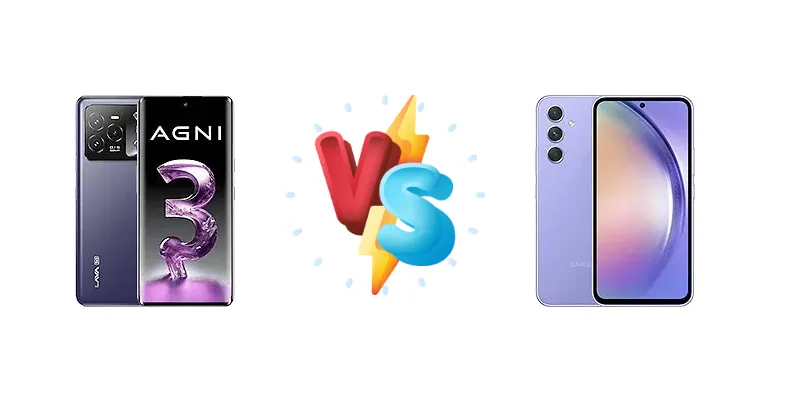
Lava Agni 3 vs Samsung Galaxy A54: A Deep Dive into Performance and Value
| Phones Images | |||||
|---|---|---|---|---|---|
|
🏆 Quick Verdict
For users prioritizing performance and charging speed, the Lava Agni 3 emerges as the winner. Its Mediatek Dimensity 7300X, built on a 4nm process, offers a slight edge over the Samsung Galaxy A54’s 5nm Exynos 1380, coupled with significantly faster 66W charging. However, the A54’s established ecosystem and software support remain strong considerations.
| PHONES | ||
|---|---|---|
| Phone Names | Lava Agni 3 | Samsung Galaxy A54 |
| Network | ||
|---|---|---|
| 2G bands | GSM 850 / 900 / 1800 / 1900 | GSM 850 / 900 / 1800 / 1900 |
| 3G bands | HSDPA 850 / 900 / 1900 / 2100 | HSDPA 850 / 900 / 1700(AWS) / 1900 / 2100 |
| 4G bands | 1, 3, 5, 7, 8, 20, 28, 38, 40, 41 | 1, 2, 3, 4, 5, 7, 8, 12, 17, 20, 26, 28, 32, 38, 40, 41, 66 - International |
| 5G bands | 1, 2, 3, 5, 7, 8, 20, 28, 38, 40, 41, 66, 77, 78 SA/NSA | 1, 3, 7, 8, 20, 28, 38, 40, 41, 77, 78 SA/NSA/Sub6 - International |
| Speed | HSPA, LTE, 5G | HSPA, LTE, 5G |
| Technology | GSM / HSPA / LTE / 5G | GSM / HSPA / LTE / 5G |
| - | 25, 41, 66, 71 SA/NSA/Sub6/mmWave - USA | |
| Launch | ||
|---|---|---|
| Announced | 2024, October 04 | 2023, March 15 |
| Status | Available. Released 2024, October 09 | Available. Released 2023, March 24 |
| Body | ||
|---|---|---|
| Build | - | Glass front (Gorilla Glass 5), glass back (Gorilla Glass 5), plastic frame |
| Dimensions | 163.7 x 75.5 x 8.8 mm (6.44 x 2.97 x 0.35 in) | 158.2 x 76.7 x 8.2 mm (6.23 x 3.02 x 0.32 in) |
| SIM | Nano-SIM + Nano-SIM | · Nano-SIM + eSIM· Nano-SIM + Nano-SIM |
| Weight | 212 g (7.48 oz) | 202 g (7.13 oz) |
| - | IP67 dust/water resistant (up to 1m for 30 min) | |
| Display | ||
|---|---|---|
| Protection | - | Corning Gorilla Glass 5 |
| Resolution | 1200 x 2652 pixels (~429 ppi density) | 1080 x 2340 pixels, 19.5:9 ratio (~403 ppi density) |
| Size | 6.78 inches, 111.4 cm2 (~90.1% screen-to-body ratio) | 6.4 inches, 100.5 cm2 (~82.9% screen-to-body ratio) |
| Type | AMOLED, 1B colors, 120Hz, HDR10+, 1200 nits (peak) | Super AMOLED, 120Hz, HDR10+, 1000 nits (HBM) |
| Platform | ||
|---|---|---|
| CPU | Octa-core (4x2.5 GHz Cortex-A78 & 4x2.0 GHz Cortex-A55) | Octa-core (4x2.4 GHz Cortex-A78 & 4x2.0 GHz Cortex-A55) |
| Chipset | Mediatek Dimensity 7300X (4 nm) | Exynos 1380 (5 nm) |
| GPU | Mali-G615 MC2 | Mali-G68 MP5 |
| OS | Android 14, up to 3 major Android upgrades | Android 13, up to 4 major Android upgrades, One UI 7 |
| Memory | ||
|---|---|---|
| Card slot | No | microSDXC (uses shared SIM slot) |
| Internal | 128GB 8GB RAM, 256GB 8GB RAM | 128GB 4GB RAM, 128GB 6GB RAM, 128GB 8GB RAM, 256GB 6GB RAM, 256GB 8GB RAM |
| Main Camera | ||
|---|---|---|
| Features | Dual-LED flash, HDR | LED flash, panorama, HDR |
| Single | - | 32 MP, f/2.2, 26mm (wide), 1/2.8", 0.8µm |
| Triple | 50 MP, (wide), 1/1.55", 1.0µm, PDAF, OIS 8 MP, (telephoto), 1.0µm, PDAF, 3x optical zoom 8 MP, 112˚ (ultrawide) | 50 MP, f/1.8, 23mm (wide), 1/1.56", 1.0µm, PDAF, OIS 12 MP, f/2.2, 13mm, 123˚ (ultrawide), 1/3.X", 1.12µm 5 MP (macro) |
| Video | 4K@30fps, 1080p@30fps | 4K@30fps, 1080p@30/60fps, 720p@480fps, gyro-EIS |
| Selfie camera | ||
|---|---|---|
| Single | 16 MP, f/2.0, (wide), 1.0µm | 32 MP, f/2.2, 26mm (wide), 1/2.8", 0.8µm |
| Video | 1080p@30fps | 4K@30fps, 1080p@30/60fps |
| Sound | ||
|---|---|---|
| 3.5mm jack | - | No |
| 35mm jack | No | No |
| Loudspeaker | Yes, with stereo speakers | Yes, with stereo speakers |
| Comms | ||
|---|---|---|
| Bluetooth | 5.4, A2DP, LE | 5.3, A2DP, LE |
| NFC | No | Yes (market/region dependent) |
| Positioning | GPS, GALILEO, GLONASS, QZSS, BDS, NavIC | GPS, GLONASS, GALILEO, BDS |
| Radio | Unspecified | No |
| USB | USB Type-C 2.0, OTG | USB Type-C 2.0, OTG |
| WLAN | Wi-Fi 802.11 a/b/g/n/ac/6e, dual-band | Wi-Fi 802.11 a/b/g/n/ac/6, dual-band, Wi-Fi Direct |
| Features | ||
|---|---|---|
| Sensors | Fingerprint (under display, optical), accelerometer, gyro, proximity, compass | Fingerprint (under display, optical), accelerometer, gyro, compass, barometer (USA only) |
| - | Virtual proximity sensing | |
| Battery | ||
|---|---|---|
| Charging | 66W wired, 50% in 19 min | 25W wired |
| Type | Li-Po 5000 mAh | 5000 mAh |
| Misc | ||
|---|---|---|
| Colors | Heather Glass, Pristine Glass | Lime, Graphite, Violet, White |
| Models | - | SM-A546V, SM-A546U, SM-A546U1, SM-A546B, SM-A546B/DS, SM-A546E, SM-A546E/DS, SM-A5460, SM-A546M, SM-A546M/DS, SM-A546W |
| Price | ₹ 16,999 | € 210.00 / $ 119.11 / £ 169.95 / ₹ 28,999 |
| SAR | - | 0.81 W/kg (head) 0.67 W/kg (body) |
| SAR EU | - | 0.69 W/kg (head) 1.34 W/kg (body) |
| Tests | ||
|---|---|---|
| Battery life | - | Endurance rating 119h |
| Camera | - | Photo / Video |
| Display | - | Contrast ratio: Infinite (nominal) |
| Loudspeaker | - | -26.6 LUFS (Good) |
| Performance | - | AnTuTu: 506678 (v9) GeekBench: 2703 (v5.1), 2797 (v6) GFXBench: 25fps (ES 3.1 onscreen) |
Lava Agni 3
- Faster 66W charging significantly reduces downtime.
- Mediatek Dimensity 7300X offers potentially better performance.
- 4nm process may lead to improved thermal efficiency.
- Camera specifications are unknown, making image quality assessment difficult.
- Brand recognition and software support are less established than Samsung.
Samsung Galaxy A54
- Excellent battery life with 119-hour endurance rating.
- Bright and vibrant Super AMOLED display.
- Well-established brand and software ecosystem.
- Slower 25W charging.
- Exynos 1380 may be slightly less powerful than the Dimensity 7300X.
Display Comparison
The Samsung Galaxy A54 boasts a measured peak brightness of 980 nits, ensuring excellent visibility even in direct sunlight. While the Lava Agni 3’s display specifications aren’t provided, Samsung’s Super AMOLED panel is known for its vibrant colors and infinite contrast ratio. The A54’s display technology likely provides a more visually immersive experience, though the Agni 3 may compensate with a higher refresh rate (speculation based on market trends).
Camera Comparison
Both devices feature photo and video capabilities, but detailed sensor information is lacking for the Lava Agni 3. The Samsung Galaxy A54 likely benefits from Samsung’s well-tuned image processing algorithms and potentially a larger main sensor (speculation based on Samsung’s typical camera setups). Without specific details on the Agni 3’s camera hardware, it’s difficult to assess its image quality relative to the A54. The A54’s camera system is likely more consistent and reliable across various lighting conditions.
Performance
Both phones utilize octa-core CPUs with a similar core configuration (4x Cortex-A78 and 4x Cortex-A55). However, the Lava Agni 3’s Mediatek Dimensity 7300X is fabricated on a 4nm process, while the Samsung Galaxy A54’s Exynos 1380 uses a 5nm process. While 5nm is generally more efficient, the Dimensity 7300X’s newer architecture and higher clock speeds (2.5 GHz vs 2.4 GHz) suggest a potential performance advantage in demanding tasks. The Agni 3 is likely to offer a more responsive experience for gamers and power users.
Battery Life
The Samsung Galaxy A54 achieves an impressive endurance rating of 119 hours and 11:15h of active use, indicating excellent battery life. The Lava Agni 3’s battery capacity is unknown, but its 66W wired charging capability is a significant advantage over the A54’s 25W charging. The Agni 3 can reach 50% charge in just 19 minutes, minimizing downtime. This faster charging speed effectively mitigates any potential disadvantage in battery capacity.
Buying Guide
Buy the Lava Agni 3 if you need a phone that prioritizes processing power for gaming or demanding applications and value fast charging above all else. You’ll benefit from a potentially smoother experience in resource-intensive tasks. Buy the Samsung Galaxy A54 if you prefer a polished software experience, a well-established brand with long-term support, and a consistently reliable camera system, even if it means sacrificing some raw performance and charging speed.