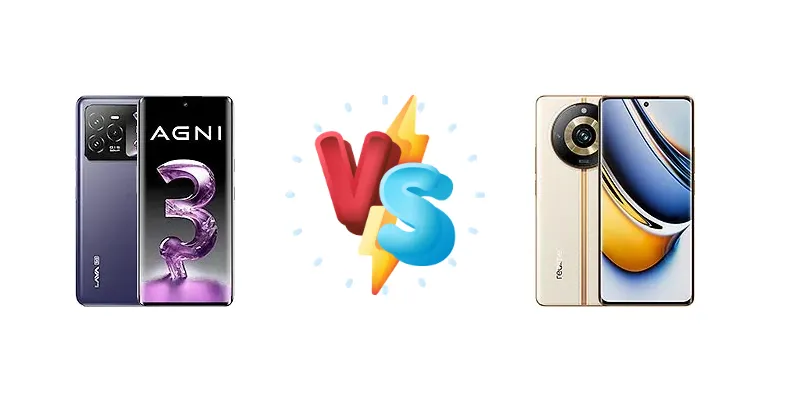
The Lava Agni 3 and Realme 11 Pro+ both target the competitive mid-range smartphone market, but approach it with different philosophies. The Agni 3 focuses on delivering flagship-level processing power at a more accessible price, while the 11 Pro+ emphasizes fast charging and a brighter display. This comparison dissects their key differences to help you choose the right device.
🏆 Quick Verdict
For most users, the Realme 11 Pro+ offers a more well-rounded experience thanks to its significantly faster 100W charging and brighter display. However, the Lava Agni 3’s newer Dimensity 7300X chipset provides a performance edge, making it ideal for demanding users and gamers.
| Network |
|---|
| 2G bands | GSM 850 / 900 / 1800 / 1900 | GSM 850 / 900 / 1800 / 1900 |
| 3G bands | HSDPA 850 / 900 / 1900 / 2100 | HSDPA 850 / 900 / 2100 |
| 4G bands | 1, 3, 5, 7, 8, 20, 28, 38, 40, 41 | 1, 3, 5, 8, 28, 38, 40, 41 - India |
| 5G bands | 1, 2, 3, 5, 7, 8, 20, 28, 38, 40, 41, 66, 77, 78 SA/NSA | 1, 3, 5, 8, 28, 40, 41, 77, 78 SA/NSA - International |
| Speed | HSPA, LTE, 5G | HSPA, LTE, 5G |
| Technology | GSM / HSPA / LTE / 5G | GSM / CDMA / HSPA / CDMA2000 / LTE / 5G |
| | - | CDMA2000 1x |
| Launch |
|---|
| Announced | 2024, October 04 | 2023, May 10 |
| Status | Available. Released 2024, October 09 | Available. Released 2023, May 15 |
| Body |
|---|
| Build | - | Glass front, leather or plastic back, plastic frame |
| Dimensions | 163.7 x 75.5 x 8.8 mm (6.44 x 2.97 x 0.35 in) | 161.6 x 73.9 x 8.2 mm or 8.7 mm |
| SIM | Nano-SIM + Nano-SIM | Nano-SIM + Nano-SIM |
| Weight | 212 g (7.48 oz) | 183 g or 189 g (6.46 oz) |
| Display |
|---|
| Resolution | 1200 x 2652 pixels (~429 ppi density) | 1080 x 2412 pixels, 20:9 ratio (~394 ppi density) |
| Size | 6.78 inches, 111.4 cm2 (~90.1% screen-to-body ratio) | 6.7 inches, 108.0 cm2 (~90.5% screen-to-body ratio) |
| Type | AMOLED, 1B colors, 120Hz, HDR10+, 1200 nits (peak) | AMOLED, 1B colors, HDR10+, 120Hz, 950 nits (peak) |
| Platform |
|---|
| CPU | Octa-core (4x2.5 GHz Cortex-A78 & 4x2.0 GHz Cortex-A55) | Octa-core (2x2.6 GHz Cortex-A78 & 6x2.0 GHz Cortex-A55) |
| Chipset | Mediatek Dimensity 7300X (4 nm) | Mediatek Dimensity 7050 (6 nm) |
| GPU | Mali-G615 MC2 | Mali-G68 MC4 |
| OS | Android 14, up to 3 major Android upgrades | Android 13, up to 2 major Android upgrades, Realme UI 5.0 |
| Memory |
|---|
| Card slot | No | No |
| Internal | 128GB 8GB RAM, 256GB 8GB RAM | 256GB 8GB RAM, 256GB 12GB RAM, 512GB 12GB RAM, 1TB 12GB RAM |
| Main Camera |
|---|
| Features | Dual-LED flash, HDR | LED flash, HDR, panorama |
| Triple | 50 MP, (wide), 1/1.55", 1.0µm, PDAF, OIS
8 MP, (telephoto), 1.0µm, PDAF, 3x optical zoom
8 MP, 112˚ (ultrawide) | 200 MP, f/1.7, 23mm (wide), 1/1.4", 0.56µm, PDAF, OIS
8 MP, f/2.2, 16mm, 112˚ (ultrawide)
2 MP (macro) |
| Video | 4K@30fps, 1080p@30fps | 4K@30fps, 1080p@30/60/120/480fps, 720p@960fps, gyro-EIS |
| Selfie camera |
|---|
| Features | - | Panorama |
| Single | 16 MP, f/2.0, (wide), 1.0µm | 32 MP, f/2.5, 22mm (wide) |
| Video | 1080p@30fps | 1080p@30fps |
| Sound |
|---|
| 3.5mm jack | - | No |
| 35mm jack | No | No |
| Loudspeaker | Yes, with stereo speakers | Yes, with stereo speakers |
| | - | 24-bit/192kHz audio |
| Comms |
|---|
| Bluetooth | 5.4, A2DP, LE | 5.2, A2DP, LE, aptX HD |
| NFC | No | Yes |
| Positioning | GPS, GALILEO, GLONASS, QZSS, BDS, NavIC | GPS, GLONASS, GALILEO, BDS, QZSS, NavIC |
| Radio | Unspecified | No |
| USB | USB Type-C 2.0, OTG | USB Type-C 2.0 |
| WLAN | Wi-Fi 802.11 a/b/g/n/ac/6e, dual-band | Wi-Fi 802.11 a/b/g/n/ac/6, dual-band |
| Features |
|---|
| Sensors | Fingerprint (under display, optical), accelerometer, gyro, proximity, compass | Fingerprint (under display, optical), accelerometer, gyro, proximity, compass |
| Battery |
|---|
| Charging | 66W wired, 50% in 19 min | 100W wired |
| Type | Li-Po 5000 mAh | 5000 mAh |
| Misc |
|---|
| Colors | Heather Glass, Pristine Glass | Astral Black, Sunrise Beige, Oasis Green |
| Models | - | RMX3740, RMX3741 |
| Price | ₹ 16,999 | € 399.90 / ₹ 27,990 |
Lava Agni 3
- More powerful Dimensity 7300X chipset
- Potentially better thermal management due to 4nm process
- Likely superior multi-core performance
- Slower 66W charging
- Display brightness likely lower than Realme 11 Pro+
Realme 11 Pro+
- Ultra-fast 100W charging
- Brighter 793 nit display
- Longer reported battery endurance
- Older Dimensity 7050 chipset
- Potentially more thermal throttling under load
Display Comparison
The Realme 11 Pro+ boasts a notably brighter display, reaching a measured 793 nits. While the Lava Agni 3’s display specs are currently unavailable, the Realme’s brightness advantage will be immediately noticeable in outdoor conditions. The Realme 11 Pro+’s panel likely benefits from its higher peak brightness for HDR content. Without knowing the Agni 3’s panel technology (LTPO or not), it’s difficult to assess power efficiency, but the Realme’s brightness is a clear win for visibility.
Camera Comparison
Detailed camera analysis is hampered by a lack of specific sensor information for both devices. However, the Realme 11 Pro+’s marketing emphasizes its camera capabilities, suggesting a more refined image processing pipeline. Without knowing the main sensor resolution or aperture, it’s difficult to definitively declare a winner. The presence of OIS (Optical Image Stabilization) on the Realme 11 Pro+ would be a significant advantage for low-light photography and video recording. We can assume both phones will include standard wide and ultrawide lenses, but the Agni 3’s processing capabilities might allow for better computational photography.
Performance
The Lava Agni 3’s Mediatek Dimensity 7300X (4nm) holds a significant architectural advantage over the Realme 11 Pro+’s Dimensity 7050 (6nm). The 4nm process node inherently offers better power efficiency and thermal performance, potentially leading to less throttling during sustained workloads. While the Realme 11 Pro+ has a slightly higher clocked Cortex-A78 core (2.6 GHz vs 2.5 GHz), the Agni 3’s chipset features four A78 cores compared to the Realme’s two, suggesting superior multi-core performance. This translates to faster app loading, smoother multitasking, and improved gaming performance for the Agni 3.
Battery Life
The Realme 11 Pro+’s 100W charging is a game-changer, allowing for a significantly faster recharge compared to the Lava Agni 3’s 66W charging. While the Agni 3 claims a 50% charge in 19 minutes, the 11 Pro+ will likely achieve a full charge in under 30 minutes. The Realme 11 Pro+’s reported 112-hour endurance rating suggests a well-optimized power management system, potentially offsetting any battery capacity differences. The faster charging speed of the Realme 11 Pro+ is a major convenience factor for users who frequently need to top up their battery.
Buying Guide
Buy the Lava Agni 3 if you prioritize raw processing power for gaming or demanding applications and are willing to trade off some charging speed and display brightness. Buy the Realme 11 Pro+ if you value a vibrant display, incredibly fast charging, and a more polished overall user experience, even if it means a slight performance compromise.
Frequently Asked Questions
❓ Does the Dimensity 7050 in the Realme 11 Pro+ get noticeably hot during extended gaming sessions?
The 6nm Dimensity 7050 is a capable chipset, but it's likely to experience more thermal throttling than the Lava Agni 3’s 4nm Dimensity 7300X during prolonged gaming. While the Realme 11 Pro+ likely has cooling solutions, the Agni 3’s more efficient process node gives it an advantage in sustained performance.
❓ How much faster is the 100W charging on the Realme 11 Pro+ compared to the 66W charging on the Lava Agni 3 in real-world use?
The 100W charging on the Realme 11 Pro+ will dramatically reduce charging times. While the Lava Agni 3 claims 50% in 19 minutes, the Realme 11 Pro+ is expected to fully charge in under 30 minutes, offering a much quicker top-up for users on the go.
❓ Is the difference in CPU core configuration (4x A78 on Agni 3 vs 2x A78 on 11 Pro+) noticeable in everyday tasks?
For most everyday tasks like browsing, social media, and video streaming, the difference will be minimal. However, the Lava Agni 3’s four A78 cores will provide a more noticeable advantage in heavily multi-threaded applications like video editing or demanding games.