
Lava Agni 3 vs OnePlus Nord CE 3 Lite: A Detailed Comparison of Mid-Range Contenders
| Phones Images | |||||
|---|---|---|---|---|---|
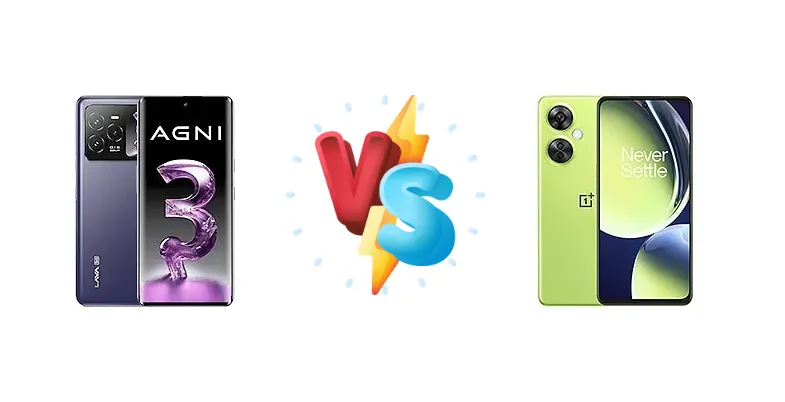
|
🏆 Quick Verdict
For users prioritizing raw performance and faster charging, the Lava Agni 3 emerges as the winner. Its Dimensity 7300X chipset provides a noticeable advantage in processing power, making it better suited for demanding tasks and gaming. However, the OnePlus Nord CE 3 Lite remains a solid choice for those valuing brand reliability and a slightly more efficient chipset.
| PHONES | ||
|---|---|---|
| Phone Names | Lava Agni 3 | OnePlus Nord CE 3 Lite |
| Network | ||
|---|---|---|
| 2G bands | GSM 850 / 900 / 1800 / 1900 | GSM 850 / 900 / 1800 / 1900 |
| 3G bands | HSDPA 850 / 900 / 1900 / 2100 | HSDPA 800 / 850 / 900 / 1700(AWS) / 1900 / 2100 - International |
| 4G bands | 1, 3, 5, 7, 8, 20, 28, 38, 40, 41 | 1, 2, 3, 4, 5, 7, 8, 12, 13, 17, 18, 19, 20, 26, 28, 32, 38, 39, 40, 41, 66 - International |
| 5G bands | 1, 2, 3, 5, 7, 8, 20, 28, 38, 40, 41, 66, 77, 78 SA/NSA | 1, 3, 5, 7, 8, 20, 28, 38, 40, 41, 66, 77, 78 SA/NSA - International |
| Speed | HSPA, LTE, 5G | HSPA, LTE, 5G |
| Technology | GSM / HSPA / LTE / 5G | GSM / HSPA / LTE / 5G |
| - | 1, 3, 5, 8, 28, 40, 41, 77, 78 SA/NSA - India | |
| Launch | ||
|---|---|---|
| Announced | 2024, October 04 | 2023, April 04 |
| Status | Available. Released 2024, October 09 | Available. Released 2023, April 11 |
| Body | ||
|---|---|---|
| Build | - | Glass front, plastic frame, plastic back |
| Dimensions | 163.7 x 75.5 x 8.8 mm (6.44 x 2.97 x 0.35 in) | 165.5 x 76 x 8.3 mm (6.52 x 2.99 x 0.33 in) |
| SIM | Nano-SIM + Nano-SIM | Nano-SIM + Nano-SIM |
| Weight | 212 g (7.48 oz) | 195 g (6.88 oz) |
| Display | ||
|---|---|---|
| Protection | - | Corning Gorilla Glass |
| Resolution | 1200 x 2652 pixels (~429 ppi density) | 1080 x 2400 pixels, 20:9 ratio (~391 ppi density) |
| Size | 6.78 inches, 111.4 cm2 (~90.1% screen-to-body ratio) | 6.72 inches, 109.6 cm2 (~87.1% screen-to-body ratio) |
| Type | AMOLED, 1B colors, 120Hz, HDR10+, 1200 nits (peak) | IPS LCD, 120Hz, 550 nits (typ), 680 nits (peak) |
| Platform | ||
|---|---|---|
| CPU | Octa-core (4x2.5 GHz Cortex-A78 & 4x2.0 GHz Cortex-A55) | Octa-core (2x2.2 GHz Kryo 660 Gold & 6x1.7 GHz Kryo 660 Silver) |
| Chipset | Mediatek Dimensity 7300X (4 nm) | Qualcomm SM6375 Snapdragon 695 5G (6 nm) |
| GPU | Mali-G615 MC2 | Adreno 619 |
| OS | Android 14, up to 3 major Android upgrades | Android 13, OxygenOS 13.1 |
| Memory | ||
|---|---|---|
| Card slot | No | microSDXC (uses shared SIM slot) |
| Internal | 128GB 8GB RAM, 256GB 8GB RAM | 128GB 8GB RAM, 256GB 8GB RAM |
| - | UFS 2.2 | |
| Main Camera | ||
|---|---|---|
| Features | Dual-LED flash, HDR | LED flash, HDR, panorama |
| Triple | 50 MP, (wide), 1/1.55", 1.0µm, PDAF, OIS 8 MP, (telephoto), 1.0µm, PDAF, 3x optical zoom 8 MP, 112˚ (ultrawide) | 108 MP, f/1.8, (wide), 1/1.67", 0.64µm, PDAF 2 MP (macro) Auxiliary lens |
| Video | 4K@30fps, 1080p@30fps | 1080p@30fps |
| Selfie camera | ||
|---|---|---|
| Features | - | HDR, panorama |
| Single | 16 MP, f/2.0, (wide), 1.0µm | 16 MP, f/2.4, (wide), 1.0µm |
| Video | 1080p@30fps | 1080p@30fps |
| Sound | ||
|---|---|---|
| 3.5mm jack | - | Yes |
| 35mm jack | No | Yes |
| Loudspeaker | Yes, with stereo speakers | Yes, with stereo speakers |
| Comms | ||
|---|---|---|
| Bluetooth | 5.4, A2DP, LE | 5.1, A2DP, LE, aptX HD |
| NFC | No | Yes (market/region dependent) |
| Positioning | GPS, GALILEO, GLONASS, QZSS, BDS, NavIC | GPS, GALILEO, GLONASS, BDS, QZSS |
| Radio | Unspecified | No |
| USB | USB Type-C 2.0, OTG | USB Type-C 2.0, OTG |
| WLAN | Wi-Fi 802.11 a/b/g/n/ac/6e, dual-band | Wi-Fi 802.11 a/b/g/n/ac, dual-band |
| Features | ||
|---|---|---|
| Sensors | Fingerprint (under display, optical), accelerometer, gyro, proximity, compass | Fingerprint (side-mounted), accelerometer, gyro, proximity, compass |
| Battery | ||
|---|---|---|
| Charging | 66W wired, 50% in 19 min | 67W wired, 80% in 30 min |
| Type | Li-Po 5000 mAh | Li-Po 5000 mAh |
| Misc | ||
|---|---|---|
| Colors | Heather Glass, Pristine Glass | Pastel Lime, Chromatic Gray |
| Models | - | CPH2467, CPH2465 |
| Price | ₹ 16,999 | £ 169.98 / € 209.99 |
| SAR | - | 1.17 W/kg (head) 0.70 W/kg (body) |
| Tests | ||
|---|---|---|
| Performance | - | AnTuTu: 412006 (v9) GeekBench: 2052 (v5) GFXBench: 17fps (ES 3.1 onscreen) |
Lava Agni 3
- More powerful Dimensity 7300X chipset
- Faster 66W charging (50% in 19 min)
- Potentially better image processing
- Lava is a less established brand
- Battery capacity unknown
OnePlus Nord CE 3 Lite
- Well-known OnePlus brand
- Efficient Snapdragon 695 chipset
- 67W charging (80% in 30 min)
- Less powerful chipset compared to Agni 3
- Slower charging speed than Agni 3
Display Comparison
Neither device boasts a standout display. While specific display specs (resolution, refresh rate) are missing, the focus here is on the underlying chipsets. Display quality will likely be similar, leaning towards adequate for the price point. Bezels are expected to be comparable, typical of this segment. Color accuracy will likely be tuned for vibrancy rather than absolute precision.
Camera Comparison
Without detailed camera specifications, a direct comparison is limited. However, the chipset’s image signal processor (ISP) plays a crucial role. The Dimensity 7300X likely has a more advanced ISP, potentially leading to better image processing, noise reduction, and dynamic range. The absence of information on sensor sizes and OIS makes it difficult to definitively declare a winner, but the Agni 3’s superior processing power gives it an edge. We can assume both phones will include standard features like portrait mode and night mode, but the quality of these features will likely differ.
Performance
The core difference lies in the chipsets. The Lava Agni 3’s Mediatek Dimensity 7300X, built on a 4nm process, offers a significant architectural advantage over the OnePlus Nord CE 3 Lite’s Qualcomm Snapdragon 695 (6nm). The Dimensity 7300X features a more modern CPU configuration – four Cortex-A78 cores clocked at 2.5 GHz versus the Nord’s Kryo 660 Gold cores at 2.2 GHz. This translates to faster application loading, smoother multitasking, and improved gaming performance. The 4nm node also implies better thermal efficiency, potentially reducing throttling during sustained workloads. While the Snapdragon 695 is known for its 5G connectivity, the Dimensity 7300X is likely to outperform it in CPU-intensive tasks.
Battery Life
Both phones feature 67W wired charging, but the implementation differs. The Lava Agni 3 claims 50% charge in 19 minutes, while the OnePlus Nord CE 3 Lite takes 30 minutes to reach 80%. This suggests the Agni 3’s charging is faster overall. While battery capacity isn’t specified, the Dimensity 7300X’s improved efficiency could offset a potentially smaller battery size, resulting in comparable real-world battery life. The faster charging speed of the Agni 3 is a significant advantage for users who frequently need to top up their phone quickly.
Buying Guide
Buy the Lava Agni 3 if you need a phone that can handle demanding apps, enjoys extended gaming sessions, and values the fastest possible charging speeds. It’s ideal for power users and those seeking maximum performance on a budget. Buy the OnePlus Nord CE 3 Lite if you prefer a well-established brand with a focus on efficient power management and a generally smooth user experience, even if it means sacrificing some peak performance.