
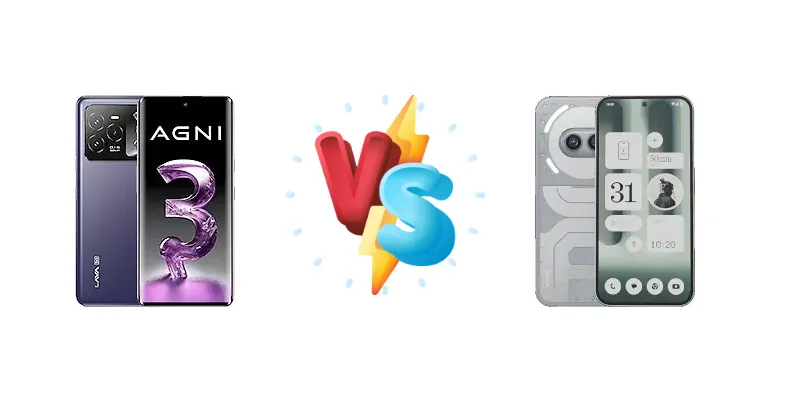
Lava Agni 3 vs Nothing Phone (2a) Plus: Which Mid-Range Phone Reigns Supreme?
| Phones Images | |||||
|---|---|---|---|---|---|
|
🏆 Quick Verdict
For users prioritizing peak performance and rapid charging, the Lava Agni 3 is the clear winner. Its Dimensity 7300X chipset delivers a noticeable edge, and the 66W charging is significantly faster. However, the Nothing Phone (2a) Plus excels in battery endurance, offering over 16 hours of active use, making it ideal for power users.
| PHONES | ||
|---|---|---|
| Phone Names | Lava Agni 3 | Nothing Phone (2a) Plus |
| Network | ||
|---|---|---|
| 2G bands | GSM 850 / 900 / 1800 / 1900 | GSM 850 / 900 / 1800 / 1900 |
| 3G bands | HSDPA 850 / 900 / 1900 / 2100 | HSDPA 800 / 850 / 900 / 1700(AWS) / 1900 / 2100 |
| 4G bands | 1, 3, 5, 7, 8, 20, 28, 38, 40, 41 | 1, 3, 4, 5, 7, 8, 18, 19, 20, 26, 28, 38, 39, 40, 41, 42, 66 |
| 5G bands | 1, 2, 3, 5, 7, 8, 20, 28, 38, 40, 41, 66, 77, 78 SA/NSA | 1, 3, 5, 7, 8, 20, 28, 38, 40, 41, 66, 77, 78 SA/NSA |
| Speed | HSPA, LTE, 5G | HSPA, LTE, 5G |
| Technology | GSM / HSPA / LTE / 5G | GSM / HSPA / LTE / 5G |
| Launch | ||
|---|---|---|
| Announced | 2024, October 04 | 2024, July 31 |
| Status | Available. Released 2024, October 09 | Available. Released 2024, August 03 |
| Body | ||
|---|---|---|
| Build | - | Glass front (Gorilla Glass 5), plastic frame, plastic back |
| Dimensions | 163.7 x 75.5 x 8.8 mm (6.44 x 2.97 x 0.35 in) | 161.7 x 76.3 x 8.5 mm (6.37 x 3.00 x 0.33 in) |
| SIM | Nano-SIM + Nano-SIM | Nano-SIM + Nano-SIM |
| Weight | 212 g (7.48 oz) | 190 g (6.70 oz) |
| Display | ||
|---|---|---|
| Protection | - | Corning Gorilla Glass 5 |
| Resolution | 1200 x 2652 pixels (~429 ppi density) | 1080 x 2412 pixels, 20:9 ratio (~395 ppi density) |
| Size | 6.78 inches, 111.4 cm2 (~90.1% screen-to-body ratio) | 6.7 inches, 107.5 cm2 (~87.1% screen-to-body ratio) |
| Type | AMOLED, 1B colors, 120Hz, HDR10+, 1200 nits (peak) | AMOLED, 1B colors, 120Hz, 2160Hz PWM, HDR10+, 700 nits (typ), 1100 nits (HBM), 1300 nits (peak) |
| Platform | ||
|---|---|---|
| CPU | Octa-core (4x2.5 GHz Cortex-A78 & 4x2.0 GHz Cortex-A55) | Octa-core (2x3.0 GHz Cortex-A715 & 6x 2.0 GHz Cortex-A510) |
| Chipset | Mediatek Dimensity 7300X (4 nm) | Mediatek Dimensity 7350 Pro (4 nm) |
| GPU | Mali-G615 MC2 | Mali-G610 MC4 |
| OS | Android 14, up to 3 major Android upgrades | Android 14, up to 3 major Android upgrades, Nothing OS 3.0 |
| Memory | ||
|---|---|---|
| Card slot | No | No |
| Internal | 128GB 8GB RAM, 256GB 8GB RAM | 256GB 8GB RAM, 256GB 12GB RAM |
| Main Camera | ||
|---|---|---|
| Dual | - | 50 MP, f/1.9, 24mm (wide), 1/1.57", 1.0µm, PDAF, OIS 50 MP, f/2.2, 114˚ (ultrawide), 1/2.76", 0.64µm |
| Features | Dual-LED flash, HDR | LED flash, panorama, HDR |
| Triple | 50 MP, (wide), 1/1.55", 1.0µm, PDAF, OIS 8 MP, (telephoto), 1.0µm, PDAF, 3x optical zoom 8 MP, 112˚ (ultrawide) | - |
| Video | 4K@30fps, 1080p@30fps | 4K@30fps, 1080p@60/120fps, gyro-EIS |
| Selfie camera | ||
|---|---|---|
| Features | - | HDR |
| Single | 16 MP, f/2.0, (wide), 1.0µm | 50 MP, f/2.2, (wide), 1/2.76" |
| Video | 1080p@30fps | 4K@30fps |
| Sound | ||
|---|---|---|
| 35mm jack | No | No |
| Loudspeaker | Yes, with stereo speakers | Yes, with stereo speakers |
| Comms | ||
|---|---|---|
| Bluetooth | 5.4, A2DP, LE | 5.3, A2DP, LE |
| NFC | No | Yes, 360˚ |
| Positioning | GPS, GALILEO, GLONASS, QZSS, BDS, NavIC | GPS, GALILEO, GLONASS, BDS, QZSS |
| Radio | Unspecified | No |
| USB | USB Type-C 2.0, OTG | USB Type-C 2.0, OTG |
| WLAN | Wi-Fi 802.11 a/b/g/n/ac/6e, dual-band | Wi-Fi 802.11 a/b/g/n/ac/6, dual-band, Wi-Fi Direct |
| Features | ||
|---|---|---|
| Sensors | Fingerprint (under display, optical), accelerometer, gyro, proximity, compass | Fingerprint (under display, optical), accelerometer, gyro, proximity, compass |
| Battery | ||
|---|---|---|
| Charging | 66W wired, 50% in 19 min | 50W wired, 50% in 21 min, 100% in 56 min |
| Type | Li-Po 5000 mAh | 5000 mAh |
| Misc | ||
|---|---|---|
| Colors | Heather Glass, Pristine Glass | Black, Grey |
| Models | - | A142P |
| Price | ₹ 16,999 | € 269.90 / ₹ 22,599 |
Lava Agni 3
- Faster 66W charging for quick power boosts
- Potentially better sustained performance due to efficient A78 cores
- Likely more affordable price point
- Unknown battery life performance
- Less information available on display quality
- Potentially less refined camera processing
Nothing Phone (2a) Plus
- Excellent 16:34h active use battery life
- Brighter 1097 nit display for outdoor visibility
- More powerful Dimensity 7350 Pro chipset
- Slower 50W charging compared to Lava Agni 3
- May be more expensive than the Lava Agni 3
- Design may not appeal to all users
Display Comparison
The Nothing Phone (2a) Plus boasts a brighter display, reaching a measured peak of 1097 nits, which translates to better visibility outdoors. While the Lava Agni 3’s display specs are not provided, the Nothing Phone (2a) Plus’s high brightness is a significant advantage for media consumption in bright environments. The Nothing Phone (2a) Plus likely utilizes a standard AMOLED panel, while the Agni 3’s panel characteristics remain unknown. The Nothing Phone (2a) Plus’s brightness is a key differentiator for users who frequently use their phones in sunlight.
Camera Comparison
Without detailed camera specifications for the Lava Agni 3, a direct comparison is limited. However, the Nothing Phone (2a) Plus’s camera system is likely to prioritize image quality and computational photography. The Dimensity 7350 Pro includes an upgraded ISP (Image Signal Processor) compared to the 7300X, potentially leading to better noise reduction and dynamic range. Users focused on photography will likely find the Nothing Phone (2a) Plus offers a more refined camera experience, assuming it features a competitive main sensor.
Performance
Both phones utilize Mediatek’s 4nm process technology, but the Nothing Phone (2a) Plus features the Dimensity 7350 Pro, a step up from the Lava Agni 3’s Dimensity 7300X. The 7350 Pro’s CPU configuration – 2x3.0 GHz Cortex-A715 and 6x2.0 GHz Cortex-A510 – offers higher peak clock speeds compared to the Agni 3’s 4x2.5 GHz Cortex-A78 & 4x2.0 GHz Cortex-A55. This translates to faster app loading times and smoother multitasking on the Nothing Phone (2a) Plus. However, the Agni 3’s Cortex-A78 cores are generally more efficient than the A510 cores, potentially offering better sustained performance in certain scenarios. The Nothing Phone (2a) Plus’s chipset is geared towards a more responsive user experience.
Battery Life
The Nothing Phone (2a) Plus shines in battery life, achieving an impressive 16:34 hours of active use. While the Lava Agni 3’s battery capacity is unknown, its 66W wired charging is significantly faster than the Nothing Phone (2a) Plus’s 50W charging. The Agni 3 can reach 50% charge in just 19 minutes, while the Nothing Phone (2a) Plus takes 21 minutes for the same. However, the Nothing Phone (2a) Plus’s superior battery endurance means users may not need to charge as frequently. The Agni 3 prioritizes quick top-ups, while the Nothing Phone (2a) Plus focuses on longevity.
Buying Guide
Buy the Lava Agni 3 if you need a phone for demanding tasks like gaming or video editing and value the fastest possible charging speeds. You'll benefit from the more powerful processor and quicker top-ups. Buy the Nothing Phone (2a) Plus if you prioritize all-day battery life, a clean software experience, and a distinctive aesthetic. It's the better choice for users who want a reliable daily driver that won't leave them searching for a charger.