
Lava Agni 3 vs Motorola Moto G84: A Detailed Comparison of Performance, Battery, and Value
| Phones Images | |||||
|---|---|---|---|---|---|
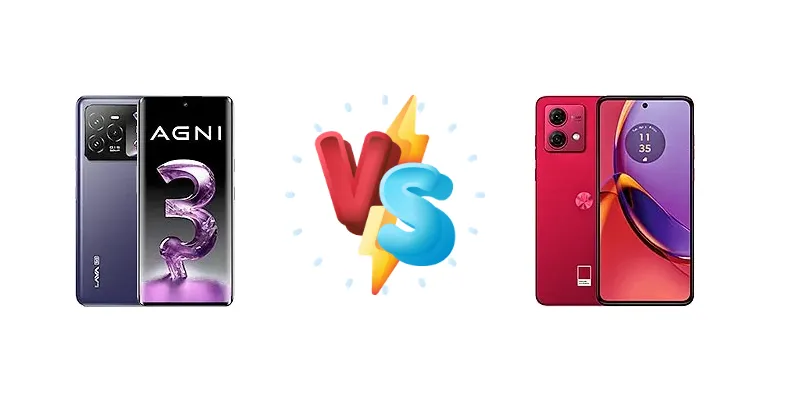
|
🏆 Quick Verdict
For users prioritizing performance and faster charging, the Lava Agni 3 is the better choice. Its Dimensity 7300X chipset offers a significant performance uplift over the Moto G84’s Snapdragon 695. However, the Moto G84 excels in battery endurance, making it ideal for users who value longevity over peak speed.
| PHONES | ||
|---|---|---|
| Phone Names | Lava Agni 3 | Motorola Moto G84 |
| Network | ||
|---|---|---|
| 2G bands | GSM 850 / 900 / 1800 / 1900 | GSM 850 / 900 / 1800 / 1900 |
| 3G bands | HSDPA 850 / 900 / 1900 / 2100 | HSDPA 850 / 900 / 1700(AWS) / 1900 / 2100 - LATAM |
| 4G bands | 1, 3, 5, 7, 8, 20, 28, 38, 40, 41 | 1, 2, 3, 4, 5, 7, 8, 12, 13, 17, 25, 26, 28, 38, 40, 41, 42, 66 - LATAM |
| 5G bands | 1, 2, 3, 5, 7, 8, 20, 28, 38, 40, 41, 66, 77, 78 SA/NSA | 1, 2, 3, 5, 7, 26, 28, 40, 66, 78 SA/NSA/Sub6 - LATAM |
| Speed | HSPA, LTE, 5G | HSPA, LTE, 5G |
| Technology | GSM / HSPA / LTE / 5G | GSM / HSPA / LTE / 5G |
| Launch | ||
|---|---|---|
| Announced | 2024, October 04 | 2023, August 24 |
| Status | Available. Released 2024, October 09 | Available. Released 2023, September 08 |
| Body | ||
|---|---|---|
| Build | - | Glass front, plastic frame, plastic back or eco leather back |
| Dimensions | 163.7 x 75.5 x 8.8 mm (6.44 x 2.97 x 0.35 in) | 160 x 74.4 x 7.6 mm (6.30 x 2.93 x 0.30 in) |
| SIM | Nano-SIM + Nano-SIM | Nano-SIM + Nano-SIM |
| Weight | 212 g (7.48 oz) | 166.8 g (5.86 oz) |
| Display | ||
|---|---|---|
| Resolution | 1200 x 2652 pixels (~429 ppi density) | 1080 x 2400 pixels, 20:9 ratio (~405 ppi density) |
| Size | 6.78 inches, 111.4 cm2 (~90.1% screen-to-body ratio) | 6.5 inches, 102.0 cm2 (~85.7% screen-to-body ratio) |
| Type | AMOLED, 1B colors, 120Hz, HDR10+, 1200 nits (peak) | P-OLED, 1B colors, 120Hz, 1300 nits (peak) |
| Platform | ||
|---|---|---|
| CPU | Octa-core (4x2.5 GHz Cortex-A78 & 4x2.0 GHz Cortex-A55) | Octa-core (2x2.2 GHz Kryo 660 Gold & 6x1.7 GHz Kryo 660 Silver) |
| Chipset | Mediatek Dimensity 7300X (4 nm) | Qualcomm SM6375 Snapdragon 695 5G (6 nm) |
| GPU | Mali-G615 MC2 | Adreno 619 |
| OS | Android 14, up to 3 major Android upgrades | Android 13, upgradable to Android 15 |
| Memory | ||
|---|---|---|
| Card slot | No | microSDXC (uses shared SIM slot) |
| Internal | 128GB 8GB RAM, 256GB 8GB RAM | 256GB 8GB RAM, 256GB 12GB RAM |
| Main Camera | ||
|---|---|---|
| Dual | - | 50 MP, f/1.9 (wide), 1/1.5", 1.0µm, PDAF, OIS 8 MP, f/2.2, 120˚ (ultrawide), 1/4.0", 1.12µm, AF |
| Features | Dual-LED flash, HDR | LED flash, HDR, panorama |
| Triple | 50 MP, (wide), 1/1.55", 1.0µm, PDAF, OIS 8 MP, (telephoto), 1.0µm, PDAF, 3x optical zoom 8 MP, 112˚ (ultrawide) | - |
| Video | 4K@30fps, 1080p@30fps | 1080p@30/60fps |
| Selfie camera | ||
|---|---|---|
| Single | 16 MP, f/2.0, (wide), 1.0µm | 16 MP, f/2.5, (wide), 1.0µm |
| Video | 1080p@30fps | 1080p@30fps |
| Sound | ||
|---|---|---|
| 35mm jack | No | Yes |
| Loudspeaker | Yes, with stereo speakers | Yes, with stereo speakers |
| Comms | ||
|---|---|---|
| Bluetooth | 5.4, A2DP, LE | 5.1, A2DP, LE |
| NFC | No | Yes (market/region dependent) |
| Positioning | GPS, GALILEO, GLONASS, QZSS, BDS, NavIC | GPS, GLONASS, GALILEO |
| Radio | Unspecified | FM radio (market/region dependent) |
| USB | USB Type-C 2.0, OTG | USB Type-C 2.0 |
| WLAN | Wi-Fi 802.11 a/b/g/n/ac/6e, dual-band | Wi-Fi 802.11 a/b/g/n/ac, dual-band, Wi-Fi Direct |
| Features | ||
|---|---|---|
| Sensors | Fingerprint (under display, optical), accelerometer, gyro, proximity, compass | Fingerprint (under display, optical), accelerometer, gyro, proximity, compass |
| Battery | ||
|---|---|---|
| Charging | 66W wired, 50% in 19 min | 30W wired |
| Type | Li-Po 5000 mAh | Li-Po 5000 mAh |
| Misc | ||
|---|---|---|
| Colors | Heather Glass, Pristine Glass | Marshmallow Blue, Midnight Blue, Viva Magenta |
| Models | - | XT2347, XT2347-1, XT2347-2 |
| Price | ₹ 16,999 | $ 399.00 / £ 189.99 / € 169.00 |
Lava Agni 3
- Significantly faster processor (Dimensity 7300X)
- Faster charging speed (66W)
- Potentially better thermal management (4nm process)
- Battery life details are unknown
- Display brightness not specified
Motorola Moto G84
- Excellent battery life (12:31h active use)
- Bright display (996 nits)
- Good endurance rating (117h)
- Less powerful processor (Snapdragon 695)
- Slower charging speed (30W)
Display Comparison
The Motorola Moto G84 boasts a notably brighter display, reaching a measured 996 nits of peak brightness. This is a significant advantage for outdoor use, where the Agni 3’s brightness is not specified. While the Moto G84’s panel technology isn’t detailed, the high peak brightness suggests a good quality IPS LCD. The Agni 3’s display specs are currently unavailable, making a direct comparison difficult, but the G84’s brightness is a clear win for visibility.
Camera Comparison
Camera details are limited for both devices. The Moto G84 is listed as having Photo/Video capabilities, but lacks specific sensor information. The Agni 3’s camera specs are also missing. Without knowing sensor sizes, apertures, or the presence of Optical Image Stabilization (OIS), it’s impossible to definitively declare a winner. However, given the Agni 3’s focus on overall performance, it’s reasonable to assume it may prioritize camera processing capabilities. We'll need more data to make a meaningful comparison.
Performance
The Lava Agni 3’s Mediatek Dimensity 7300X (4nm) represents a substantial leap in processing power compared to the Motorola Moto G84’s Qualcomm Snapdragon 695 5G (6nm). The Dimensity 7300X features a more modern CPU architecture – four Cortex-A78 cores clocked at 2.5 GHz versus the G84’s Kryo 660 Gold cores at 2.2 GHz. The 4nm fabrication process of the Dimensity chip also contributes to improved power efficiency and thermal management, potentially leading to sustained performance during intensive tasks. The Snapdragon 695 is adequate for everyday use, but will struggle with demanding games or multitasking compared to the Agni 3.
Battery Life
The Motorola Moto G84 shines in battery endurance, achieving an impressive 12:31h of active use and an endurance rating of 117 hours. This suggests excellent power efficiency. The Lava Agni 3, while featuring 66W wired charging (50% in 19 minutes), lacks detailed battery capacity information. The Moto G84’s 30W charging is slower, but its superior battery life may negate the need for frequent top-ups. The Agni 3’s faster charging is beneficial for quick boosts, but the G84’s longevity is a significant advantage for users away from power outlets.
Buying Guide
Buy the Lava Agni 3 if you need a phone for demanding tasks like gaming or video editing, and appreciate significantly faster charging speeds. You'll benefit from the more powerful processor and quicker top-ups. Buy the Motorola Moto G84 if you prioritize all-day battery life, a consistently smooth experience, and a brighter display for outdoor visibility. It’s the better option for everyday users who don’t push their phones to the limit.