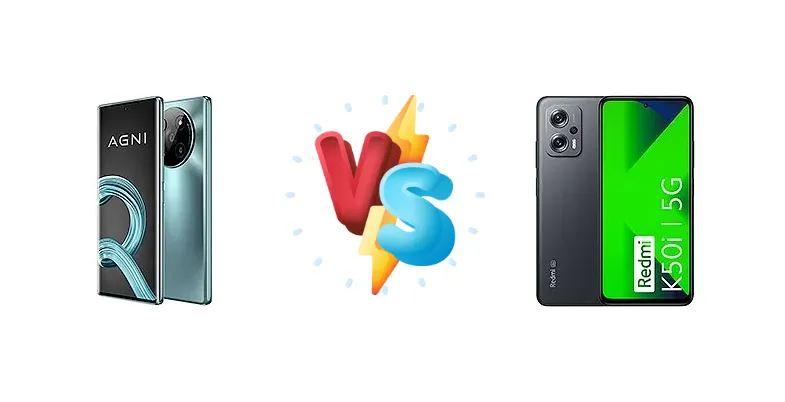
The mid-range smartphone market is fiercely competitive, and the Lava Agni 2 and Xiaomi Redmi K50i are two strong contenders. Both offer compelling features at attractive price points, but which one truly comes out on top? Let's dive into a detailed comparison to help you decide.
🏆 Quick Verdict
The Xiaomi Redmi K50i edges out the Lava Agni 2 thanks to its superior Dimensity 8100 chipset, slightly faster charging, and generally better overall performance. While the Agni 2 is a solid offering, the K50i provides a more premium experience for the price.
| Network |
|---|
| 2G bands | GSM 850 / 900 / 1800 / 1900 | GSM 850 / 900 / 1800 / 1900 |
| 3G bands | HSDPA 850 / 900 / 1900 / 2100 | HSDPA 850 / 900 / 1700(AWS) / 1900 / 2100 |
| 4G bands | 1, 3, 5, 7, 8, 20, 28, 38, 40, 41 | 1, 2, 3, 4, 5, 7, 8, 20, 28, 38, 40, 41 |
| 5G bands | 1, 3, 5, 7, 8, 20, 28, 38, 40, 41, 66, 77, 78 SA/NSA | 1, 3, 5, 7, 8, 20, 28, 38, 40, 41, 77, 78 SA/NSA |
| Speed | HSPA, LTE, 5G | HSPA, LTE, 5G |
| Technology | GSM / HSPA / LTE / 5G | GSM / HSPA / LTE / 5G |
| Launch |
|---|
| Announced | 2023, May 16 | 2022, July 20 |
| Status | Available. Released 2023, May 24 | Available. Released 2022, July 23 |
| Body |
|---|
| Dimensions | 164.2 x 74.7 x 8.8 mm (6.46 x 2.94 x 0.35 in) | 163.6 x 74.3 x 8.9 mm (6.44 x 2.93 x 0.35 in) |
| SIM | Nano-SIM + Nano-SIM | Nano-SIM + Nano-SIM |
| Weight | 210 g (7.41 oz) | 200 g (7.05 oz) |
| Display |
|---|
| Protection | - | Corning Gorilla Glass 5 |
| Resolution | 1080 x 2400 pixels, 20:9 ratio (~388 ppi density) | 1080 x 2460 pixels (~407 ppi density) |
| Size | 6.78 inches, 111.0 cm2 (~90.5% screen-to-body ratio) | 6.6 inches, 103.4 cm2 (~85.1% screen-to-body ratio) |
| Type | AMOLED, 1B colors, 120Hz, HDR10+, 950 nits (HBM) | FFS LCD, 144Hz, HDR10, Dolby Vision, 500 nits (typ), 650 nits (HBM) |
| Platform |
|---|
| CPU | Octa-core (2x2.6 GHz Cortex-A78 & 6x2.0 GHz Cortex-A55) | Octa-core (4x2.85 GHz Cortex-A78 & 4x2.0 GHz Cortex-A55) |
| Chipset | Mediatek Dimensity 7050 (6 nm) | Mediatek Dimensity 8100 (5 nm) |
| GPU | Mali-G68 MC4 | Mali-G610 MC6 |
| OS | Android 13 | Android 12, upgradable to Android 13, MIUI 14 |
| Memory |
|---|
| Card slot | No | No |
| Internal | 256GB 8GB RAM | 128GB 6GB RAM, 128GB 8GB RAM, 256GB 8GB RAM |
| Main Camera |
|---|
| Features | Dual-LED flash, HDR | Color spectrum sensor, LED flash, HDR, panorama |
| Quad | 50 MP, f/1.9, (wide), 1/1.55", 1.0µm, PDAF
8 MP, (ultrawide)
2 MP (macro)
Auxiliary lens | - |
| Triple | - | 64 MP, f/1.9, (wide), 1/1.72", 0.8µm, PDAF
8 MP, f/2.2, 120˚, (ultrawide)
2 MP (macro) |
| Video | 4K@30fps, 1080p@30fps | 4K@30fps, 1080p@30/60fps |
| Selfie camera |
|---|
| Single | 16 MP, f/2.0, (wide), 1.0µm | 16 MP, f/2.5, (wide) |
| Video | 1080p@30fps | 1080p@30fps |
| Sound |
|---|
| 3.5mm jack | Yes | - |
| 35mm jack | No | Yes |
| Loudspeaker | Yes | Yes, with stereo speakers |
| Comms |
|---|
| Bluetooth | 5.2, A2DP, LE | 5.3, A2DP, LE |
| Infrared port | - | Yes |
| NFC | No | No |
| Positioning | GPS, GLONASS, GALILEO, BDS, QZSS | GPS (L1), GLONASS (L1), BDS (B1I+B1c), GALILEO (E1), QZSS (L1) |
| Radio | Unspecified | No |
| USB | USB Type-C 2.0, OTG | USB Type-C 2.0, OTG |
| WLAN | Wi-Fi 802.11 a/b/g/n/ac/6, dual-band | Wi-Fi 802.11 a/b/g/n/ac/6, dual-band, Wi-Fi Direct |
| Features |
|---|
| Sensors | Fingerprint (under display, optical), accelerometer, gyro, proximity, compass | Fingerprint (side-mounted), accelerometer, proximity, gyro, compass |
| Battery |
|---|
| Charging | 66W wired, 50% in 16 min | 67W wired, 50% in 15 min, 100% in 46 min |
| Type | Li-Po 4700 mAh | Li-Po 5080 mAh |
| Misc |
|---|
| Colors | Blue, Purple, Gray | Phantom Blue, Stealth Black, Quick Silver |
| Models | - | 22041216I |
| Price | About 220 EUR | About 320 EUR |
Lava Agni 2
- Clean and bloatware-free software
- Decent camera performance for the price
- Stylish design
- Fast charging (66W)
- Less powerful chipset compared to competitors
- Potential software update uncertainty
- May lack some premium features
Xiaomi Redmi K50i
- Powerful Dimensity 8100 chipset
- Faster charging (67W)
- Good value for money
- Likely better camera processing
- Xiaomi's MIUI can be polarizing
- Potential for ads in the UI (can be disabled)
- Design may be less distinctive
Display Comparison
Both phones feature vibrant displays, likely LCD panels given the price range. The Redmi K50i potentially has a slight edge in brightness and color accuracy, though detailed reviews are needed for confirmation. Expect FHD+ resolution on both, offering sharp visuals for everyday use.
Camera Comparison
While both phones likely offer versatile camera setups (likely including a main sensor, ultrawide, and macro), the Redmi K50i's superior processing power should result in better image quality, especially in low-light conditions. Expect both to capture decent photos and videos for social media.
Performance
The Redmi K50i's Dimensity 8100 chipset is significantly more powerful than the Agni 2's Dimensity 7050. This translates to smoother gaming, faster app loading times, and better overall responsiveness. The 5nm process of the 8100 also contributes to better power efficiency.
Battery Life
Both phones offer respectable battery capacities. The Redmi K50i's 67W charging is marginally faster than the Agni 2's 66W, allowing for quicker top-ups. Battery life itself will depend on usage patterns, but the more efficient Dimensity 8100 in the K50i could provide a slight advantage.
Buying Guide
The Lava Agni 2 is a good choice for budget-conscious buyers who prioritize a clean software experience and a decent camera. The Xiaomi Redmi K50i is ideal for users who demand strong performance for gaming and multitasking, and appreciate faster charging speeds.
Frequently Asked Questions
❓ What is the difference between the Dimensity 7050 and Dimensity 8100?
The Dimensity 8100 is a more powerful chipset built on a smaller 5nm process, offering better performance and efficiency compared to the 6nm Dimensity 7050.
❓ Which phone has better software support?
Xiaomi generally offers more consistent software updates and a larger user base for MIUI, potentially providing better long-term support compared to Lava.