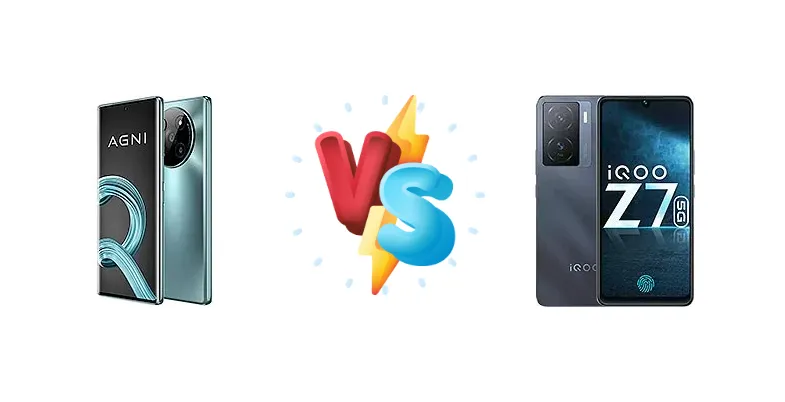
The mid-range smartphone market is fiercely competitive, offering incredible value for your money. Today, we're pitting two contenders against each other: the Lava Agni 2 and the vivo iQOO Z7. Both promise impressive features, but which one truly delivers?
🏆 Quick Verdict
The iQOO Z7 edges out the Lava Agni 2 thanks to its slightly more powerful Dimensity 920 chipset and generally better software optimization. While the Agni 2 boasts faster charging, the Z7's overall performance and smoother experience make it the preferred choice for most users.
| Network |
|---|
| 2G bands | GSM 850 / 900 / 1800 / 1900 | GSM 850 / 900 / 1800 / 1900 |
| 3G bands | HSDPA 850 / 900 / 1900 / 2100 | HSDPA 850 / 900 / 2100 |
| 4G bands | 1, 3, 5, 7, 8, 20, 28, 38, 40, 41 | 1, 3, 5, 8, 38, 40, 41 |
| 5G bands | 1, 3, 5, 7, 8, 20, 28, 38, 40, 41, 66, 77, 78 SA/NSA | 1, 3, 8, 28, 77, 78 SA/NSA |
| Speed | HSPA, LTE, 5G | HSPA, LTE, 5G |
| Technology | GSM / HSPA / LTE / 5G | GSM / HSPA / LTE / 5G |
| Launch |
|---|
| Announced | 2023, May 16 | 2023, March 17 |
| Status | Available. Released 2023, May 24 | Available. Released 2023, March 21 |
| Body |
|---|
| Dimensions | 164.2 x 74.7 x 8.8 mm (6.46 x 2.94 x 0.35 in) | 158.9 x 73.5 x 7.8 mm (6.26 x 2.89 x 0.31 in) |
| SIM | Nano-SIM + Nano-SIM | Nano-SIM + Nano-SIM |
| Weight | 210 g (7.41 oz) | 173 g (6.10 oz) |
| | - | IP54, dust and water resistant |
| Display |
|---|
| Protection | - | Schott Xensation glass |
| Resolution | 1080 x 2400 pixels, 20:9 ratio (~388 ppi density) | 1080 x 2400 pixels, 20:9 ratio (~413 ppi density) |
| Size | 6.78 inches, 111.0 cm2 (~90.5% screen-to-body ratio) | 6.38 inches, 98.3 cm2 (~84.1% screen-to-body ratio) |
| Type | AMOLED, 1B colors, 120Hz, HDR10+, 950 nits (HBM) | AMOLED, 90Hz, HDR10+, 1300 nits (peak) |
| Platform |
|---|
| CPU | Octa-core (2x2.6 GHz Cortex-A78 & 6x2.0 GHz Cortex-A55) | Octa-core (2x2.5 GHz Cortex-A78 & 6x2.0 GHz Cortex-A55) |
| Chipset | Mediatek Dimensity 7050 (6 nm) | Mediatek Dimensity 920 (6 nm) |
| GPU | Mali-G68 MC4 | Mali-G68 MC4 |
| OS | Android 13 | Android 13, upgradable to Android 14, Funtouch 14 |
| Memory |
|---|
| Card slot | No | microSDXC (uses shared SIM slot) |
| Internal | 256GB 8GB RAM | 128GB 6GB RAM, 128GB 8GB RAM |
| | - | UFS 2.2 |
| Main Camera |
|---|
| Dual | - | 64 MP, (wide), 1/1.97", 0.7µm, PDAF, OIS
Auxiliary lens |
| Features | Dual-LED flash, HDR | LED flash, HDR, panorama |
| Quad | 50 MP, f/1.9, (wide), 1/1.55", 1.0µm, PDAF
8 MP, (ultrawide)
2 MP (macro)
Auxiliary lens | - |
| Video | 4K@30fps, 1080p@30fps | 4K@30fps, 1080p@30fps |
| Selfie camera |
|---|
| Single | 16 MP, f/2.0, (wide), 1.0µm | 16 MP, f/2.0, (wide) |
| Video | 1080p@30fps | 1080p@30fps |
| Sound |
|---|
| 3.5mm jack | Yes | Yes |
| 35mm jack | No | Yes |
| Loudspeaker | Yes | Yes |
| Comms |
|---|
| Bluetooth | 5.2, A2DP, LE | 5.2, A2DP, LE |
| NFC | No | No |
| Positioning | GPS, GLONASS, GALILEO, BDS, QZSS | GPS, GLONASS, GALILEO, BDS, QZSS |
| Radio | Unspecified | Unspecified |
| USB | USB Type-C 2.0, OTG | USB Type-C 2.0, OTG |
| WLAN | Wi-Fi 802.11 a/b/g/n/ac/6, dual-band | Wi-Fi 802.11 a/b/g/n/ac/6, dual-band, Wi-Fi Direct |
| Features |
|---|
| Sensors | Fingerprint (under display, optical), accelerometer, gyro, proximity, compass | Fingerprint (under display, optical), accelerometer, gyro, proximity, compass |
| Battery |
|---|
| Charging | 66W wired, 50% in 16 min | 44W wired, 50% in 25 min |
| Type | Li-Po 4700 mAh | 4500 mAh |
| Misc |
|---|
| Colors | Blue, Purple, Gray | Norway Blue, Pacific Night |
| Models | - | I2207 |
| Price | About 220 EUR | About 200 EUR |
| SAR | - | 1.15 W/kg (head) 0.84 W/kg (body) |
Lava Agni 2
- Faster Charging (66W)
- Potentially Unique Design
- Decent Performance for the Price
- Less Powerful Chipset
- Potentially Less Optimized Software
- Camera May Not Be as Good
vivo iQOO Z7
- More Powerful Chipset (Dimensity 920)
- Better Performance & Gaming
- Likely Superior Camera System
- Smoother Software Experience
- Slower Charging (44W)
- Design May Be Less Distinctive
Display Comparison
Both phones likely feature a 6.67-inch FHD+ AMOLED display with a 120Hz refresh rate, offering vibrant colors and smooth scrolling. However, the iQOO Z7 might have slightly better color accuracy and brightness due to vivo's display tuning expertise. Expect similar viewing experiences overall.
Camera Comparison
The iQOO Z7 is expected to have a 64MP main camera, potentially with OIS, alongside ultrawide and macro lenses. The Lava Agni 2 likely features a 50MP main camera. While megapixels aren't everything, the iQOO Z7's likely better image processing and potential OIS should result in superior photo and video quality, especially in low light. Expect the Z7 to offer more consistent results.
Performance
The iQOO Z7's Dimensity 920 chipset holds a clear advantage over the Agni 2's Dimensity 7050. While both are 6nm chips, the 920 offers better CPU and GPU performance, resulting in smoother multitasking, faster app loading times, and improved gaming performance. The Agni 2 will still handle everyday tasks well, but the Z7 is the winner here.
Battery Life
The Lava Agni 2 takes the lead in charging speed with its 66W wired charging, reaching 50% in just 16 minutes. The iQOO Z7's 44W charging takes 25 minutes to reach the same milestone. However, both phones likely have a similar battery capacity (around 5000mAh), so real-world battery life should be comparable, with the Agni 2 potentially offering slightly faster top-ups.
Buying Guide
The Lava Agni 2 is a good option for users prioritizing fast charging and a potentially more unique design. The vivo iQOO Z7 is ideal for those seeking a well-rounded experience with strong performance and a reliable camera system, especially if gaming is a priority.
Frequently Asked Questions
❓ Which phone is better for gaming?
The vivo iQOO Z7 is the better choice for gaming due to its more powerful Dimensity 920 chipset.
❓ Does the Lava Agni 2 have fast charging?
Yes, the Lava Agni 2 supports 66W fast charging, allowing it to reach 50% battery in just 16 minutes.