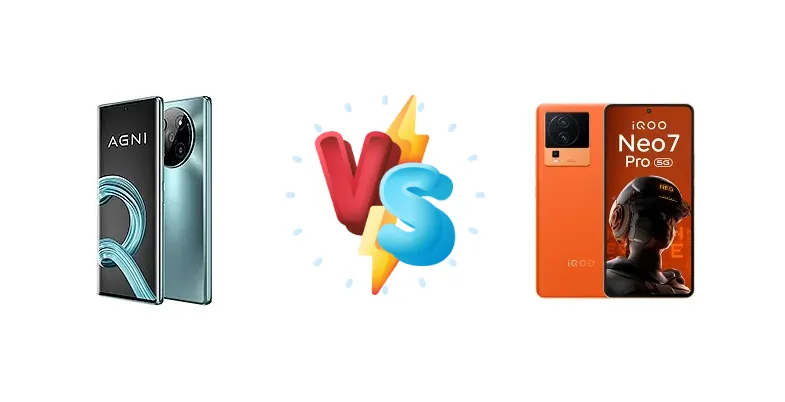
The Lava Agni 2 and vivo iQOO Neo 7 Pro represent compelling options in the increasingly competitive mid-range smartphone market. The Agni 2 aims to deliver a balanced experience, while the iQOO Neo 7 Pro prioritizes raw performance and incredibly fast charging. This comparison dissects their key differences to help you determine which device best suits your needs.
🏆 Quick Verdict
For users prioritizing peak performance and blazing-fast charging, the vivo iQOO Neo 7 Pro is the clear winner. Its Snapdragon 8+ Gen 1 chipset and 120W charging significantly outperform the Lava Agni 2’s Dimensity 7050 and 66W charging. However, the Agni 2 offers a competitive experience at a potentially lower price point.
| Network |
|---|
| 2G bands | GSM 850 / 900 / 1800 / 1900 | GSM 850 / 900 / 1800 / 1900 |
| 3G bands | HSDPA 850 / 900 / 1900 / 2100 | HSDPA 800 / 850 / 900 / 1700(AWS) / 1900 / 2100 |
| 4G bands | 1, 3, 5, 7, 8, 20, 28, 38, 40, 41 | 1, 2, 3, 4, 5, 8, 28, 34, 38, 39, 40, 41 |
| 5G bands | 1, 3, 5, 7, 8, 20, 28, 38, 40, 41, 66, 77, 78 SA/NSA | 1, 3, 5, 8, 28, 40, 77, 78 SA/NSA |
| Speed | HSPA, LTE, 5G | HSPA, LTE, 5G |
| Technology | GSM / HSPA / LTE / 5G | GSM / HSPA / LTE / 5G |
| Launch |
|---|
| Announced | 2023, May 16 | 2023, July 04 |
| Status | Available. Released 2023, May 24 | Available. Released 2023, July 15 |
| Body |
|---|
| Build | - | Glass front, plastic frame, glass or leather back |
| Dimensions | 164.2 x 74.7 x 8.8 mm (6.46 x 2.94 x 0.35 in) | 164.8 x 76.9 x 8.5 mm or 8.9 mm |
| SIM | Nano-SIM + Nano-SIM | Nano-SIM + Nano-SIM |
| Weight | 210 g (7.41 oz) | 197 g or 202 g (6.95 oz) |
| Display |
|---|
| Resolution | 1080 x 2400 pixels, 20:9 ratio (~388 ppi density) | 1080 x 2400 pixels, 20:9 ratio (~388 ppi density) |
| Size | 6.78 inches, 111.0 cm2 (~90.5% screen-to-body ratio) | 6.78 inches, 111.0 cm2 (~87.6% screen-to-body ratio) |
| Type | AMOLED, 1B colors, 120Hz, HDR10+, 950 nits (HBM) | AMOLED, 1B colors, 120Hz, HDR10+, 1300 nits (peak) |
| Platform |
|---|
| CPU | Octa-core (2x2.6 GHz Cortex-A78 & 6x2.0 GHz Cortex-A55) | Octa-core (1x3.19 GHz Cortex-X2 & 3x2.75 GHz Cortex-A710 & 4x2.0 GHz Cortex-A510) |
| Chipset | Mediatek Dimensity 7050 (6 nm) | Qualcomm SM8475 Snapdragon 8+ Gen 1 (4 nm) |
| GPU | Mali-G68 MC4 | Adreno 730 |
| OS | Android 13 | Android 13, Funtouch 13 |
| Memory |
|---|
| Card slot | No | No |
| Internal | 256GB 8GB RAM | 128GB 8GB RAM, 256GB 12GB RAM |
| Main Camera |
|---|
| Features | Dual-LED flash, HDR | LED flash, HDR, panorama |
| Quad | 50 MP, f/1.9, (wide), 1/1.55", 1.0µm, PDAF
8 MP, (ultrawide)
2 MP (macro)
Auxiliary lens | - |
| Triple | - | 50 MP, f/1.9, 24mm (wide), 1/1.57", 1.0µm, PDAF, OIS
8 MP, f/2.2, 16mm (ultrawide), 1/4.0", 1.12µm
2 MP (macro) |
| Video | 4K@30fps, 1080p@30fps | 4K@30fps, 1080p@30fps |
| Selfie camera |
|---|
| Features | - | HDR |
| Single | 16 MP, f/2.0, (wide), 1.0µm | 16 MP, f/2.5, (wide), 1/3.1", 1.0µm |
| Video | 1080p@30fps | 1080p@30fps |
| Sound |
|---|
| 3.5mm jack | Yes | - |
| 35mm jack | No | No |
| Loudspeaker | Yes | Yes, with stereo speakers |
| Comms |
|---|
| Bluetooth | 5.2, A2DP, LE | 5.3, A2DP, LE, aptX HD, aptX Adaptive |
| Infrared port | - | Yes |
| NFC | No | No |
| Positioning | GPS, GLONASS, GALILEO, BDS, QZSS | GPS, GLONASS, GALILEO, BDS, QZSS, NavIC |
| Radio | Unspecified | No |
| USB | USB Type-C 2.0, OTG | USB Type-C 2.0, OTG |
| WLAN | Wi-Fi 802.11 a/b/g/n/ac/6, dual-band | Wi-Fi 802.11 a/b/g/n/ac/6, dual-band, Wi-Fi Direct |
| Features |
|---|
| Sensors | Fingerprint (under display, optical), accelerometer, gyro, proximity, compass | Fingerprint (under display, optical), accelerometer, gyro, proximity, compass |
| Battery |
|---|
| Charging | 66W wired, 50% in 16 min | 120W wired, 50% in 8 min |
| Type | Li-Po 4700 mAh | 5000 mAh |
| Misc |
|---|
| Colors | Blue, Purple, Gray | Fearless Flame, Dark Storm |
| Models | - | I2217 |
| Price | About 220 EUR | About 380 EUR |
Lava Agni 2
- Potentially more affordable price point
- Good all-around performance for daily tasks
- Reliable Mediatek Dimensity 7050 chipset
- Slower charging speed (66W)
- Less powerful chipset compared to Snapdragon 8+ Gen 1
- Likely less advanced camera system
vivo iQOO Neo 7 Pro
- Blazing-fast 120W charging
- Superior performance with Snapdragon 8+ Gen 1
- More advanced ISP for better image quality
- Potentially higher price
- Snapdragon 8+ Gen 1 can run warmer under sustained load
- May require more frequent charging if heavily used
Display Comparison
While display specifications aren't provided, the iQOO Neo 7 Pro, typical of its segment, likely features a higher refresh rate panel (120Hz or higher) compared to the Agni 2. The iQOO’s panel is also likely to achieve higher peak brightness, enhancing outdoor visibility. The Snapdragon’s more powerful ISP also suggests better display calibration and color accuracy. The Agni 2 will likely focus on efficiency, potentially using a slightly less power-hungry panel.
Camera Comparison
Without detailed camera specs, it’s difficult to make a definitive judgment. However, the iQOO Neo 7 Pro, given its positioning, likely incorporates a larger main sensor and more sophisticated image processing algorithms powered by the Snapdragon’s ISP. The Snapdragon 8+ Gen 1’s image signal processor (ISP) is significantly more capable than the Dimensity 7050’s, resulting in better dynamic range, noise reduction, and overall image quality, especially in challenging lighting conditions. The Agni 2 will likely focus on providing a good, but not class-leading, camera experience.
Performance
The core difference lies in the chipsets. The iQOO Neo 7 Pro’s Snapdragon 8+ Gen 1, built on a 4nm process, offers a substantial performance advantage over the Lava Agni 2’s Mediatek Dimensity 7050 (6nm). The Snapdragon 8+ Gen 1’s Cortex-X2 prime core, clocked at 3.19 GHz, provides a significant boost in single-core performance, crucial for responsive UI and app loading. The iQOO also benefits from a more advanced GPU, delivering superior graphics performance for gaming. The Dimensity 7050 is still capable, but will show its limitations in graphically intensive titles. The iQOO’s LPDDR5x RAM further enhances performance, offering faster data transfer speeds compared to the Agni 2’s likely LPDDR4x or LPDDR5 configuration.
Battery Life
The iQOO Neo 7 Pro’s 120W charging is a game-changer, achieving a 50% charge in just 8 minutes. This drastically reduces downtime compared to the Lava Agni 2’s 66W charging, which takes 16 minutes for a 50% charge. While battery capacity isn’t specified, the iQOO’s more efficient chipset and faster charging mitigate the impact of a potentially smaller battery. The 4nm process of the Snapdragon 8+ Gen 1 contributes to better power efficiency, allowing the iQOO to deliver comparable or even better battery life despite the faster charging.
Buying Guide
Buy the Lava Agni 2 if you need a reliable daily driver with good performance for everyday tasks and moderate gaming, and value a potentially lower price. Buy the vivo iQOO Neo 7 Pro if you demand the highest possible performance for demanding games and applications, and absolutely require the fastest possible charging speeds – minimizing downtime is a priority.
Frequently Asked Questions
❓ Does the Snapdragon 8+ Gen 1 in the iQOO Neo 7 Pro tend to overheat during prolonged gaming sessions?
While the Snapdragon 8+ Gen 1 is a powerful chip, it can generate heat under sustained load. However, iQOO typically implements robust cooling solutions, including vapor chamber cooling, to mitigate thermal throttling. Expect some heat, but the iQOO Neo 7 Pro is designed to maintain performance for extended gaming periods.
❓ Is the 66W charging on the Lava Agni 2 slow compared to the competition?
66W charging is still relatively fast and will fully charge the phone in under an hour. However, the iQOO Neo 7 Pro’s 120W charging is significantly faster, offering a substantial time saving for users who prioritize quick top-ups. The difference is most noticeable when charging from low battery levels.
❓ How does the Dimensity 7050 handle demanding games like Genshin Impact or Call of Duty: Mobile?
The Dimensity 7050 can run these games, but you may need to lower graphics settings to achieve a consistently smooth frame rate. The Snapdragon 8+ Gen 1 in the iQOO Neo 7 Pro will provide a noticeably smoother and more stable gaming experience at higher settings.