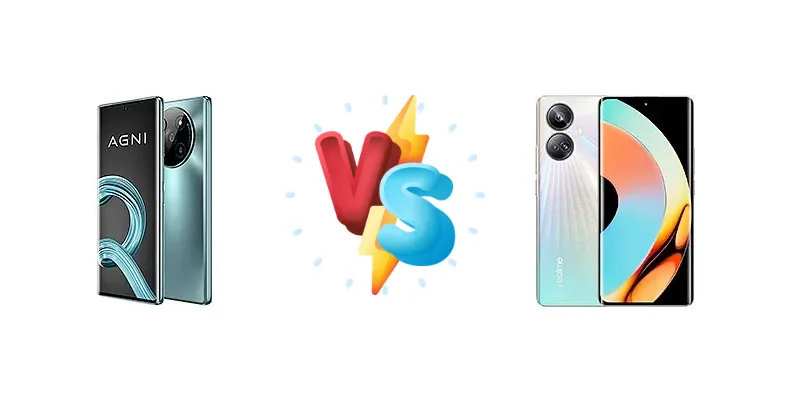
The mid-range smartphone market is fiercely competitive, offering incredible value for your money. Today, we're pitting two contenders against each other: the Lava Agni 2 and the Realme 10 Pro+. Both promise impressive features, but which one truly delivers? Let's dive in and find out.
🏆 Quick Verdict
The Realme 10 Pro+ edges out the Lava Agni 2 thanks to its superior camera system, slightly faster processor, and potentially better display. However, the Agni 2 offers competitive performance and fast charging at a potentially lower price point, making it a strong contender for budget-conscious buyers.
| Network |
|---|
| 2G bands | GSM 850 / 900 / 1800 / 1900 | GSM 850 / 900 / 1800 / 1900 - SIM 1 & SIM 2 |
| 3G bands | HSDPA 850 / 900 / 1900 / 2100 | HSDPA 850 / 900 / 1700(AWS) / 1900 / 2100 |
| 4G bands | 1, 3, 5, 7, 8, 20, 28, 38, 40, 41 | 1, 3, 5, 7, 8, 19, 28, 34, 38, 39, 40, 41 |
| 5G bands | 1, 3, 5, 7, 8, 20, 28, 38, 40, 41, 66, 77, 78 SA/NSA | 1, 3, 5, 8, 28, 40, 41, 77, 78 SA/NSA |
| Speed | HSPA, LTE, 5G | HSPA, LTE-A, 5G |
| Technology | GSM / HSPA / LTE / 5G | GSM / CDMA / HSPA / CDMA2000 / LTE / 5G |
| | - | CDMA2000 1x |
| Launch |
|---|
| Announced | 2023, May 16 | 2022, November 17 |
| Status | Available. Released 2023, May 24 | Available. Released 2022, November 24 |
| Body |
|---|
| Build | - | Glass front, plastic frame, plastic back |
| Dimensions | 164.2 x 74.7 x 8.8 mm (6.46 x 2.94 x 0.35 in) | 161.5 x 73.9 x 7.8 mm or 8 mm |
| SIM | Nano-SIM + Nano-SIM | Dual SIM (Nano-SIM, dual stand-by) |
| Weight | 210 g (7.41 oz) | 173 g / 175 g (6.10 oz) |
| Display |
|---|
| Resolution | 1080 x 2400 pixels, 20:9 ratio (~388 ppi density) | 1080 x 2412 pixels, 20:9 ratio (~394 ppi density) |
| Size | 6.78 inches, 111.0 cm2 (~90.5% screen-to-body ratio) | 6.7 inches, 108.0 cm2 (~90.5% screen-to-body ratio) |
| Type | AMOLED, 1B colors, 120Hz, HDR10+, 950 nits (HBM) | AMOLED, 1B colors, HDR10+, 120Hz, 800 nits |
| Platform |
|---|
| CPU | Octa-core (2x2.6 GHz Cortex-A78 & 6x2.0 GHz Cortex-A55) | Octa-core (2x2.6 GHz Cortex-A78 & 6x2.0 GHz Cortex-A55) |
| Chipset | Mediatek Dimensity 7050 (6 nm) | Mediatek MT6877V Dimensity 1080 (6 nm) |
| GPU | Mali-G68 MC4 | Mali-G68 MC4 |
| OS | Android 13 | Android 13, Realme UI 4.0 |
| Memory |
|---|
| Card slot | No | No |
| Internal | 256GB 8GB RAM | 128GB 6GB RAM, 128GB 8GB RAM, 256GB 8GB RAM, 256GB 12GB RAM |
| Main Camera |
|---|
| Features | Dual-LED flash, HDR | LED flash, HDR, panorama |
| Quad | 50 MP, f/1.9, (wide), 1/1.55", 1.0µm, PDAF
8 MP, (ultrawide)
2 MP (macro)
Auxiliary lens | - |
| Single | - | 16 MP, f/2.5, 25mm (wide) |
| Triple | - | 108 MP, f/1.8, 24mm (wide), 1/1.67", 0.64µm, PDAF
8 MP, f/2.2, 16mm, 112˚ (ultrawide)
2 MP, f/2.4, (macro) |
| Video | 4K@30fps, 1080p@30fps | 4K@30fps, 1080p@30/60/120/480fps, 720p@960fps, gyro-EIS |
| Selfie camera |
|---|
| Features | - | Panorama |
| Single | 16 MP, f/2.0, (wide), 1.0µm | 16 MP, f/2.5, 25mm (wide) |
| Video | 1080p@30fps | 1080p@30fps |
| Sound |
|---|
| 3.5mm jack | Yes | No |
| 35mm jack | No | - |
| Loudspeaker | Yes | Yes, with stereo speakers |
| | - | 24-bit/192kHz audio |
| Comms |
|---|
| Bluetooth | 5.2, A2DP, LE | 5.2, A2DP, LE, aptX HD |
| NFC | No | Yes (market/region dependent) |
| Positioning | GPS, GLONASS, GALILEO, BDS, QZSS | GPS (L1+L5), GALILEO, GLONASS, BDS, QZSS |
| Radio | Unspecified | No |
| USB | USB Type-C 2.0, OTG | USB Type-C 2.0 |
| WLAN | Wi-Fi 802.11 a/b/g/n/ac/6, dual-band | Wi-Fi 802.11 a/b/g/n/ac/6, dual-band |
| Features |
|---|
| Sensors | Fingerprint (under display, optical), accelerometer, gyro, proximity, compass | Fingerprint (under display, optical), accelerometer, gyro, proximity, compass |
| Battery |
|---|
| Charging | 66W wired, 50% in 16 min | 67W wired, PD3.0, 50% in 17 min (advertised) |
| Type | Li-Po 4700 mAh | Li-Po 5000 mAh, non-removable |
| Misc |
|---|
| Colors | Blue, Purple, Gray | Dark Matter Black, Nebula Blue, Hyperspace |
| Models | - | RMX3687, RMX3686 |
| Price | About 220 EUR | $ 269.00 / ₹ 22,999 |
| Tests |
|---|
| Battery life | - |
Endurance rating 149h
|
| Camera | - |
Photo / Video |
| Display | - |
Contrast ratio: Infinite (nominal) |
| Loudspeaker | - |
-25.4 LUFS (Very good)
|
| Performance | - |
AnTuTu: 522376 (v9)
GeekBench: 2371 (v5.1)
GFXBench: 23fps (ES 3.1 onscreen) |
Lava Agni 2
- Fast 66W Charging
- Solid Performance for the Price
- Decent Display
- Competitive Price (likely)
- Camera likely inferior to Realme
- Potentially less efficient chipset
- Build quality may not be as premium
Realme 10 Pro+
- Superior Camera System
- Slightly Faster Processor
- Potentially Higher Refresh Rate Display
- Excellent Battery Life
- Premium Design
- Potentially Higher Price
- Software experience can be polarizing (Realme UI)
Display Comparison
Both phones feature AMOLED displays, offering vibrant colors and deep blacks. The Realme 10 Pro+ boasts a potentially higher refresh rate (likely 120Hz, based on typical Realme specs) and a higher peak brightness, resulting in a slightly more immersive viewing experience. The 'Infinite' contrast ratio claim for the Realme is largely marketing, as AMOLEDs inherently have very high contrast.
Camera Comparison
The Realme 10 Pro+ is expected to have a significantly better camera system. While specific details are missing, Realme typically delivers excellent camera performance in this price range. The Agni 2's camera is likely adequate but won't match the Realme's capabilities, especially in low light. The Realme likely has a higher resolution main sensor and improved image processing.
Performance
While both phones share the same CPU core configuration, the Realme 10 Pro+'s Dimensity 1080 chipset generally offers slightly better overall performance and efficiency compared to the Dimensity 7050. Expect smoother multitasking and slightly faster app loading times on the Realme.
Battery Life
Both phones offer fast charging capabilities. The Lava Agni 2's 66W charging is competitive, but the Realme 10 Pro+'s 67W charging with PD3.0 support might offer slightly faster top-ups. The Realme's endurance rating of 149h suggests excellent battery life, potentially exceeding the Agni 2's.
Buying Guide
The Lava Agni 2 is ideal for users prioritizing fast charging and a solid all-around experience without breaking the bank. The Realme 10 Pro+ is a better choice for photography enthusiasts and those seeking a premium feel and slightly enhanced performance.
Frequently Asked Questions
❓ Which phone has better gaming performance?
The Realme 10 Pro+ with its Dimensity 1080 chipset generally offers slightly better gaming performance due to its superior GPU.
❓ Is the Lava Agni 2 worth considering if I'm on a tight budget?
Absolutely! The Lava Agni 2 provides a good balance of features and performance at a likely more affordable price point, making it a strong contender for budget-conscious buyers.