
Lava Agni 2 vs Motorola Edge 40 Neo: A Deep Dive into Mid-Range Power
| Phones Images | |||||
|---|---|---|---|---|---|
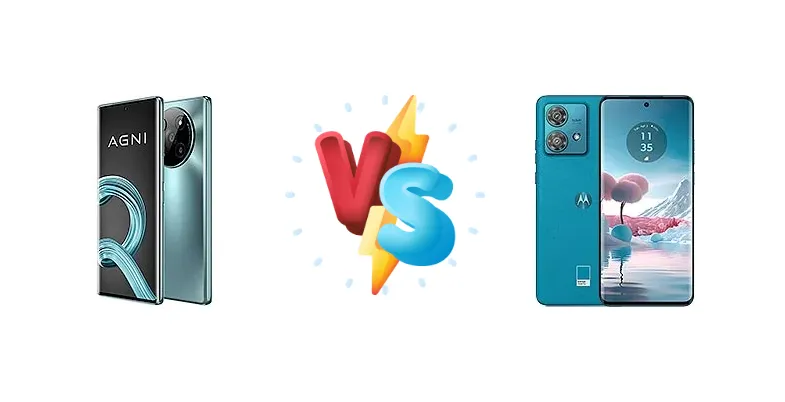
|
🏆 Quick Verdict
For the average user prioritizing sustained performance and rapid charging, the Lava Agni 2 emerges as the stronger contender. While the Motorola Edge 40 Neo boasts a brighter display and longer battery endurance in testing, the Agni 2's slightly more powerful chipset and comparable charging speed offer a more balanced package.
| PHONES | ||
|---|---|---|
| Phone Names | Lava Agni 2 | Motorola Edge 40 Neo |
| Network | ||
|---|---|---|
| 2G bands | GSM 850 / 900 / 1800 / 1900 | GSM 850 / 900 / 1800 / 1900 |
| 3G bands | HSDPA 850 / 900 / 1900 / 2100 | HSDPA 800 / 850 / 900 / 1700(AWS) / 1900 / 2100 |
| 4G bands | 1, 3, 5, 7, 8, 20, 28, 38, 40, 41 | 1, 2, 3, 4, 5, 7, 8, 12, 13, 17, 18, 19, 20, 25, 26, 28, 32, 38, 38, 39, 40, 41, 42, 43, 48, 66 |
| 5G bands | 1, 3, 5, 7, 8, 20, 28, 38, 40, 41, 66, 77, 78 SA/NSA | 1, 2, 3, 5, 7, 8, 20, 28, 38, 40, 41, 66, 77, 78 SA/NSA |
| Speed | HSPA, LTE, 5G | HSPA, LTE, 5G |
| Technology | GSM / HSPA / LTE / 5G | GSM / HSPA / LTE / 5G |
| Launch | ||
|---|---|---|
| Announced | 2023, May 16 | 2023, September 14 |
| Status | Available. Released 2023, May 24 | Available. Released 2023, September 14 |
| Body | ||
|---|---|---|
| Build | - | Glass front (Gorilla Glass 3), plastic frame, plastic back |
| Dimensions | 164.2 x 74.7 x 8.8 mm (6.46 x 2.94 x 0.35 in) | 159.6 x 72 x 7.9 mm (6.28 x 2.83 x 0.31 in) |
| SIM | Nano-SIM + Nano-SIM | · Nano-SIM + eSIM· Nano-SIM + Nano-SIM |
| Weight | 210 g (7.41 oz) | 170 g or 172 g (6.00 oz) |
| Display | ||
|---|---|---|
| Protection | - | Corning Gorilla Glass 3 |
| Resolution | 1080 x 2400 pixels, 20:9 ratio (~388 ppi density) | 1080 x 2400 pixels, 20:9 ratio (~402 ppi density) |
| Size | 6.78 inches, 111.0 cm2 (~90.5% screen-to-body ratio) | 6.55 inches, 103.6 cm2 (~90.1% screen-to-body ratio) |
| Type | AMOLED, 1B colors, 120Hz, HDR10+, 950 nits (HBM) | P-OLED, 1B colors, 144Hz, HDR10+, 1300 nits (peak) |
| Platform | ||
|---|---|---|
| CPU | Octa-core (2x2.6 GHz Cortex-A78 & 6x2.0 GHz Cortex-A55) | Octa-core (2x2.5 GHz Cortex-A78 & 6x2.0 GHz Cortex-A55) |
| Chipset | Mediatek Dimensity 7050 (6 nm) | MediaTek Dimensity 7030 (6 nm) |
| GPU | Mali-G68 MC4 | Mali-G610 MC3 |
| OS | Android 13 | Android 13, up to 2 major Android upgrades |
| Memory | ||
|---|---|---|
| Card slot | No | No |
| Internal | 256GB 8GB RAM | 128GB 8GB RAM, 256GB 8GB RAM, 256GB 12GB RAM |
| Main Camera | ||
|---|---|---|
| Dual | - | 50 MP, f/1.8, (wide), 1/1.55", 1.0µm, multi-directional PDAF, OIS 13 MP, f/2.2, 120˚ (ultrawide), 1/3.0", 1.12µm, PDAF |
| Features | Dual-LED flash, HDR | LED flash, HDR, panorama |
| Quad | 50 MP, f/1.9, (wide), 1/1.55", 1.0µm, PDAF 8 MP, (ultrawide) 2 MP (macro) Auxiliary lens | - |
| Video | 4K@30fps, 1080p@30fps | 4K@30fps, 1080p@30/60/120/240fps, gyro-EIS |
| Selfie camera | ||
|---|---|---|
| Features | - | HDR |
| Single | 16 MP, f/2.0, (wide), 1.0µm | 32 MP, f/2.4, (wide), 1/3.0", 0.7µm |
| Video | 1080p@30fps | 4K@30fps, 1080p@30fps |
| Sound | ||
|---|---|---|
| 3.5mm jack | Yes | - |
| 35mm jack | No | No |
| Loudspeaker | Yes | Yes, with stereo speakers |
| Comms | ||
|---|---|---|
| Bluetooth | 5.2, A2DP, LE | 5.4, A2DP, LE |
| NFC | No | Yes |
| Positioning | GPS, GLONASS, GALILEO, BDS, QZSS | GPS, GLONASS, GALILEO |
| Radio | Unspecified | No |
| USB | USB Type-C 2.0, OTG | USB Type-C 2.0, OTG |
| WLAN | Wi-Fi 802.11 a/b/g/n/ac/6, dual-band | Wi-Fi 802.11 a/b/g/n/ac/6e, tri-band, Wi-Fi Direct |
| Features | ||
|---|---|---|
| Sensors | Fingerprint (under display, optical), accelerometer, gyro, proximity, compass | Fingerprint (under display, optical), accelerometer, gyro, proximity, compass |
| Battery | ||
|---|---|---|
| Charging | 66W wired, 50% in 16 min | 68W wired, 50% in 15 min |
| Type | Li-Po 4700 mAh | Li-Po 5000 mAh |
| Misc | ||
|---|---|---|
| Colors | Blue, Purple, Gray | Black, Soothing Sea, Caneel Bay, Peach Fuzz |
| Models | - | XT2307-1 |
| Price | About 220 EUR | $ 299.00 / € 168.73 / ₹ 19,900 |
Lava Agni 2
- Slightly faster CPU clock speed for improved performance.
- Competitive 66W fast charging.
- Potentially better sustained performance due to chipset clock speed.
- Battery capacity and endurance are unknown.
- Display brightness data is unavailable.
Motorola Edge 40 Neo
- High peak display brightness (1073 nits) for excellent outdoor visibility.
- Impressive battery life (10:28h active use, 80h endurance).
- Fast 68W charging.
- Slightly slower CPU clock speed compared to the Agni 2.
- May experience more throttling under sustained load.
Display Comparison
The Motorola Edge 40 Neo distinguishes itself with a measured peak brightness of 1073 nits, suggesting superior outdoor visibility compared to the Lava Agni 2 (brightness data unavailable). While the Agni 2’s panel type isn’t specified, the Edge 40 Neo’s brightness advantage is significant for users frequently exposed to direct sunlight. The absence of LTPO technology in either device suggests both will rely on adaptive refresh rate switching to conserve power, but the Edge 40 Neo’s higher peak brightness is a clear win for visual clarity.
Camera Comparison
Detailed camera analysis is hampered by a lack of sensor specifications for both devices. However, focusing on the chipset’s ISP capabilities, both phones should deliver comparable image processing performance. The absence of information regarding OIS (Optical Image Stabilization) is a key omission; its presence would significantly benefit low-light photography and video recording. Without further details, it’s difficult to definitively declare a camera winner, but the focus should be on real-world image samples to assess dynamic range and detail retention.
Performance
Both phones utilize MediaTek’s Dimensity 7000 series, but the Lava Agni 2 features the Dimensity 7050, clocked at 2.6 GHz for its Cortex-A78 cores, while the Motorola Edge 40 Neo uses the Dimensity 7030 with a slightly lower 2.5 GHz clock speed. This 100 MHz difference, while seemingly small, can translate to a measurable performance advantage for the Agni 2 in CPU-intensive tasks. Both chipsets are built on a 6nm process, indicating similar power efficiency. However, the Agni 2’s higher clock speed suggests it may sustain peak performance for longer periods before thermal throttling becomes a factor.
Battery Life
The Motorola Edge 40 Neo showcases a strong battery performance with a 10:28 hour active use score and an endurance rating of 80 hours, indicating excellent efficiency. The Lava Agni 2’s battery capacity is unspecified, but its 66W wired charging (50% in 16 minutes) is competitive with the Edge 40 Neo’s 68W charging (50% in 15 minutes). The Edge 40 Neo’s longer endurance rating suggests better overall power management, but the Agni 2’s rapid charging can mitigate concerns about battery life for users who prioritize quick top-ups.
Buying Guide
Buy the Lava Agni 2 if you need a phone that can handle demanding tasks like gaming and video editing without significant throttling, and if fast charging is a priority. Buy the Motorola Edge 40 Neo if you prioritize a vibrant, bright display for media consumption and require all-day battery life with moderate usage, even if it means slightly less raw processing power.