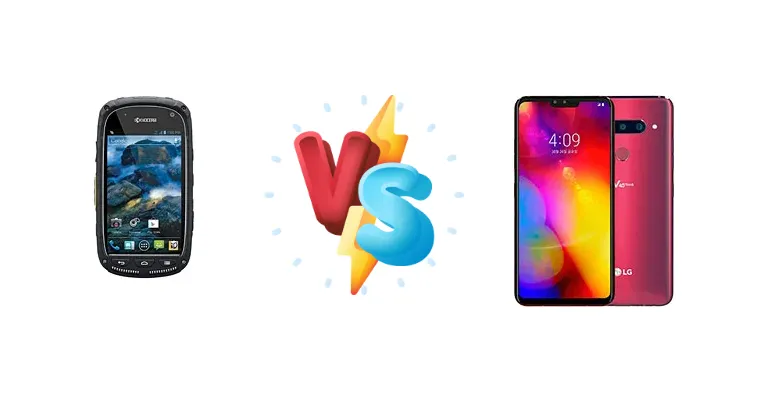
The Kyocera Torque E6710 and LG V40 ThinQ represent vastly different approaches to the smartphone experience. The Torque prioritizes extreme durability for demanding work environments, while the V40 ThinQ aimed for a premium, feature-rich experience in its time. This comparison dissects their core differences, helping you determine which device best suits your needs.
🏆 Quick Verdict
For the average user prioritizing performance and features, the LG V40 ThinQ is the clear winner. Its Snapdragon 845 chipset delivers significantly faster processing and graphics capabilities. However, if absolute durability and a long-lasting, rugged device are paramount, the Kyocera Torque E6710 remains a viable, albeit dated, option.
| Network |
|---|
| 2G bands | CDMA 800 / 1900 | GSM 850 / 900 / 1800 / 1900 |
| 3G bands | CDMA2000 1xEV-DO | HSDPA 850 / 900 / 1700(AWS) / 1900 / 2100 - V405QA7 |
| 4G bands | 25 | 1, 2, 3, 4, 5, 7, 8, 12, 13, 14, 17, 20, 25, 26, 28, 29, 30, 38, 39, 40, 41, 46, 66, 71 - V405QA7 |
| Speed | LTE Cat3 100/50 Mbps, EV-DO Rev.A 3.1 Mbps | HSPA 42.2/5.76 Mbps, LTE (4CA) Cat16 1024/150 Mbps |
| Technology | CDMA / EVDO / LTE | GSM / CDMA / HSPA / EVDO / LTE |
| | - | CDMA2000 1xEV-DO - V405QA7 |
| Launch |
|---|
| Announced | 2013, January. Released 2013, March | 2018, October 03. Released 2018, October 16 |
| Status | Discontinued | Discontinued |
| Body |
|---|
| Build | - | Glass front (Gorilla Glass 5), glass back (Gorilla Glass 5), aluminum frame |
| Dimensions | 128.5 x 68.4 x 12.9 mm (5.06 x 2.69 x 0.51 in) | 158.8 x 75.7 x 7.6 mm (6.25 x 2.98 x 0.30 in) |
| SIM | Non-removable | · Nano-SIM· Nano-SIM + Nano-SIM |
| Weight | 168.5 g (5.93 oz) | 169 g (5.96 oz) |
| | IP67 dust/water resistant (up to 1m for 30 mins)
MIL-STD-810G compliant
IPX5, IPX7 certified
Flashlight | IP68 dust/water resistant (up to 1.5m for 30 min)
MIL-STD-810G compliant*
*does not guarantee ruggedness or use in extreme conditions |
| Display |
|---|
| Protection | - Corning Gorilla Glass 2 | Corning Gorilla Glass 5 |
| Resolution | 480 x 800 pixels, 5:3 ratio (~233 ppi density) | 1440 x 3120 pixels, 19.5:9 ratio (~537 ppi density) |
| Size | 4.0 inches, 45.5 cm2 (~51.8% screen-to-body ratio) | 6.4 inches, 100.5 cm2 (~83.6% screen-to-body ratio) |
| Type | IPS LCD | P-OLED, HDR10 |
| | - | Always-on display |
| Platform |
|---|
| CPU | Dual-core 1.2 GHz Krait | Octa-core (4x2.8 GHz Kryo 385 Gold & 4x1.7 GHz Kryo 385 Silver) |
| Chipset | Qualcomm MSM8960 Snapdragon S4 Plus | Qualcomm SDM845 Snapdragon 845 (10 nm) |
| GPU | Adreno 225 | Adreno 630 |
| OS | Android 4.0.4 (Ice Cream Sandwich) | Android 8.1 (Oreo), upgradable to Android 10 |
| Memory |
|---|
| Card slot | microSDHC (dedicated slot) | microSDXC (uses shared SIM slot) |
| Internal | 4GB (1GB user available), 1GB RAM | 64GB 6GB RAM, 128GB 6GB RAM |
| | - | UFS 2.1 |
| Main Camera |
|---|
| Features | LED flash, HDR | LED flash, HDR, panorama |
| Single | 5 MP, AF | - |
| Triple | - | 12 MP, 27mm (standard), f/1.5, 1/2.55", 1.4µm, dual pixel PDAF, 3-axis OIS
12 MP, 52mm (telephoto), f/2.4, 1.0µm, 2x optical zoom, PDAF, OIS
16 MP, 16mm (ultrawide), f/1.9, 1/3.1", 1.0µm, no AF |
| Video | 1080p@30fps | 4K@30/60fps, 1080p@30/60/240fps, 24-bit/192kHz stereo sound rec., HDR video, gyro-EIS |
| Selfie camera |
|---|
| Dual | - | 8 MP, f/1.9, 26mm (standard), 1/3.2", 1.4µm
5 MP, 21mm (wide), f/2.2, 1.4µm |
| Features | - | HDR |
| Single | 1.3 MP | - |
| Video | - | 1080p@30fps |
| Sound |
|---|
| 3.5mm jack | Yes | Yes |
| 35mm jack | Yes | Yes |
| Loudspeaker | Yes | Yes |
| | - | 32-bit/192kHz audio
24-bit/48kHz audio recording
Tuned with Meridian Audio |
| Comms |
|---|
| Bluetooth | 4.0, A2DP, EDR, LE | 5.0, A2DP, LE, aptX HD |
| NFC | Yes | Yes |
| Positioning | GPS | GPS, GLONASS, GALILEO |
| Radio | No | FM radio (market/region dependent) |
| USB | microUSB 2.0 | USB Type-C 2.0 |
| WLAN | Wi-Fi 802.11 b/g/n, hotspot | Wi-Fi 802.11 a/b/g/n/ac, dual-band, Wi-Fi Direct, DLNA |
| Features |
|---|
| Sensors | Accelerometer, proximity, compass | Fingerprint (rear-mounted), accelerometer, gyro, proximity, compass, barometer |
| Battery |
|---|
| Charging | - | 18W wired, PD2.0, QC3, 50% in 36 min
10W wireless (Qi) |
| Talk time | Up to 19 h | - |
| Type | Li-Ion 2500 mAh, removable | Li-Po 3300 mAh, non-removable |
| Misc |
|---|
| Colors | Black | New Platinum Gray, Carmine Red, New Aurora Black, New Moroccan Blue |
| Models | - | V405, LM-V405, LM-V409N |
| Price | About 270 EUR | About 330 EUR |
| Tests |
|---|
| Audio quality | - |
Noise -93.3dB / Crosstalk -94.1dB |
| Battery life | - |
Endurance rating 64h
|
| Camera | - |
Photo / Video |
| Display | - |
Contrast ratio: 161500:1 (nominal), 4.256 (sunlight) |
| Loudspeaker | - |
Voice 68dB / Noise 74dB / Ring 77dB
|
| Performance | - |
AnTuTu: 254304 (v7)
GeekBench: 8568 (v4.4)
GFXBench: 16fps (ES 3.1 onscreen) |
Kyocera Torque E6710
- Extremely durable and ruggedized design
- Long-lasting build quality
- Designed for harsh environments
- Outdated processor and limited performance
- Inferior camera capabilities
- Likely limited software support
LG V40 ThinQ
- Powerful Snapdragon 845 processor
- Excellent battery life and fast charging
- High-quality display with excellent contrast
- Less durable than the Kyocera Torque E6710
- More susceptible to damage from drops
- May require more careful handling
Display Comparison
The LG V40 ThinQ boasts a superior display experience, though specific details beyond the impressive 161500:1 contrast ratio (nominal) and 4.256 sunlight contrast are missing. This suggests a vibrant and readable screen even in bright outdoor conditions. The Kyocera Torque E6710, by contrast, likely features a more utilitarian display focused on visibility rather than color accuracy or peak brightness, typical of ruggedized devices. The V40’s panel technology was likely OLED, offering deeper blacks and better energy efficiency compared to the Torque’s likely LCD.
Camera Comparison
Both devices are listed as having Photo/Video capabilities, but the LG V40 ThinQ likely offers a far more sophisticated camera system. While specifics are absent, LG flagships of this era were known for their versatile camera setups. The Kyocera Torque E6710’s camera is likely a basic module designed for functional documentation rather than high-quality photography. The V40’s image processing capabilities, leveraging the SDM845’s ISP, would also be significantly more advanced.
Performance
The performance gap between these devices is substantial. The LG V40 ThinQ’s Qualcomm SDM845 Snapdragon 845 (10nm) is a flagship-level chipset with an octa-core CPU (4x2.8 GHz Kryo 385 Gold & 4x1.7 GHz Kryo 385 Silver), offering a significant leap in processing power compared to the Kyocera Torque E6710’s Qualcomm MSM8960 Snapdragon S4 Plus with its dual-core 1.2 GHz Krait CPU. This translates to faster app loading times, smoother multitasking, and a much better gaming experience on the V40. The 10nm process node of the SDM845 also contributes to better thermal efficiency, reducing throttling under sustained load.
Battery Life
The LG V40 ThinQ achieves an impressive endurance rating of 64 hours, suggesting excellent battery optimization despite its powerful hardware. It also supports 18W wired charging with PD2.0 and QC3 standards, reaching 50% charge in just 36 minutes, alongside 10W wireless charging (Qi). The Kyocera Torque E6710’s battery capacity is unknown, but its older chipset and likely smaller battery suggest it will require more frequent charging. The V40’s fast charging capabilities provide a significant convenience advantage.
Buying Guide
Buy the Kyocera Torque E6710 if you need a virtually indestructible phone for harsh conditions, prioritizing longevity and drop resistance over modern features. This is ideal for construction workers, field technicians, or anyone prone to accidents. Buy the LG V40 ThinQ if you prefer a more refined smartphone experience with a powerful processor, excellent camera capabilities, and faster charging, even if it means sacrificing some ruggedness.
Frequently Asked Questions
❓ Is the LG V40 ThinQ still receiving software updates?
Software support for the LG V40 ThinQ is limited. While it originally launched with Android 8.1 Oreo, it received updates to Android 10, but further updates are unlikely. This means it may lack the latest security patches and features.
❓ Can the Kyocera Torque E6710 handle extreme temperatures?
The Kyocera Torque E6710 is designed to operate within a wider temperature range than most smartphones, making it suitable for use in hot or cold environments. However, prolonged exposure to extreme temperatures can still affect battery performance and potentially damage the device.
❓ What type of charging does the LG V40 ThinQ support?
The LG V40 ThinQ supports 18W wired charging with both PD2.0 and Quick Charge 3.0 standards, allowing for fast charging with compatible adapters. It also supports 10W wireless charging via the Qi standard.
❓ Is the Kyocera Torque E6710 waterproof?
The Kyocera Torque E6710 is typically rated for IP68 water and dust resistance, meaning it can withstand immersion in up to 1.5 meters of water for 30 minutes. However, it's important to ensure all ports and seals are properly closed before submersion.