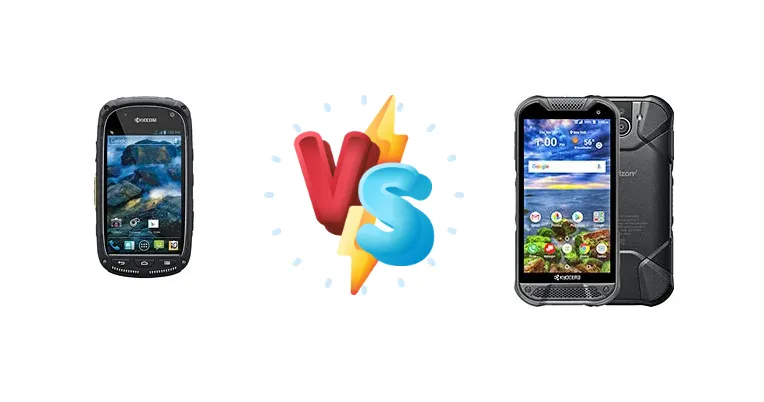
Kyocera has long been a stalwart in the rugged phone market, catering to professionals and outdoor enthusiasts. The Torque E6710, representing an older generation, offers a proven track record of durability. The DuraForce Pro 2, however, brings a more modern chipset and features like wireless charging to the table. This comparison dissects the key differences to determine which device best suits your needs.
🏆 Quick Verdict
For the average user prioritizing performance and modern features, the Kyocera DuraForce Pro 2 is the clear winner. Its Snapdragon 630 chipset offers a substantial performance leap over the Torque E6710’s Snapdragon S4 Plus, and the addition of Qi wireless charging adds convenience. However, the Torque E6710 remains a viable option for those on a tight budget or needing a very basic, reliable device.
| Network |
|---|
| 2G bands | CDMA 800 / 1900 | GSM 850 / 900 / 1800 / 1900 |
| 3G bands | CDMA2000 1xEV-DO | HSDPA 850 / 900 / 1900 / 2100 |
| 4G bands | 25 | 1, 2, 3, 4, 5, 7, 13, 66 |
| Speed | LTE Cat3 100/50 Mbps, EV-DO Rev.A 3.1 Mbps | HSPA 42.2/5.76 Mbps, LTE (3CA) Cat9 450/50 Mbps |
| Technology | CDMA / EVDO / LTE | GSM / HSPA / LTE |
| Launch |
|---|
| Announced | 2013, January. Released 2013, March | 2018, November. Released 2018, November |
| Status | Discontinued | Discontinued |
| Body |
|---|
| Dimensions | 128.5 x 68.4 x 12.9 mm (5.06 x 2.69 x 0.51 in) | 150.2 x 73.4 x 13.5 mm (5.91 x 2.89 x 0.53 in) |
| SIM | Non-removable | Nano-SIM |
| Weight | 168.5 g (5.93 oz) | 243 g (8.25 oz) |
| | IP67 dust/water resistant (up to 1m for 30 mins)
MIL-STD-810G compliant
IPX5, IPX7 certified
Flashlight | IP68 dust/water resistant (up to 2m for 30 mins)
MIL-STD-810G compliant
Push-to-talk button |
| Display |
|---|
| Protection | - Corning Gorilla Glass 2 | Sapphire crystal glass |
| Resolution | 480 x 800 pixels, 5:3 ratio (~233 ppi density) | 1080 x 1920 pixels, 16:9 ratio (~441 ppi density) |
| Size | 4.0 inches, 45.5 cm2 (~51.8% screen-to-body ratio) | 5.0 inches, 68.9 cm2 (~62.5% screen-to-body ratio) |
| Type | IPS LCD | IPS LCD |
| Platform |
|---|
| CPU | Dual-core 1.2 GHz Krait | Octa-core 2.2 GHz Cortex-A53 |
| Chipset | Qualcomm MSM8960 Snapdragon S4 Plus | Qualcomm SDM630 Snapdragon 630 (14 nm) |
| GPU | Adreno 225 | Adreno 508 |
| OS | Android 4.0.4 (Ice Cream Sandwich) | Android 8.0 (Oreo) |
| Memory |
|---|
| Card slot | microSDHC (dedicated slot) | microSDXC (dedicated slot) |
| Internal | 4GB (1GB user available), 1GB RAM | 64GB 4GB RAM |
| Main Camera |
|---|
| Features | LED flash, HDR | LED flash, HDR, panorama |
| Single | 5 MP, AF | 13 MP, AF
8 MP (ultra wide; dedicated video camera) |
| Video | 1080p@30fps | 4K@30fps, 1080p@30fps |
| Selfie camera |
|---|
| Single | 1.3 MP | 5 MP |
| Sound |
|---|
| 3.5mm jack | Yes | Yes |
| 35mm jack | Yes | Yes |
| Loudspeaker | Yes | Yes, with stereo speakers |
| Comms |
|---|
| Bluetooth | 4.0, A2DP, EDR, LE | 5.0, A2DP, LE |
| NFC | Yes | Yes |
| Positioning | GPS | GPS |
| Radio | No | No |
| USB | microUSB 2.0 | USB Type-C 3.1 |
| WLAN | Wi-Fi 802.11 b/g/n, hotspot | Wi-Fi 802.11 a/b/g/n/ac/i/r/k, dual-band, Wi-Fi Direct |
| Features |
|---|
| Sensors | Accelerometer, proximity, compass | Fingerprint (side-mounted), accelerometer, gyro, proximity, compass, barometer |
| Battery |
|---|
| Charging | - | 10W wired
Wireless (Qi) |
| Stand-by | - | Up to 312 h (3G) |
| Talk time | Up to 19 h | Up to 21 h (3G) |
| Type | Li-Ion 2500 mAh, removable | Li-Ion 3240 mAh, non-removable |
| Misc |
|---|
| Colors | Black | Black |
| Price | About 270 EUR | About 400 EUR |
Kyocera Torque E6710
- Lower price point (likely)
- Proven rugged durability
- Simple and reliable operation
- Outdated processor
- Limited performance
- No wireless charging
Kyocera DuraForce Pro 2
- Significantly faster processor
- Wireless (Qi) charging
- Improved power efficiency
- Higher price point
- May have similar ruggedness to older model
- Potentially larger size/weight
Display Comparison
Display specifications are not provided for either device. However, given the target market, both likely utilize LCD panels prioritizing visibility in direct sunlight over color accuracy. The DuraForce Pro 2, being a newer model, may benefit from improved viewing angles and potentially higher peak brightness. The Torque E6710, due to its age, likely has larger bezels, impacting the screen-to-body ratio.
Camera Comparison
Camera details are limited. It’s safe to assume both phones prioritize functionality over photographic excellence. The DuraForce Pro 2 likely benefits from improved image processing capabilities inherent in the newer Snapdragon 630 chipset. While sensor sizes and apertures are unknown, the newer device likely has a more capable camera system, even if resolution remains similar. The presence of any image stabilization (OIS or EIS) is unknown for both devices, but would be a significant advantage for the DuraForce Pro 2.
Performance
The performance gap between the Qualcomm MSM8960 Snapdragon S4 Plus in the Torque E6710 and the Qualcomm SDM630 Snapdragon 630 in the DuraForce Pro 2 is significant. The S4 Plus, with its dual-core 1.2 GHz Krait architecture, is a generation behind. The SDM630’s octa-core 2.2 GHz Cortex-A53 configuration provides substantially improved multi-tasking and app loading speeds. The 14nm manufacturing process of the SDM630 also contributes to better power efficiency, potentially leading to longer battery life under load. Users needing to run multiple apps or demanding applications will find the DuraForce Pro 2 far more responsive.
Battery Life
Battery capacity is not specified for either device. However, the Snapdragon 630’s improved power efficiency in the DuraForce Pro 2 likely translates to longer real-world battery life, even if the Torque E6710 has a slightly larger battery. The DuraForce Pro 2’s 10W wired charging and Qi wireless charging capabilities offer significant convenience, allowing for flexible charging options. The Torque E6710 is limited to wired charging, and likely at a slower rate.
Buying Guide
Buy the Kyocera Torque E6710 if you need an extremely affordable, durable phone for basic communication and limited app usage, and aren't concerned with performance or modern features. Buy the Kyocera DuraForce Pro 2 if you prefer a significantly faster processor for multitasking and app responsiveness, require wireless charging, and value a more contemporary user experience, even within the rugged phone category.
Frequently Asked Questions
❓ Is the Snapdragon 630 in the DuraForce Pro 2 powerful enough for demanding work apps like CAD viewers or remote desktop clients?
The Snapdragon 630 is a capable mid-range processor. While it won't match flagship performance, it should handle most common work apps, including basic CAD viewers and remote desktop clients, with reasonable responsiveness. However, extremely complex models or high-resolution remote sessions may experience some lag.
❓ How does the ruggedness of the DuraForce Pro 2 compare to the Torque E6710, considering the E6710 has a longer history in the rugged market?
Both phones are built to withstand harsh conditions, meeting MIL-STD-810G standards. While the Torque E6710 has a longer track record, Kyocera consistently maintains high ruggedness standards across its DuraForce line. The DuraForce Pro 2 likely incorporates updated sealing and impact resistance technologies, potentially offering slightly improved protection.
❓ Does the DuraForce Pro 2 support fast charging beyond the 10W wired charging?
No, the DuraForce Pro 2 is limited to 10W wired charging. While it does offer the convenience of Qi wireless charging, the wired charging speed is relatively slow compared to modern smartphones. Expect a longer charge time from 0-100% compared to phones supporting Quick Charge or Power Delivery.