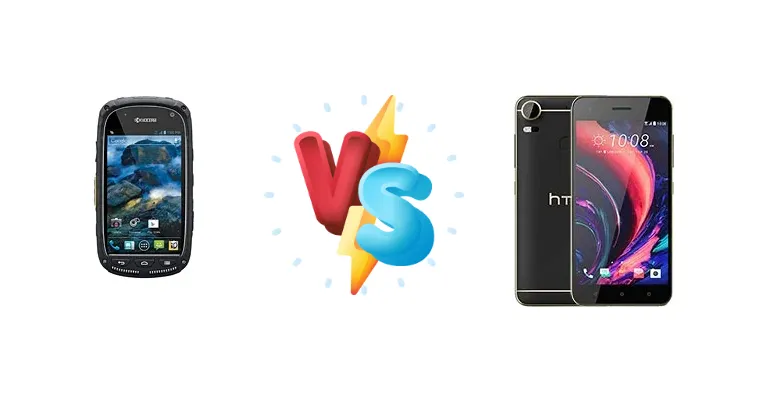
Released around the same timeframe, the Kyocera Torque E6710 and HTC Desire 10 Pro represent different approaches to the mid-range Android market. The Torque prioritizes durability and a focused user experience, while the Desire 10 Pro aims for a more feature-rich, multimedia-focused package. This comparison dissects their core components to determine which device delivers the best value.
🏆 Quick Verdict
For the average user prioritizing everyday tasks and multimedia consumption, the HTC Desire 10 Pro is the better choice. Its octa-core Helio P10 chipset provides significantly more processing power than the Kyocera Torque E6710’s dual-core Snapdragon S4 Plus. However, users needing extreme durability and a simpler experience will find the Torque more suitable.
| Network |
|---|
| 2G bands | CDMA 800 / 1900 | GSM 850 / 900 / 1800 / 1900 - SIM 1 & SIM 2 |
| 3G bands | CDMA2000 1xEV-DO | HSDPA 850 / 900 / 1900 / 2100 |
| 4G bands | 25 | 1, 3, 5, 7, 8, 20, 28, 38, 40 |
| Speed | LTE Cat3 100/50 Mbps, EV-DO Rev.A 3.1 Mbps | HSPA 42.2/5.76 Mbps, LTE (2CA) Cat6 300/50 Mbps |
| Technology | CDMA / EVDO / LTE | GSM / HSPA / LTE |
| Launch |
|---|
| Announced | 2013, January. Released 2013, March | 2016, September 20. Released 2016, December 20 |
| Status | Discontinued | Discontinued |
| Body |
|---|
| Build | - | Glass front (Gorilla Glass), aluminum back, aluminum frame |
| Dimensions | 128.5 x 68.4 x 12.9 mm (5.06 x 2.69 x 0.51 in) | 156.5 x 76 x 7.9 mm (6.16 x 2.99 x 0.31 in) |
| SIM | Non-removable | Nano-SIM + Nano-SIM |
| Weight | 168.5 g (5.93 oz) | 165 g (5.82 oz) |
| | IP67 dust/water resistant (up to 1m for 30 mins)
MIL-STD-810G compliant
IPX5, IPX7 certified
Flashlight | - |
| Display |
|---|
| Protection | - Corning Gorilla Glass 2 | Corning Gorilla Glass (unspecified version) |
| Resolution | 480 x 800 pixels, 5:3 ratio (~233 ppi density) | 1080 x 1920 pixels, 16:9 ratio (~400 ppi density) |
| Size | 4.0 inches, 45.5 cm2 (~51.8% screen-to-body ratio) | 5.5 inches, 83.8 cm2 (~70.5% screen-to-body ratio) |
| Type | IPS LCD | IPS LCD |
| Platform |
|---|
| CPU | Dual-core 1.2 GHz Krait | Octa-core (4x1.8 GHz Cortex-A53 & 4x1.0 GHz Cortex-A53) |
| Chipset | Qualcomm MSM8960 Snapdragon S4 Plus | Mediatek MT6755 Helio P10 (28 nm) |
| GPU | Adreno 225 | Mali-T860MP2 |
| OS | Android 4.0.4 (Ice Cream Sandwich) | Android 6.0 (Marshmallow) |
| Memory |
|---|
| Card slot | microSDHC (dedicated slot) | microSDXC (uses shared SIM slot) |
| Internal | 4GB (1GB user available), 1GB RAM | 64GB 4GB RAM |
| | - | eMMC 5.1 |
| Main Camera |
|---|
| Features | LED flash, HDR | Laser AF, Dual-LED dual-tone flash, panorama |
| Single | 5 MP, AF | 20 MP, f/2.2, 28mm (wide) |
| Video | 1080p@30fps | 1080p@30fps |
| Selfie camera |
|---|
| Features | - | HDR |
| Single | 1.3 MP | 13 MP, f/2.2, 28mm (wide), 1/3.1", 1.12µm |
| Video | - | 1080p@30fps |
| Sound |
|---|
| 3.5mm jack | Yes | Yes |
| 35mm jack | Yes | Yes |
| Loudspeaker | Yes | Yes, dual mono speakers |
| Comms |
|---|
| Bluetooth | 4.0, A2DP, EDR, LE | 4.2, A2DP, LE |
| NFC | Yes | Yes |
| Positioning | GPS | GPS, GLONASS |
| Radio | No | FM radio |
| USB | microUSB 2.0 | microUSB 2.0 |
| WLAN | Wi-Fi 802.11 b/g/n, hotspot | Wi-Fi 802.11 a/b/g/n, dual-band, Wi-Fi Direct |
| Features |
|---|
| Sensors | Accelerometer, proximity, compass | Fingerprint (rear-mounted), accelerometer, gyro, proximity, compass |
| Battery |
|---|
| Charging | - | 10W wired |
| Music play | - | Up to 53 h |
| Stand-by | - | Up to 480 h (3G) |
| Talk time | Up to 19 h | Up to 19 h (3G) |
| Type | Li-Ion 2500 mAh, removable | Li-Ion 3000 mAh, non-removable |
| Misc |
|---|
| Colors | Black | Stone Black, Polar White, Royal Blue, Valentine Lux, Mint Green |
| Models | - | Desire 10 pro, D10i |
| Price | About 270 EUR | About 260 EUR |
Kyocera Torque E6710
- Ruggedized design for enhanced durability
- Simpler user experience, potentially less bloatware
- Lower power consumption potentially leading to longer battery life
- Significantly slower processor
- Outdated chipset architecture
- Likely inferior camera performance
HTC Desire 10 Pro
- Faster octa-core processor for smoother performance
- More versatile for multitasking and demanding apps
- Potentially better camera quality
- Less durable design
- Less efficient chipset potentially impacting battery life
- Slower 10W charging
Display Comparison
Neither device boasts a standout display. Given the context of their release, we can assume both likely feature 720p panels. The Desire 10 Pro, being positioned slightly higher in the market, likely has a marginally better panel in terms of color accuracy and viewing angles. However, neither is expected to compete with modern OLED or high-refresh-rate LCDs. Bezels are likely substantial on both, typical for the era.
Camera Comparison
Without specific camera specs beyond the existence of cameras, it’s difficult to make a definitive statement. However, the Desire 10 Pro, being a more feature-rich device, likely has a higher-resolution main sensor and potentially more advanced image processing capabilities. The Kyocera Torque E6710 likely prioritizes functionality over image quality, focusing on capturing usable images in challenging conditions rather than artistic flair. The inclusion of a 2MP macro camera on the Desire 10 Pro is likely a marketing gimmick, offering limited real-world benefit.
Performance
The performance gap is the most significant differentiator. The Kyocera Torque E6710’s Qualcomm MSM8960 Snapdragon S4 Plus, with its dual-core 1.2 GHz Krait CPU, is demonstrably slower than the HTC Desire 10 Pro’s MediaTek MT6755 Helio P10. The Helio P10’s octa-core configuration (4x1.8 GHz Cortex-A53 & 4x1.0 GHz Cortex-A53) allows for better multitasking and smoother performance in demanding applications. The Cortex-A53 architecture, while not cutting-edge, is significantly more efficient and capable than the Krait cores in the Snapdragon S4 Plus. This translates to faster app loading times and a more responsive user interface on the Desire 10 Pro. Thermal management is less of a concern on the Torque due to its lower power draw, but this comes at the cost of performance.
Battery Life
Battery capacity is unknown for both devices. However, the Helio P10’s 28nm process node is less efficient than more modern chipsets. The Snapdragon S4 Plus, while older, may offer comparable or even slightly better battery life due to its lower power consumption. The Desire 10 Pro’s 10W wired charging is slow by today’s standards, but was typical for the time. Without knowing the battery capacities, it’s difficult to determine which device offers superior real-world battery performance, but the lower power draw of the Torque could give it an edge.
Buying Guide
Buy the Kyocera Torque E6710 if you need a rugged, dependable device for demanding work environments or outdoor activities where drops and impacts are common. Its focus on durability outweighs its performance limitations. Buy the HTC Desire 10 Pro if you prefer a more versatile smartphone for everyday use, social media, and light gaming, and value a more modern processor and faster performance.
Frequently Asked Questions
❓ Is the MediaTek Helio P10 prone to overheating during extended gaming sessions?
While the Helio P10 isn't a flagship processor, it's unlikely to experience severe overheating during moderate gaming. However, prolonged, graphically intensive games may lead to thermal throttling, reducing performance to prevent damage. The Kyocera Torque E6710, with its less powerful Snapdragon S4 Plus, will likely run cooler but offer a significantly less enjoyable gaming experience.
❓ How does the ruggedized design of the Kyocera Torque E6710 impact its size and weight compared to the HTC Desire 10 Pro?
The Kyocera Torque E6710’s ruggedized design necessitates a thicker and heavier build to accommodate the reinforced chassis and protective elements. The HTC Desire 10 Pro, lacking these features, is likely slimmer and lighter, making it more comfortable to hold and carry for extended periods. This trade-off is central to the Torque’s appeal – durability comes at the cost of portability.
❓ Can the HTC Desire 10 Pro be used for basic photo editing, or is the processor too limited?
The Helio P10 in the Desire 10 Pro is capable of handling basic photo editing tasks, such as cropping, adjusting brightness and contrast, and applying simple filters. However, more complex edits or working with large image files may be slow and laggy. It's suitable for casual editing but not for professional-level work.