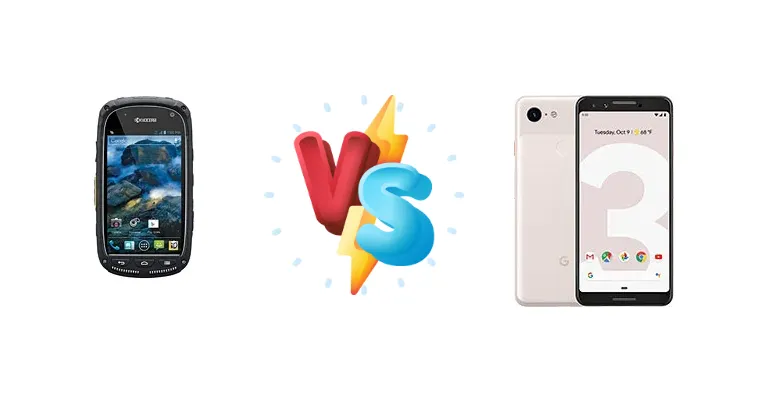
The Kyocera Torque E6710 and Google Pixel 3 represent vastly different philosophies in smartphone design. The Torque prioritizes extreme durability for demanding work environments, while the Pixel 3 aimed to deliver a flagship experience centered around computational photography and a clean Android interface. This comparison dissects their core differences, helping you determine which device best suits your needs.
🏆 Quick Verdict
For the average user prioritizing camera quality, smooth performance, and software updates, the Google Pixel 3 is the clear winner. However, if your work or lifestyle demands a virtually indestructible phone, the Kyocera Torque E6710 offers a level of ruggedness the Pixel 3 simply cannot match.
| Network |
|---|
| 2G bands | CDMA 800 / 1900 | GSM 850 / 900 / 1800 / 1900 |
| 3G bands | CDMA2000 1xEV-DO | HSDPA 850 / 900 / 1700(AWS) / 1900 / 2100 |
| 4G bands | 25 | 1, 2, 3, 4, 5, 7, 8, 12, 13, 17, 18, 19, 20, 25, 26, 28, 29, 32, 38, 39, 40, 41, 42, 46, 66, 71 |
| Speed | LTE Cat3 100/50 Mbps, EV-DO Rev.A 3.1 Mbps | HSPA 42.2/5.76 Mbps, LTE (5CA) Cat16 1024/75 Mbps |
| Technology | CDMA / EVDO / LTE | GSM / CDMA / HSPA / EVDO / LTE |
| Launch |
|---|
| Announced | 2013, January. Released 2013, March | 2018, October 09. Released 2018, October 18 |
| Status | Discontinued | Discontinued |
| Body |
|---|
| Build | - | Glass front (Gorilla Glass 5), glass back (Gorilla Glass 5), aluminum frame |
| Dimensions | 128.5 x 68.4 x 12.9 mm (5.06 x 2.69 x 0.51 in) | 145.6 x 68.2 x 7.9 mm (5.73 x 2.69 x 0.31 in) |
| SIM | Non-removable | Nano-SIM + eSIM |
| Weight | 168.5 g (5.93 oz) | 148 g (5.22 oz) |
| | IP67 dust/water resistant (up to 1m for 30 mins)
MIL-STD-810G compliant
IPX5, IPX7 certified
Flashlight | - |
| Display |
|---|
| Protection | - Corning Gorilla Glass 2 | Corning Gorilla Glass 5 |
| Resolution | 480 x 800 pixels, 5:3 ratio (~233 ppi density) | 1080 x 2160 pixels, 18:9 ratio (~443 ppi density) |
| Size | 4.0 inches, 45.5 cm2 (~51.8% screen-to-body ratio) | 5.5 inches, 76.7 cm2 (~77.2% screen-to-body ratio) |
| Type | IPS LCD | P-OLED, HDR |
| Platform |
|---|
| CPU | Dual-core 1.2 GHz Krait | Octa-core (4x2.5 GHz Kryo 385 Gold & 4x1.6 GHz Kryo 385 Silver) |
| Chipset | Qualcomm MSM8960 Snapdragon S4 Plus | Qualcomm SDM845 Snapdragon 845 (10 nm) |
| GPU | Adreno 225 | Adreno 630 |
| OS | Android 4.0.4 (Ice Cream Sandwich) | Android 9.0 (Pie), upgradable to Android 12 |
| Memory |
|---|
| Card slot | microSDHC (dedicated slot) | No |
| Internal | 4GB (1GB user available), 1GB RAM | 64GB 4GB RAM, 128GB 4GB RAM |
| Main Camera |
|---|
| Features | LED flash, HDR | Dual-LED flash, Pixel Shift, Auto-HDR, panorama |
| Single | 5 MP, AF | 12.2 MP, f/1.8, 28mm (wide), 1/2.55", 1.4µm, dual pixel PDAF, OIS |
| Video | 1080p@30fps | 4K@30fps, 1080p@30/60/120fps, 1080p@30fps (gyro-EIS) |
| Selfie camera |
|---|
| Dual | - | 8 MP, f/1.8, 28mm (wide), PDAF
8 MP, f/2.2, 19mm (ultrawide), no AF |
| Features | - | HDR |
| Single | 1.3 MP | - |
| Video | - | 1080p@30fps |
| Sound |
|---|
| 3.5mm jack | Yes | No |
| 35mm jack | Yes | No |
| Loudspeaker | Yes | Yes, with stereo speakers |
| Comms |
|---|
| Bluetooth | 4.0, A2DP, EDR, LE | 5.0, A2DP, LE, aptX HD |
| NFC | Yes | Yes |
| Positioning | GPS | GPS, GLONASS, BDS, GALILEO |
| Radio | No | No |
| USB | microUSB 2.0 | USB Type-C 3.1 |
| WLAN | Wi-Fi 802.11 b/g/n, hotspot | Wi-Fi 802.11 a/b/g/n/ac, dual-band, Wi-Fi Direct, DLNA |
| Features |
|---|
| Sensors | Accelerometer, proximity, compass | Fingerprint (rear-mounted), accelerometer, gyro, proximity, compass, barometer |
| Battery |
|---|
| Charging | - | 18W wired, PD2.0
Wireless |
| Talk time | Up to 19 h | - |
| Type | Li-Ion 2500 mAh, removable | Li-Po 2915 mAh, non-removable |
| Misc |
|---|
| Colors | Black | Clearly White, Just Black, Not Pink |
| Models | - | G013A |
| Price | About 270 EUR | About 450 EUR |
| Tests |
|---|
| Audio quality | - |
Noise -71.7dB / Crosstalk -70.1dB |
| Battery life | - | Endurance rating 69h |
| Camera | - |
Photo / Video |
| Display | - |
Contrast ratio: Infinite (nominal), 4.350 (sunlight) |
| Loudspeaker | - |
Voice 77dB / Noise 71dB / Ring 81dB |
| Performance | - |
AnTuTu: 285044 (v7)
GeekBench: 8337 (v4.4)
GFXBench: 33fps (ES 3.1 onscreen) |
Kyocera Torque E6710
- Extremely durable and rugged design
- Built to withstand harsh environments
- Potentially longer software support due to simpler OS
- Significantly slower processor
- Outdated chipset and limited performance
- Inferior camera quality
Google Pixel 3
- Powerful Snapdragon 845 processor
- Excellent camera with computational photography
- Fast charging and wireless charging support
- Less durable design
- Older device with potentially limited software updates
- More susceptible to damage from drops and water
Display Comparison
The Pixel 3 boasts an 'infinite' (nominal) contrast ratio and a 4.350 contrast ratio in sunlight, suggesting excellent visibility even outdoors. While the Torque's display specifications are unavailable, its focus on durability likely means a simpler, less color-accurate panel. The Pixel 3's display technology, though older, offers a significantly better viewing experience for media consumption and photo review, crucial given its camera prowess. The Pixel 3's smaller 5.5-inch screen size also contributes to a more pocketable form factor.
Camera Comparison
Both phones offer photo and video capabilities, but the Pixel 3’s camera is in a different league. While specific sensor details are missing for the Torque, its focus on ruggedness suggests a less sophisticated camera system. The Pixel 3 was renowned for its computational photography, leveraging Google’s image processing algorithms to produce exceptional image quality, particularly in low-light conditions. The Pixel 3’s camera excels in dynamic range and detail, making it ideal for capturing memories. The Torque’s camera is likely adequate for basic documentation but won’t compete with the Pixel 3’s photographic capabilities.
Performance
The performance gap between these devices is substantial. The Google Pixel 3’s Qualcomm SDM845 Snapdragon 845, built on a 10nm process, features an octa-core CPU (4x2.5 GHz Kryo 385 Gold & 4x1.6 GHz Kryo 385 Silver) delivering significantly faster processing speeds and improved efficiency compared to the Kyocera Torque E6710’s dual-core 1.2 GHz Krait processor based on the older Snapdragon S4 Plus. This translates to smoother multitasking, faster app loading times, and a more responsive user experience on the Pixel 3. The Pixel 3 is capable of handling demanding applications and games, while the Torque E6710 will struggle with anything beyond basic tasks.
Battery Life
Interestingly, both devices share an endurance rating of 69 hours. However, this doesn't tell the whole story. The Pixel 3 supports 18W wired charging with PD2.0 and wireless charging, offering convenient and relatively fast replenishment. The Torque’s charging capabilities are unknown, but likely slower and limited to wired charging. The Snapdragon 845 in the Pixel 3 is more power-efficient than the Snapdragon S4 Plus in the Torque, meaning the Pixel 3 can maintain its battery life while delivering significantly more performance.
Buying Guide
Buy the Kyocera Torque E6710 if you need a phone that can withstand drops, dust, and water exposure in harsh conditions – construction sites, outdoor work, or active lifestyles. Buy the Google Pixel 3 if you prioritize a superior camera experience, responsive performance for everyday tasks, and a streamlined software experience with timely updates, even acknowledging its age.
Frequently Asked Questions
❓ Is the Kyocera Torque E6710 a good choice for construction workers or outdoor professionals?
Absolutely. The Torque E6710 is specifically designed for these users. Its rugged construction can withstand drops, dust, water, and extreme temperatures, making it a reliable tool on the job site. However, be prepared for significantly slower performance compared to modern smartphones.
❓ Can the Google Pixel 3 still receive software updates in 2024?
Official software updates from Google have ended for the Pixel 3. However, the active Android developer community means custom ROMs are available, allowing users to extend the device's lifespan and potentially receive security updates. Be aware that installing custom ROMs voids the warranty and requires technical expertise.
❓ How does the Snapdragon S4 Plus in the Torque E6710 handle modern apps like TikTok or Instagram?
The Snapdragon S4 Plus will struggle with modern, resource-intensive apps like TikTok and Instagram. Expect slow loading times, laggy performance, and potential crashes. These apps are optimized for much more powerful processors, and the Torque E6710 simply lacks the processing power to run them smoothly.
❓ Is the Pixel 3's battery life still acceptable for daily use?
While the Pixel 3's battery life is rated at 69 hours of endurance, real-world usage will vary. With moderate use, it should last a full day. However, heavy users may need to top up the battery during the day, especially given the battery's age. The 18W fast charging helps mitigate this.