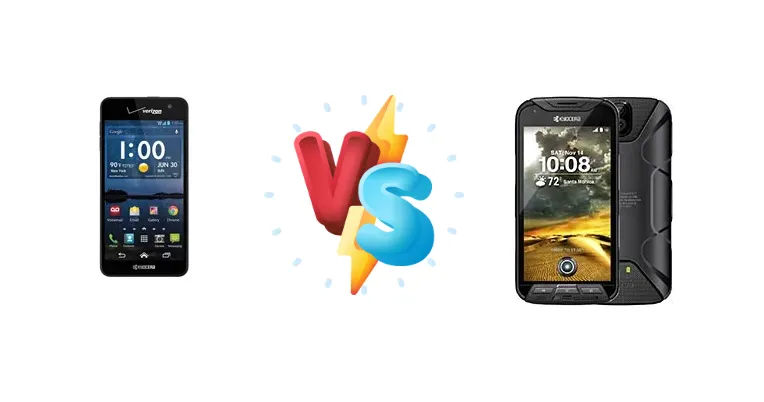
Kyocera carved a niche with durable, work-focused smartphones. The Hydro Elite, representing an earlier generation, prioritizes affordability, while the DuraForce Pro aims for a more modern experience with a newer chipset and faster charging. This comparison dissects the core differences to determine which device best suits demanding users.
🏆 Quick Verdict
For most users needing a reliable, rugged phone, the Kyocera DuraForce Pro is the better choice. Its octa-core Snapdragon 617 offers significantly improved multi-tasking and application performance compared to the Hydro Elite’s dual-core Snapdragon S4 Plus, and the inclusion of Quick Charge 2.0 is a practical benefit.
| Network |
|---|
| 2G bands | CDMA 800 / 1900 | GSM 850 / 900 / 1800 / 1900 |
| 3G bands | CDMA2000 1xEV-DO | HSDPA 850 / 900 / 1700(AWS) / 1900 / 2100 |
| 4G bands | LTE | 2, 4, 5, 12, 25, 26, 41 |
| Speed | HSPA, LTE Cat3 100/50 Mbps, EV-DO Rev.A 3.1 Mbps | HSPA 42.2/5.76 Mbps, LTE (2CA) Cat6 300/50 Mbps |
| Technology | GSM / CDMA / EVDO / LTE | GSM / HSPA / LTE |
| | HSDPA | - |
| Launch |
|---|
| Announced | 2013, Q3. Released 2013, Q3 | 2016, August. Released 2016, October |
| Status | Discontinued | Discontinued |
| Body |
|---|
| Dimensions | 122.4 x 60.4 x 10.8 mm (4.82 x 2.38 x 0.43 in) | 148.4 x 73.4 x 12.9 mm (5.84 x 2.89 x 0.51 in) |
| SIM | Yes | Nano-SIM |
| Weight | 128 g (4.52 oz) | 230 g (8.11 oz) |
| | IP57 dust/water resistant (up to 1m. and 30 min)
MIL-STD-810G compliant salt, dust, humidity, rain, vibration, solar radiation, transport and thermal shock resistant. | IP68 dust/water resistant (up to 1.5m for 30 mins)
MIL-STD-810G compliant
Push-to-talk button |
| Display |
|---|
| Protection | Yes | Yes |
| Resolution | 720 x 1280 pixels, 16:9 ratio (~342 ppi density) | 1080 x 1920 pixels, 16:9 ratio (~441 ppi density) |
| Size | 4.3 inches, 51.0 cm2 (~68.9% screen-to-body ratio) | 5.0 inches, 68.9 cm2 (~63.3% screen-to-body ratio) |
| Type | IPS LCD | IPS LCD |
| Platform |
|---|
| CPU | Dual-core 1.5 GHz Krait | Octa-core (4x1.5 GHz Cortex-A53 & 4x1.2 GHz Cortex-A53) |
| Chipset | Qualcomm MSM8960 Snapdragon S4 Plus | Qualcomm MSM8952 Snapdragon 617 (28 nm) |
| GPU | Adreno 225 | Adreno 405 |
| OS | Android 4.1.2 (Jelly Bean) | Android 6.0 (Marshmallow) |
| Memory |
|---|
| Card slot | microSDHC (dedicated slot) | microSDXC (dedicated slot) |
| Internal | 16GB 1.5GB RAM | 32GB 3GB RAM |
| | - | eMMC 5.1 |
| Main Camera |
|---|
| Features | LED flash, HDR, panorama | LED flash, HDR, panorama |
| Single | 8 MP, AF | 13 MP, AF
2 MP |
| Video | 1080p@30fps | 1080p@30fps |
| Selfie camera |
|---|
| Single | 1.3 MP | 5 MP |
| Sound |
|---|
| 3.5mm jack | Yes | Yes |
| 35mm jack | Yes | Yes |
| Loudspeaker | Yes | Yes, with stereo speakers |
| Comms |
|---|
| Bluetooth | 4.0, A2DP, EDR, LE | 4.2, A2DP, LE |
| NFC | Yes | Yes |
| Positioning | GPS | GPS |
| Radio | No | No |
| USB | microUSB 2.0 (MHL TV-out) | microUSB 2.0 |
| WLAN | Wi-Fi 802.11 a/b/g/n, dual-band, Wi-Fi Direct, DLNA | Wi-Fi 802.11 a/b/g/n/ac/i/r/k, dual-band, Wi-Fi Direct |
| Features |
|---|
| Sensors | Accelerometer, proximity, compass | Fingerprint (front-mounted), accelerometer, gyro, proximity, compass, barometer |
| Battery |
|---|
| Charging | - | 18W wired, QC2 |
| Stand-by | Up to 236 h | Up to 480 h (3G) |
| Talk time | Up to 13 h | Up to 19 h (3G) |
| Type | Li-Ion 2100 mAh, removable | Li-Ion 3240 mAh, non-removable |
| Misc |
|---|
| Colors | Black | Black |
| Models | - | E6810 |
Kyocera Hydro Elite
- Extremely durable build quality
- Lower price point
- Simple and easy to use
- Outdated processor
- Slow performance
- Likely slow charging
Kyocera DuraForce Pro
- Faster octa-core processor
- Quick Charge 2.0 support
- More modern software experience
- Potentially higher price
- May have similar battery capacity to Hydro Elite
- Still a basic camera system
Display Comparison
Display specifications are unavailable for both devices. However, given the target market, both likely utilize LCD panels optimized for outdoor visibility. The Hydro Elite, being an older model, likely has wider bezels. The DuraForce Pro, benefiting from later design trends, may offer a slightly more immersive experience. Color accuracy is unlikely to be a priority on either device, focusing instead on readability in harsh conditions.
Camera Comparison
Camera details are limited. Both phones likely feature basic camera setups geared towards functional documentation rather than high-quality photography. Without sensor size or aperture information, it’s difficult to make a direct comparison. However, the DuraForce Pro, being a newer device, likely benefits from improved image processing algorithms, potentially resulting in slightly better image quality in favorable lighting conditions. Any 2MP macro sensors on either device are likely to offer minimal practical benefit.
Performance
The core difference lies in the chipsets. The Kyocera Hydro Elite’s Qualcomm MSM8960 Snapdragon S4 Plus, with its dual-core 1.5 GHz Krait CPU, is significantly outmatched by the DuraForce Pro’s MSM8952 Snapdragon 617. The 617’s octa-core configuration (4x1.5 GHz Cortex-A53 & 4x1.2 GHz Cortex-A53) provides superior multi-tasking capabilities and a smoother experience with demanding applications. While both are 28nm chips, the architectural improvements in the Cortex-A53 cores and the increased core count translate to a noticeable performance advantage for the DuraForce Pro. The S4 Plus will struggle with modern app bloat and multitasking.
Battery Life
Battery capacity is not specified for either device. However, the DuraForce Pro’s inclusion of 18W wired charging with Quick Charge 2.0 (QC2) is a significant advantage. This allows for substantially faster charging times compared to the Hydro Elite, which likely relies on slower, standard charging. While a larger battery capacity is always preferable, the DuraForce Pro’s faster charging mitigates the impact of a potentially smaller battery, offering more uptime in a typical workday.
Buying Guide
Buy the Kyocera Hydro Elite if you need a basic, extremely durable phone for essential communication and are on a very tight budget. It’s ideal for situations where functionality trumps speed. Buy the Kyocera DuraForce Pro if you prioritize smoother performance for apps, faster charging, and a more modern processor for handling work tasks or occasional media consumption. It’s the better option for users who demand more from their device.
Frequently Asked Questions
❓ Is the Snapdragon 617 in the DuraForce Pro powerful enough for modern work apps like Microsoft Teams or Slack?
Yes, the Snapdragon 617’s octa-core architecture provides sufficient processing power for typical work applications like Microsoft Teams and Slack. While it won’t deliver flagship-level performance, it will handle these apps smoothly, unlike the dual-core Snapdragon S4 Plus in the Hydro Elite, which would likely struggle with multitasking.
❓ How does the ruggedization of the DuraForce Pro compare to the Hydro Elite? Are they both waterproof and dustproof?
Both the Hydro Elite and DuraForce Pro are designed to meet military-grade durability standards (likely MIL-STD-810G or similar). They are both expected to be waterproof and dustproof, but the specific IP rating may vary. The DuraForce Pro, being a newer model, may offer slightly improved protection against drops and impacts due to advancements in materials and construction techniques.
❓ Does the DuraForce Pro's Quick Charge 2.0 support work with any USB charger, or do I need a specific adapter?
Quick Charge 2.0 is backward compatible with standard USB chargers, but to achieve the full 18W charging speed, you'll need a charger that specifically supports the Quick Charge 2.0 protocol. Using a standard charger will still charge the device, but at a slower rate.