
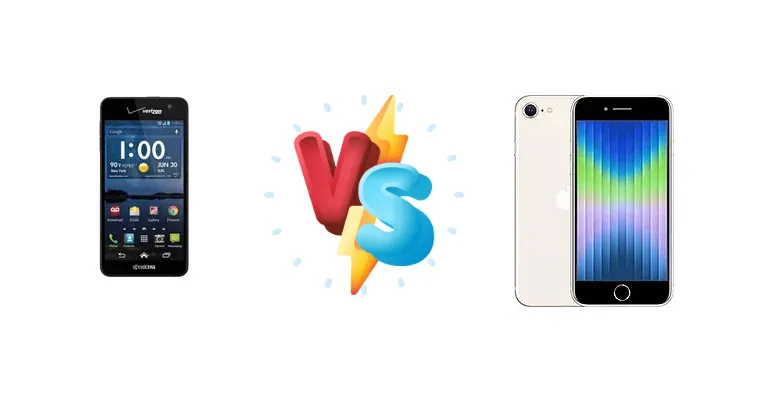
Kyocera Hydro Elite vs. Apple iPhone SE (2022): A Generational Leap in Performance
| Phones Images | |||||
|---|---|---|---|---|---|
|
🏆 Quick Verdict
For the vast majority of users, the Apple iPhone SE (2022) is the clear winner. Its A15 Bionic chip delivers exponentially faster performance, a significantly brighter display, and comparable battery endurance despite a smaller battery capacity. The Hydro Elite’s primary appeal lies in its ruggedness and extremely low price point, making it suitable only for very specific use cases.
| PHONES | ||
|---|---|---|
| Phone Names | Kyocera Hydro Elite | Apple iPhone SE (2022) |
| Network | ||
|---|---|---|
| 2G bands | CDMA 800 / 1900 | GSM 850 / 900 / 1800 / 1900 |
| 3G bands | CDMA2000 1xEV-DO | HSDPA 850 / 900 / 1700(AWS) / 1900 / 2100 |
| 4G bands | LTE | 1, 2, 3, 4, 5, 7, 8, 12, 13, 17, 18, 19, 20, 25, 26, 28, 30, 32, 34, 38, 39, 40, 41, 42, 46, 48, 66 - A2783, A2784, A2785 |
| 5G bands | - | 1, 2, 3, 5, 7, 8, 12, 20, 25, 28, 30, 38, 40, 41, 48, 66, 77, 78, 79 SA/NSA/Sub6 - A2783, A2784, A2785, A2782 |
| Speed | HSPA, LTE Cat3 100/50 Mbps, EV-DO Rev.A 3.1 Mbps | HSPA, LTE, 5G, EV-DO Rev.A 3.1 Mbps |
| Technology | GSM / CDMA / EVDO / LTE | GSM / CDMA / HSPA / EVDO / LTE / 5G |
| HSDPA | 1, 2, 3, 5, 7, 8, 12, 20, 25, 28, 29, 30, 38, 40, 41, 48, 66, 71, 77, 78, 79 SA/NSA/Sub6 - A2595 | |
| Launch | ||
|---|---|---|
| Announced | 2013, Q3. Released 2013, Q3 | 2022, March 08 |
| Status | Discontinued | Available. Released 2022, March 18 |
| Body | ||
|---|---|---|
| Build | - | Glass front, glass back, aluminum frame |
| Dimensions | 122.4 x 60.4 x 10.8 mm (4.82 x 2.38 x 0.43 in) | 138.4 x 67.3 x 7.3 mm (5.45 x 2.65 x 0.29 in) |
| SIM | Yes | Nano-SIM + eSIM |
| Weight | 128 g (4.52 oz) | 144 g (5.08 oz) |
| IP57 dust/water resistant (up to 1m. and 30 min) MIL-STD-810G compliant salt, dust, humidity, rain, vibration, solar radiation, transport and thermal shock resistant. | IP67 dust/water resistant (up to 1m for 30 min) Apple Pay (Visa, MasterCard, AMEX certified) | |
| Display | ||
|---|---|---|
| Protection | Yes | Ion-strengthened glass |
| Resolution | 720 x 1280 pixels, 16:9 ratio (~342 ppi density) | 750 x 1334 pixels, 16:9 ratio (~326 ppi density) |
| Size | 4.3 inches, 51.0 cm2 (~68.9% screen-to-body ratio) | 4.7 inches, 60.9 cm2 (~65.4% screen-to-body ratio) |
| Type | IPS LCD | Retina IPS LCD, 625 nits (typ) |
| Platform | ||
|---|---|---|
| CPU | Dual-core 1.5 GHz Krait | Hexa-core (2x3.22 GHz Avalanche + 4x1.82 GHz Blizzard) |
| Chipset | Qualcomm MSM8960 Snapdragon S4 Plus | Apple A15 Bionic (5 nm) |
| GPU | Adreno 225 | Apple GPU (4-core graphics) |
| OS | Android 4.1.2 (Jelly Bean) | iOS 15.4, upgradable to iOS 26.1 |
| Memory | ||
|---|---|---|
| Card slot | microSDHC (dedicated slot) | No |
| Internal | 16GB 1.5GB RAM | 64GB 4GB RAM, 128GB 4GB RAM, 256GB 4GB RAM |
| - | NVMe | |
| Main Camera | ||
|---|---|---|
| Features | LED flash, HDR, panorama | Quad-LED dual-tone flash, HDR, panorama |
| Single | 8 MP, AF | 12 MP, f/1.8 (wide), PDAF, OIS |
| Video | 1080p@30fps | 4K@24/30/60fps, 1080p@30/60/120/240fps, HDR, OIS, stereo sound rec. |
| Selfie camera | ||
|---|---|---|
| Features | - | HDR |
| Single | 1.3 MP | 7 MP, f/2.2 |
| Video | - | 1080p@30/120fps; gyro-EIS |
| Sound | ||
|---|---|---|
| 3.5mm jack | Yes | No |
| 35mm jack | Yes | No |
| Loudspeaker | Yes | Yes, with stereo speakers |
| Comms | ||
|---|---|---|
| Bluetooth | 4.0, A2DP, EDR, LE | 5.0, A2DP, LE |
| NFC | Yes | Yes |
| Positioning | GPS | GPS, GLONASS, GALILEO, BDS, QZSS |
| Radio | No | No |
| USB | microUSB 2.0 (MHL TV-out) | Lightning, USB 2.0 |
| WLAN | Wi-Fi 802.11 a/b/g/n, dual-band, Wi-Fi Direct, DLNA | Wi-Fi 802.11 a/b/g/n/ac/6, dual-band, hotspot |
| Features | ||
|---|---|---|
| Sensors | Accelerometer, proximity, compass | Fingerprint (front-mounted), accelerometer, proximity, gyro, compass, barometer |
| Battery | ||
|---|---|---|
| Charging | - | 20W wired, 50% in 30 min 7.5W wireless (Qi) |
| Stand-by | Up to 236 h | - |
| Talk time | Up to 13 h | - |
| Type | Li-Ion 2100 mAh, removable | Li-Ion 2018 mAh (6.96 Wh) |
| Misc | ||
|---|---|---|
| Colors | Black | Midnight, Starlight, Red |
| Models | - | A2783, A2595, A2785, A2782, A2784, iphone14,6 |
| Price | - | $ 119.84 / C$ 199.99 / £ 142.00 / € 173.00 |
| SAR | - | 0.98 W/kg (head) 0.99 W/kg (body) |
| SAR EU | - | 1.20 W/kg (head) 1.19 W/kg (body) |
| Tests | ||
|---|---|---|
| Battery life | - | Endurance rating 62h |
| Camera | - | Photo / Video |
| Display | - | Contrast ratio: 1424:1 (nominal) |
| Loudspeaker | - | -25.2 LUFS (Very good) |
| Performance | - | AnTuTu: 723486 (v9) GeekBench: 4629 (v5.1) GFXBench: 60fps (ES 3.1 onscreen) |
Kyocera Hydro Elite
- Extremely affordable price point
- Rugged and waterproof design
- Simple and straightforward Android experience
- Outdated processor and limited performance
- Low-resolution display
- Poor camera quality
Apple iPhone SE (2022)
- Blazing-fast A15 Bionic performance
- Bright and clear display
- Excellent camera quality and image processing
- Relatively small display
- Older design with large bezels
- Higher price compared to the Hydro Elite
Display Comparison
The iPhone SE (2022) boasts a significantly more advanced display experience. While both share a 1424:1 contrast ratio, the iPhone SE’s measured peak brightness of 605 nits dwarfs the Hydro Elite’s likely lower output (typical of LCD panels from that era). The SE’s smaller size also contributes to a higher pixel density, resulting in a sharper image. The Hydro Elite’s display, while functional, will appear washed out and less vibrant in direct sunlight. The lack of information on the Hydro Elite’s PWM dimming rate raises concerns for users sensitive to flicker, a feature Apple actively manages on the SE.
Camera Comparison
Both devices offer photo and video capabilities, but the iPhone SE (2022) benefits from Apple’s superior image signal processing (ISP) and computational photography algorithms. While sensor sizes aren’t specified, the A15 Bionic’s ISP can extract significantly more detail and dynamic range from the camera sensor. The Hydro Elite’s camera, while adequate for basic snapshots, will likely exhibit noticeable noise and limited low-light performance. The iPhone SE’s video recording capabilities are also far superior, offering features like Cinematic mode and Dolby Vision HDR recording.
Performance
The performance gap is immense. The Kyocera Hydro Elite’s dual-core 1.5 GHz Snapdragon S4 Plus is a relic of 2012, built on a 28nm process. In contrast, the iPhone SE (2022)’s A15 Bionic, fabricated on a 5nm node, features a hexa-core CPU (2x3.22 GHz Avalanche + 4x1.82 GHz Blizzard). This translates to a multi-generational leap in processing power and efficiency. The A15’s Neural Engine also enables advanced features like computational photography and on-device machine learning, absent in the Hydro Elite. The Hydro Elite will struggle with modern apps and multitasking, while the iPhone SE handles demanding tasks with ease.
Battery Life
Interestingly, both devices share an endurance rating of 62 hours, suggesting comparable real-world battery life despite the significant power disparity. This is likely due to the A15 Bionic’s exceptional power efficiency. The iPhone SE (2022) supports 20W wired charging (50% in 30 minutes) and 7.5W wireless charging (Qi), offering significantly faster and more convenient charging options than the Hydro Elite, which likely relies on slower, older charging standards.
Buying Guide
Buy the Kyocera Hydro Elite if you absolutely require a highly durable, waterproof phone on an extremely limited budget and prioritize longevity over speed. It’s ideal for construction workers, outdoor enthusiasts, or as a reliable backup device. Buy the Apple iPhone SE (2022) if you prioritize performance, a modern iOS experience, a bright and clear display, and a capable camera – even in a compact form factor. It’s perfect for everyday use, gaming, and photography.