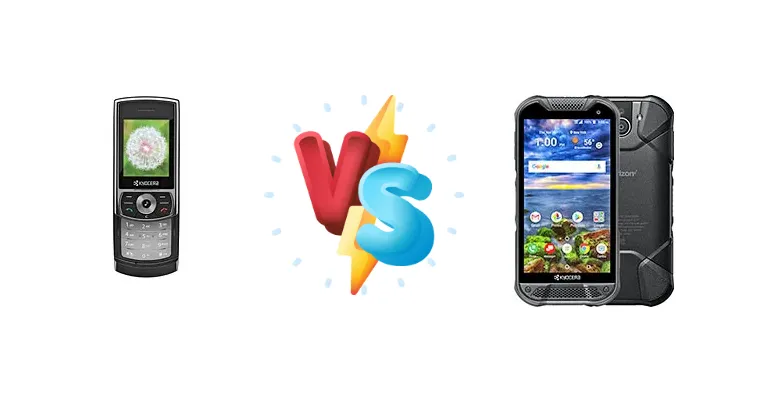
Kyocera has long been a stalwart in the rugged phone market, catering to professionals who demand durability. This comparison pits the Kyocera E4600 against the DuraForce Pro 2, examining how their features and specifications translate into real-world usability for demanding environments. While the E4600's specifics are limited in available data, we'll analyze it within the context of Kyocera's typical offerings and the Pro 2's known capabilities.
🏆 Quick Verdict
For users prioritizing a balance of modern features and ruggedness, the Kyocera DuraForce Pro 2 is the clear winner. Its Qualcomm Snapdragon 630 chipset provides a significant performance advantage, and the inclusion of Qi wireless charging adds convenience. The E4600, lacking detailed specifications, likely targets a more budget-conscious user.
| Network |
|---|
| 2G bands | GSM 850 / 900 / 1800 / 1900 | GSM 850 / 900 / 1800 / 1900 |
| 3G bands | - | HSDPA 850 / 900 / 1900 / 2100 |
| 4G bands | - | 1, 2, 3, 4, 5, 7, 13, 66 |
| EDGE | Class 10 | - |
| GPRS | Class 10 | - |
| Speed | - | HSPA 42.2/5.76 Mbps, LTE (3CA) Cat9 450/50 Mbps |
| Technology | GSM | GSM / HSPA / LTE |
| Launch |
|---|
| Announced | 2008, August. Released 2008, August | 2018, November. Released 2018, November |
| Status | Discontinued | Discontinued |
| Body |
|---|
| Dimensions | 103 x 51 x 15 mm (4.06 x 2.01 x 0.59 in) | 150.2 x 73.4 x 13.5 mm (5.91 x 2.89 x 0.53 in) |
| SIM | Mini-SIM | Nano-SIM |
| Weight | 85 g (3.00 oz) | 243 g (8.25 oz) |
| | Flashlight | IP68 dust/water resistant (up to 2m for 30 mins)
MIL-STD-810G compliant
Push-to-talk button |
| Display |
|---|
| Protection | - | Sapphire crystal glass |
| Resolution | 176 x 220 pixels (~128 ppi density) | 1080 x 1920 pixels, 16:9 ratio (~441 ppi density) |
| Size | 2.2 inches, 15.2 cm2 (~29.0% screen-to-body ratio) | 5.0 inches, 68.9 cm2 (~62.5% screen-to-body ratio) |
| Type | TFT, 65K colors | IPS LCD |
| Platform |
|---|
| CPU | - | Octa-core 2.2 GHz Cortex-A53 |
| Chipset | - | Qualcomm SDM630 Snapdragon 630 (14 nm) |
| GPU | - | Adreno 508 |
| OS | - | Android 8.0 (Oreo) |
| Memory |
|---|
| Call records | Yes | - |
| Card slot | microSD (dedicated slot) | microSDXC (dedicated slot) |
| Internal | - | 64GB 4GB RAM |
| Phonebook | Yes | - |
| Main Camera |
|---|
| Features | LED flash | LED flash, HDR, panorama |
| Single | 2 MP | 13 MP, AF
8 MP (ultra wide; dedicated video camera) |
| Video | Yes | 4K@30fps, 1080p@30fps |
| Selfie camera |
|---|
| Single | - | 5 MP |
| | No | - |
| Sound |
|---|
| 3.5mm jack | No | Yes |
| 35mm jack | No | Yes |
| Loudspeaker | Yes | Yes, with stereo speakers |
| Comms |
|---|
| Bluetooth | 2.0, A2DP | 5.0, A2DP, LE |
| NFC | - | Yes |
| Positioning | GPS | GPS |
| Radio | No | No |
| USB | miniUSB 2.0 | USB Type-C 3.1 |
| WLAN | No | Wi-Fi 802.11 a/b/g/n/ac/i/r/k, dual-band, Wi-Fi Direct |
| Features |
|---|
| Browser | WAP 2.0/xHTML | - |
| Games | Yes | - |
| Java | Yes, MIDP 2.0 | - |
| Messaging | SMS, MMS, Email, IM | - |
| Sensors | - | Fingerprint (side-mounted), accelerometer, gyro, proximity, compass, barometer |
| | MP3/WAV/AAC+ player
MP4/H.263 player
Organizer
Voice memo
Predictive text input | - |
| Battery |
|---|
| Charging | - | 10W wired
Wireless (Qi) |
| Stand-by | Up to 300 h | Up to 312 h (3G) |
| Talk time | Up to 4 h | Up to 21 h (3G) |
| Type | Removable Li-Ion 780 mAh battery | Li-Ion 3240 mAh, non-removable |
| Misc |
|---|
| Colors | Black | Black |
| Price | - | About 400 EUR |
Kyocera E4600
- Likely extremely durable build quality
- Potentially lower price point
- Simple and easy to use interface
- Limited performance capabilities
- Lack of detailed specifications
- Likely outdated software support
Kyocera DuraForce Pro 2
- Qualcomm Snapdragon 630 for improved performance
- Qi wireless charging for added convenience
- Rugged build quality with modern features
- 10W charging is relatively slow
- May be more expensive than the E4600
- Larger size and weight due to ruggedization
Display Comparison
Without specific display details for the E4600, we can assume it utilizes a standard LCD panel common in rugged devices, prioritizing visibility over color accuracy. The DuraForce Pro 2, while also likely LCD, benefits from a more modern chipset capable of driving a potentially higher resolution and brighter display. The absence of LTPO technology in either device suggests neither offers adaptive refresh rates, impacting battery life during prolonged use. Bezels are expected to be substantial on both, prioritizing screen protection.
Camera Comparison
Given the lack of camera specifications for the E4600, it's reasonable to expect a basic camera setup focused on functionality rather than image quality. The DuraForce Pro 2, while not a camera powerhouse, likely features a more capable sensor and image processing pipeline. The focus should be on reliable image capture in challenging conditions, rather than high-resolution photography. We can assume both devices prioritize durability in camera module construction over advanced features like optical image stabilization.
Performance
The Kyocera DuraForce Pro 2’s Qualcomm Snapdragon 630 (14nm) is the defining performance differentiator. Its octa-core 2.2 GHz Cortex-A53 CPU provides a substantial leap in processing power compared to what is typically found in entry-level rugged phones like the E4600. The 14nm manufacturing process, while not the latest, offers a reasonable balance between performance and power efficiency. The E4600 likely utilizes a less powerful chipset, suitable for basic tasks but struggling with multitasking or demanding applications. The Pro 2’s GPU will handle graphics-intensive tasks far more smoothly.
Battery Life
Battery capacity for the E4600 is unknown, but rugged phones often prioritize larger batteries for extended uptime. The DuraForce Pro 2 offers 10W wired charging and the convenience of Qi wireless charging. While 10W is relatively slow by modern standards, the wireless charging capability is a significant advantage for users who prefer cable-free convenience. The Snapdragon 630’s power efficiency contributes to potentially longer battery life on the Pro 2, despite potentially similar battery capacities.
Buying Guide
Buy the Kyocera E4600 if you need a basic, extremely durable phone for essential communication and require minimal smartphone functionality. It's likely suited for roles where device longevity and resistance to damage are paramount, and advanced features aren't necessary. Buy the Kyocera DuraForce Pro 2 if you prefer a more capable smartphone experience with faster performance, wireless charging, and a more modern feature set, all while maintaining Kyocera’s renowned rugged build quality. This is ideal for field workers who rely on apps and data access.
Frequently Asked Questions
❓ Is the Snapdragon 630 in the DuraForce Pro 2 still capable of running modern apps?
Yes, the Snapdragon 630 remains a capable chipset for everyday tasks and most mainstream applications. While it won't deliver flagship-level performance, it provides a smooth experience for communication, navigation, and many field-specific apps. It's a significant step up from the likely processor in the E4600.
❓ How does the DuraForce Pro 2’s ruggedization compare to other phones in its class?
The DuraForce Pro 2 is built to meet MIL-STD-810G standards, meaning it's tested against shock, vibration, temperature extremes, and other environmental factors. It also boasts an IP68 rating for dust and water resistance. This level of protection is comparable to other leading rugged smartphones, ensuring reliable operation in harsh conditions.
❓ What kind of software support can I expect from Kyocera for the DuraForce Pro 2?
Kyocera typically provides a reasonable level of software support for its devices, including security updates and bug fixes. However, the duration of support may be shorter compared to mainstream smartphone brands. Check Kyocera’s official website for the latest information on software updates for the DuraForce Pro 2.