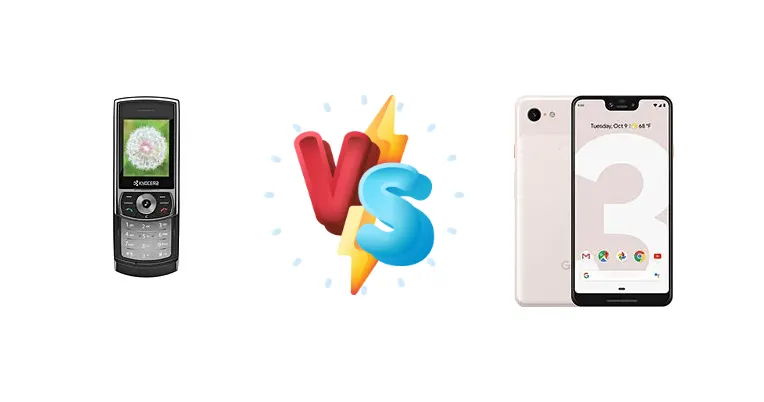
The Kyocera E4600 and Google Pixel 3 XL represent vastly different philosophies in smartphone design. The E4600, typical of Kyocera, likely prioritizes durability and essential functionality, while the Pixel 3 XL aimed for a premium experience centered around Google’s AI-powered features and a class-leading camera. This comparison dissects these differences, helping you determine which device best suits your needs.
🏆 Quick Verdict
For the average user prioritizing camera quality, software experience, and overall performance, the Google Pixel 3 XL is the clear winner. However, users needing a robust, potentially more affordable device for demanding work environments will find the Kyocera E4600 a compelling option, assuming its feature set meets their basic needs.
| Network |
|---|
| 2G bands | GSM 850 / 900 / 1800 / 1900 | GSM 850 / 900 / 1800 / 1900 |
| 3G bands | - | HSDPA 850 / 900 / 1700(AWS) / 1900 / 2100 |
| 4G bands | - | 1, 2, 3, 4, 5, 7, 8, 12, 13, 17, 18, 19, 20, 25, 26, 28, 29, 32, 38, 39, 40, 41, 42, 46, 66, 71 |
| EDGE | Class 10 | - |
| GPRS | Class 10 | - |
| Speed | - | HSPA 42.2/5.76 Mbps, LTE (5CA) Cat16 1024/75 Mbps |
| Technology | GSM | GSM / CDMA / HSPA / EVDO / LTE |
| | - | CDMA2000 1xEV-DO |
| Launch |
|---|
| Announced | 2008, August. Released 2008, August | 2018, October 09. Released 2018, October 18 |
| Status | Discontinued | Discontinued |
| Body |
|---|
| Build | - | Glass front (Gorilla Glass 5), glass back (Gorilla Glass 5), aluminum frame |
| Dimensions | 103 x 51 x 15 mm (4.06 x 2.01 x 0.59 in) | 158 x 76.7 x 7.9 mm (6.22 x 3.02 x 0.31 in) |
| SIM | Mini-SIM | Nano-SIM + eSIM |
| Weight | 85 g (3.00 oz) | 184 g (6.49 oz) |
| | Flashlight | IP68 dust/water resistant (up to 1.5m for 30 min) |
| Display |
|---|
| Protection | - | Corning Gorilla Glass 5 |
| Resolution | 176 x 220 pixels (~128 ppi density) | 1440 x 2960 pixels, 18.5:9 ratio (~523 ppi density) |
| Size | 2.2 inches, 15.2 cm2 (~29.0% screen-to-body ratio) | 6.3 inches, 100.3 cm2 (~82.8% screen-to-body ratio) |
| Type | TFT, 65K colors | P-OLED, HDR |
| | - | Always-on display |
| Platform |
|---|
| CPU | - | Octa-core (4x2.5 GHz Kryo 385 Gold & 4x1.6 GHz Kryo 385 Silver) |
| Chipset | - | Qualcomm SDM845 Snapdragon 845 (10 nm) |
| GPU | - | Adreno 630 |
| OS | - | Android 9.0 (Pie), upgradable to Android 12 |
| Memory |
|---|
| Call records | Yes | - |
| Card slot | microSD (dedicated slot) | No |
| Internal | - | 64GB 4GB RAM, 128GB 4GB RAM |
| Phonebook | Yes | - |
| | - | UFS 2.1 |
| Main Camera |
|---|
| Features | LED flash | Dual-LED flash, Pixel Shift, Auto-HDR, panorama |
| Single | 2 MP | 12.2 MP, f/1.8, 28mm (wide), 1/2.55", 1.4µm, dual pixel PDAF, OIS |
| Video | Yes | 4K@30fps, 1080p@30/60/120fps, 1080p@30fps (gyro-EIS) |
| Selfie camera |
|---|
| Dual | - | 8 MP, f/1.8, 28mm (wide), PDAF
8 MP, f/2.2, 19mm (ultrawide), no AF |
| Features | - | HDR |
| Video | - | 1080p@30fps |
| | No | - |
| Sound |
|---|
| 3.5mm jack | No | No |
| 35mm jack | No | No |
| Loudspeaker | Yes | Yes, with stereo speakers |
| Comms |
|---|
| Bluetooth | 2.0, A2DP | 5.0, A2DP, LE, aptX HD |
| NFC | - | Yes |
| Positioning | GPS | GPS, GLONASS, BDS, GALILEO |
| Radio | No | No |
| USB | miniUSB 2.0 | USB Type-C 3.1 |
| WLAN | No | Wi-Fi 802.11 a/b/g/n/ac, dual-band, Wi-Fi Direct, DLNA |
| Features |
|---|
| Browser | WAP 2.0/xHTML | - |
| Games | Yes | - |
| Java | Yes, MIDP 2.0 | - |
| Messaging | SMS, MMS, Email, IM | - |
| Sensors | - | Fingerprint (rear-mounted), accelerometer, gyro, proximity, compass, barometer |
| | MP3/WAV/AAC+ player
MP4/H.263 player
Organizer
Voice memo
Predictive text input | - |
| Battery |
|---|
| Charging | - | 18W wired, PD2.0
Wireless |
| Stand-by | Up to 300 h | - |
| Talk time | Up to 4 h | - |
| Type | Removable Li-Ion 780 mAh battery | Li-Po 3430 mAh, non-removable |
| Misc |
|---|
| Colors | Black | Clearly White, Just Black, Not Pink |
| Models | - | G013C |
| Price | - | About 260 EUR |
| Tests |
|---|
| Performance | - |
AnTuTu: 258244 (v7), 341814 (v8)
GeekBench: 8088 (v4.4), 2092 (v5.1)
GFXBench: 12fps (ES 3.1 onscreen) |
Kyocera E4600
- Exceptional durability and ruggedness
- Potentially lower price point
- Long-term reliability in harsh environments
- Likely limited performance and features
- Inferior camera quality
- Outdated software experience (potentially)
Google Pixel 3 XL
- Excellent camera performance with AI features
- Smooth and responsive software experience
- Powerful Snapdragon 845 processor
- More fragile design
- Higher price point (originally)
- Potential for software update limitations (age)
Display Comparison
Given the lack of display specifications for the Kyocera E4600, we can infer it utilizes a more basic LCD panel focused on visibility and durability rather than color accuracy or high refresh rates. The Google Pixel 3 XL, in contrast, features a 6.3-inch OLED display, offering superior contrast and color reproduction. The Pixel 3 XL’s OLED technology also allows for true blacks, enhancing media consumption. While the Pixel 3 XL’s resolution (1440 x 3120) is significantly higher, the E4600 likely prioritizes power efficiency over pixel density.
Camera Comparison
The Google Pixel 3 XL was renowned for its computational photography prowess. While specific sensor details aren’t available for the Kyocera E4600, it’s reasonable to assume it features a more basic camera system focused on capturing functional images rather than artistic ones. The Pixel 3 XL’s single 12.2MP rear camera, coupled with Google’s HDR+ processing, consistently delivered excellent image quality in various lighting conditions. Features like Night Sight, exclusive to the Pixel line, provided exceptional low-light performance. The Pixel 3 XL also benefits from Optical Image Stabilization (OIS), reducing blur in photos and videos.
Performance
The Google Pixel 3 XL’s Qualcomm SDM845 Snapdragon 845 (10nm) chipset delivers a substantial performance advantage. Its octa-core CPU, with Kryo 385 Gold cores clocked at 2.5 GHz and Silver cores at 1.6 GHz, provides ample power for demanding tasks like gaming and video editing. The E4600, lacking detailed specifications, likely employs a more modest processor designed for basic functionality and power efficiency. The Snapdragon 845’s Adreno 630 GPU in the Pixel 3 XL also offers a significantly superior graphics experience. The Pixel 3 XL’s use of a 10nm process node also contributes to better thermal management, reducing the likelihood of performance throttling during sustained workloads.
Battery Life
The Google Pixel 3 XL supports 18W wired charging with PD2.0 and wireless charging, offering convenient charging options. The Kyocera E4600’s battery capacity and charging capabilities are unknown, but given its focus on durability and essential features, it likely prioritizes battery life over fast charging speeds. The Pixel 3 XL’s larger battery capacity, combined with the Snapdragon 845’s power efficiency, generally translates to all-day battery life for moderate users. The Pixel 3 XL’s wireless charging capability is a feature absent from most ruggedized devices.
Buying Guide
Buy the Kyocera E4600 if you need a phone that can withstand harsh conditions, prioritize long-term durability over cutting-edge features, and operate reliably in environments where a flagship device would be impractical. Buy the Google Pixel 3 XL if you prefer a smooth, intelligent software experience, a top-tier camera system, and are willing to accept the trade-offs of a more fragile device.
Frequently Asked Questions
❓ Is the Google Pixel 3 XL still receiving software updates?
Official software updates from Google have ended for the Pixel 3 XL. However, the active Android community provides custom ROMs and security patches for those willing to explore them, extending the device’s usability.
❓ What kind of protection does the Kyocera E4600 offer against drops and water?
Kyocera phones are known for their ruggedness, typically meeting MIL-STD-810G standards for shock and vibration resistance. The E4600 likely also features an IP rating for water and dust resistance, though the specific rating is unknown without further specifications.
❓ Will the Snapdragon 845 in the Pixel 3 XL struggle with modern apps?
While not the latest chipset, the Snapdragon 845 remains capable of handling most modern apps and games. Some graphically intensive titles may require reduced settings for optimal performance, but the Pixel 3 XL should provide a generally smooth experience.