
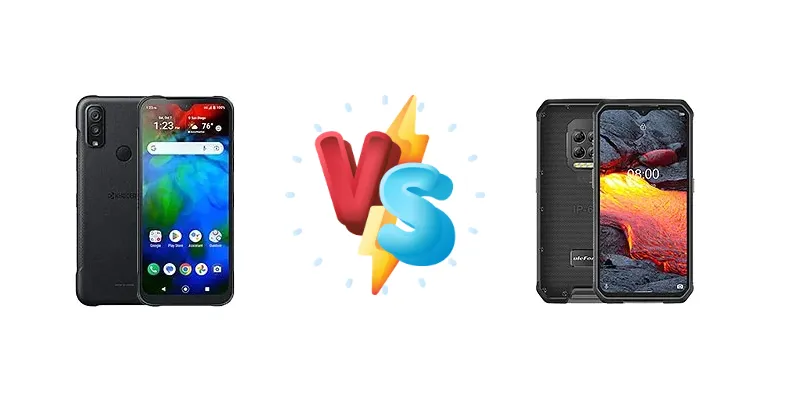
Kyocera DuraSport UW vs. Ulefone Armor 9E: A Deep Dive into Rugged Performance
| Phones Images | |||||
|---|---|---|---|---|---|
|
🏆 Quick Verdict
For the average user prioritizing future-proofing and faster data speeds, the Kyocera DuraSport UW is the better choice. Its Snapdragon 480 5G chipset offers a performance advantage and 5G support, despite the Armor 9E's slightly higher CPU clock speeds. However, the Armor 9E remains a viable option for those on a tighter budget and without immediate 5G needs.
| PHONES | ||
|---|---|---|
| Phone Names | Kyocera DuraSport UW | Ulefone Armor 9E |
| Network | ||
|---|---|---|
| 2G bands | GSM 850 / 900 / 1800 / 1900 | GSM 850 / 900 / 1800 / 1900 |
| 3G bands | HSDPA 850 / 900 / 1900 / 2100 | HSDPA 850 / 900 / 1700(AWS) / 1900 / 2100 |
| 4G bands | 1, 2, 3, 4, 5, 7, 12, 13, 48, 66, 71 - unlocked | 1, 2, 3, 4, 5, 7, 8, 12, 13, 17, 18, 19, 20, 25, 26, 28, 34, 38, 39, 40, 41, 66 |
| 5G bands | 2, 5, 48, 66, 71, 77, 260, 261 SA/NSA/Sub6/mmWave - unlocked | - |
| Speed | HSPA, LTE, 5G | HSPA 42.2/11.5 Mbps, LTE Cat12 600/150 Mbps |
| Technology | GSM / HSPA / LTE / 5G | GSM / CDMA / HSPA / EVDO / LTE |
| - | CDMA2000 1xEV-DO | |
| Launch | ||
|---|---|---|
| Announced | 2023, November | 2020, September 08. Released 2020, September 08 |
| Status | Available. Released 2023, December | Discontinued |
| Body | ||
|---|---|---|
| Build | - | Front glass, aluminum back with rubber, aluminum frame |
| Dimensions | 154.7 x 70.7 x 9.9 mm (6.09 x 2.78 x 0.39 in) | 168.2 x 82 x 15 mm (6.62 x 3.23 x 0.59 in) |
| SIM | Nano SIM | Nano-SIM + Nano-SIM |
| Weight | 185 g (6.53 oz) | 324 g (11.43 oz) |
| - | IP68/IP69K dust/water resistant (up to 1.5m for 30 min) Drop-to-concrete resistance from up to 1.2m MIL-STD-810G compliant | |
| Display | ||
|---|---|---|
| Protection | Shatter-Resistant Glass | Scratch-resistant glass, oleophobic coating |
| Resolution | 1080 x 2400 pixels, 20:9 ratio (~431 ppi density) | 1080 x 2340 pixels, 19.5:9 ratio (~409 ppi density) |
| Size | 6.1 inches, 89.8 cm2 (~82.1% screen-to-body ratio) | 6.3 inches, 97.4 cm2 (~70.6% screen-to-body ratio) |
| Type | IPS LCD | IPS LCD |
| Platform | ||
|---|---|---|
| CPU | Octa-core (2x2.0 GHz Kryo 460 & 6x1.8 GHz Kryo 460) | Octa-core (2x2.2 GHz Cortex-A75 & 6x2.0 GHz Cortex-A55) |
| Chipset | Qualcomm SM4350 Snapdragon 480 5G (8 nm) | Mediatek MT6779 Helio P90 (12 nm) |
| GPU | Adreno 619 | PowerVR GM9446 |
| OS | Android 13 (unlocked), Android 12 (Verizon) | Android 10 |
| Memory | ||
|---|---|---|
| Card slot | microSDXC (dedicated slot) | microSDXC (uses shared SIM slot) |
| Internal | 64GB 4GB RAM | 128GB 8GB RAM |
| - | UFS 2.1 | |
| Main Camera | ||
|---|---|---|
| Dual | 48 MP, f/1.8, 25mm (wide), 0.8µm, PDAF 16 MP, f/2.0, 16mm, 117˚ (ultrawide), 1.0µm | - |
| Features | LED flash, HDR, panorama | Quad-LED flash, HDR, panorama |
| Quad | - | 64 MP, f/1.9, 26mm (wide), 1/1.72", 0.8µm, PDAF 8 MP, f/2.4, 100˚ (ultrawide), 1/4.0", 1.12µm 2 MP (macro) Auxiliary lens |
| Video | 1080p@30fps | 4K@30fps, 1080p@30fps |
| Selfie camera | ||
|---|---|---|
| Features | - | HDR, panorama |
| Single | 8 MP, f/2.0, 23mm (wide), 1/4.0", 1.12µm | 8 MP, f/2.2 |
| Video | 1080p@30fps | 1080p@30fps |
| Sound | ||
|---|---|---|
| 3.5mm jack | - | Yes |
| 35mm jack | Unspecified | Yes |
| Loudspeaker | Yes | Yes |
| Comms | ||
|---|---|---|
| Bluetooth | 5.1, A2DP, LE | 5.0, A2DP, LE |
| NFC | Yes | Yes |
| Positioning | GPS (L1+L5) | GPS, GLONASS, GALILEO, BDS |
| Radio | No | FM radio, RDS, recording |
| USB | USB Type-C 3.1 | USB Type-C 2.0, OTG, accessory connector |
| WLAN | Wi-Fi 802.11 a/b/g/n/ac/e/i/k/r/v, dual-band, Wi-Fi Direct | Wi-Fi 802.11 a/b/g/n/ac, Wi-Fi Direct |
| Features | ||
|---|---|---|
| Sensors | Fingerprint (rear-mounted); unspecified sensors | Fingerprint (side-mounted), accelerometer, gyro, proximity, compass, coulombmeter |
| - | Endoscope mount (camera sold separately) | |
| Battery | ||
|---|---|---|
| Charging | 27W wired, PD, QC4.0 8W wireless (Qi) | 18W wired |
| Type | Li-Po 4500 mAh | Li-Po 6600 mAh |
| Misc | ||
|---|---|---|
| Colors | Black | Black |
| Price | About 550 EUR | About 290 EUR |
Kyocera DuraSport UW
- 5G Connectivity for faster data speeds
- More efficient Snapdragon 480 chipset
- Faster 27W charging with PD/QC4.0
- Wireless charging support (Qi)
- Potentially higher price point
- Limited details on display quality
Ulefone Armor 9E
- Lower upfront cost
- Durable build quality
- Slightly higher CPU clock speeds (on paper)
- Established MediaTek Helio P90 platform
- Lacks 5G connectivity
- Slower 18W charging
- Less power-efficient chipset
- Potential for limited software updates
Display Comparison
Neither device boasts a standout display. Details regarding panel type (IPS, AMOLED) and resolution are missing, but both are likely to be 720p+ given their price points. The focus here is on durability, not visual fidelity. The Armor 9E's display is likely to be slightly more power-efficient due to the older Helio P90 chipset, but the difference will be minimal. Bezels are expected to be substantial on both devices, prioritizing screen protection.
Camera Comparison
Camera performance is likely to be similar on both devices, with neither excelling in this area. Details on sensor size and image processing are unavailable, but both will likely feature a primary sensor paired with auxiliary lenses of limited utility. The focus is on capturing functional images in challenging conditions, not photographic quality. Expect adequate performance in good lighting, but struggles in low-light scenarios. The absence of Optical Image Stabilization (OIS) on either device further limits low-light capabilities.
Performance
The Kyocera DuraSport UW’s Qualcomm Snapdragon 480 5G (8nm) represents a significant architectural advantage over the Ulefone Armor 9E’s MediaTek Helio P90 (12nm). While the Helio P90’s Cortex-A75 cores clock slightly higher at 2.2 GHz versus the Snapdragon’s 2.0 GHz Kryo 460 cores, the 8nm process node of the Snapdragon yields better power efficiency and thermal management. This translates to sustained performance under load, crucial for tasks beyond basic communication. The Snapdragon 480 also includes an integrated 5G modem, a feature absent in the Armor 9E. The Armor 9E's older chipset may struggle with demanding applications and future software updates.
Battery Life
The Kyocera DuraSport UW’s 27W wired charging with Power Delivery (PD) and Quick Charge 4.0 (QC4.0) offers a significant advantage over the Ulefone Armor 9E’s 18W charging. While battery capacity isn’t specified, the faster charging speeds of the DuraSport UW will result in quicker top-ups. The inclusion of 8W wireless charging (Qi) on the DuraSport UW adds convenience, a feature missing on the Armor 9E. The Snapdragon 480’s improved power efficiency also contributes to potentially longer battery life, despite any potential capacity differences.
Buying Guide
Buy the Kyocera DuraSport UW if you need reliable 5G connectivity for remote work or streaming, and value a more modern processor for smoother app performance and future software updates. Buy the Ulefone Armor 9E if you prioritize a lower upfront cost and are content with 4G connectivity, and need a durable phone for basic tasks and communication in harsh environments.