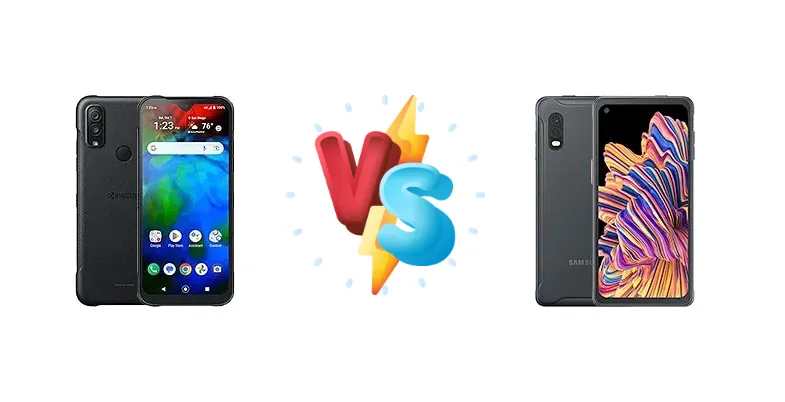
The Kyocera DuraSport UW and Samsung Galaxy XCover Pro represent distinct approaches to the rugged smartphone market. The DuraSport UW prioritizes 5G connectivity and a newer chipset, while the XCover Pro focuses on Samsung’s established ecosystem and a more mature software experience. This comparison dissects their core components to determine which device best suits demanding users.
🏆 Quick Verdict
For users prioritizing 5G speeds and a more modern chipset, the Kyocera DuraSport UW is the better choice. Its Snapdragon 480 offers a performance edge and faster charging. However, the Samsung Galaxy XCover Pro remains a solid option for those deeply invested in the Samsung ecosystem and seeking a reliable, if slightly older, platform.
| Network |
|---|
| 2G bands | GSM 850 / 900 / 1800 / 1900 | GSM 850 / 900 / 1800 / 1900 |
| 3G bands | HSDPA 850 / 900 / 1900 / 2100 | HSDPA 850 / 900 / 1900 / 2100 - International |
| 4G bands | 1, 2, 3, 4, 5, 7, 12, 13, 48, 66, 71 - unlocked | 1, 2, 3, 5, 7, 8, 20, 28, 38, 40, 41 - International |
| 5G bands | 2, 5, 48, 66, 71, 77, 260, 261 SA/NSA/Sub6/mmWave - unlocked | - |
| Speed | HSPA, LTE, 5G | HSPA 42.2/5.76 Mbps, LTE (3CA) Cat11 600/50 Mbps |
| Technology | GSM / HSPA / LTE / 5G | GSM / HSPA / LTE |
| | - | 1, 2, 3, 4, 5, 7, 12, 13, 14, 20, 29, 38, 40, 41, 66 - Canada |
| Launch |
|---|
| Announced | 2023, November | 2020, January |
| Status | Available. Released 2023, December | Available. Released 2020, January |
| Body |
|---|
| Dimensions | 154.7 x 70.7 x 9.9 mm (6.09 x 2.78 x 0.39 in) | 159.9 x 76.7 x 10 mm (6.30 x 3.02 x 0.39 in) |
| SIM | Nano SIM | · Nano-SIM· Nano-SIM + Nano-SIM |
| Weight | 185 g (6.53 oz) | 218 g (7.69 oz) |
| | - | IP68 dust/water resistant (up to 1.5m for 35 min)
Drop-to-concrete resistance from up to 1.5m
MIL-STD-810G compliant*
*does not guarantee ruggedness or use in extreme conditions |
| Display |
|---|
| Protection | Shatter-Resistant Glass | Corning Gorilla Glass 5 |
| Resolution | 1080 x 2400 pixels, 20:9 ratio (~431 ppi density) | 1080 x 2340 pixels, 19.5:9 ratio (~409 ppi density) |
| Size | 6.1 inches, 89.8 cm2 (~82.1% screen-to-body ratio) | 6.3 inches, 97.4 cm2 (~79.4% screen-to-body ratio) |
| Type | IPS LCD | IPS LCD |
| Platform |
|---|
| CPU | Octa-core (2x2.0 GHz Kryo 460 & 6x1.8 GHz Kryo 460) | Octa-core (4x2.3 GHz Cortex-A73 & 4x1.7 GHz Cortex-A53) |
| Chipset | Qualcomm SM4350 Snapdragon 480 5G (8 nm) | Exynos 9611 (10 nm) |
| GPU | Adreno 619 | Mali-G72 MP3 |
| OS | Android 13 (unlocked), Android 12 (Verizon) | Android 10, upgradable to Android 13, One UI 5 |
| Memory |
|---|
| Card slot | microSDXC (dedicated slot) | microSDXC (dedicated slot) |
| Internal | 64GB 4GB RAM | 64GB 4GB RAM |
| Main Camera |
|---|
| Dual | 48 MP, f/1.8, 25mm (wide), 0.8µm, PDAF
16 MP, f/2.0, 16mm, 117˚ (ultrawide), 1.0µm | 25 MP, f/1.7, 26mm (wide), PDAF
8 MP, f/2.2, 123˚ (ultrawide), 1/4.0", 1.12µm |
| Features | LED flash, HDR, panorama | Dual-LED flash, HDR, panorama |
| Video | 1080p@30fps | 1080p@30fps |
| Selfie camera |
|---|
| Features | - | HDR |
| Single | 8 MP, f/2.0, 23mm (wide), 1/4.0", 1.12µm | 13 MP, f/2.0, (wide), 1/3.1", 1.12µm |
| Video | 1080p@30fps | 1080p@30fps |
| Sound |
|---|
| 3.5mm jack | - | Yes |
| 35mm jack | Unspecified | Yes |
| Loudspeaker | Yes | Yes |
| Comms |
|---|
| Bluetooth | 5.1, A2DP, LE | 5.0, A2DP, LE |
| NFC | Yes | Yes |
| Positioning | GPS (L1+L5) | GPS, GLONASS, GALILEO, BDS |
| Radio | No | FM radio (market/region dependent) |
| USB | USB Type-C 3.1 | USB Type-C 2.0 |
| WLAN | Wi-Fi 802.11 a/b/g/n/ac/e/i/k/r/v, dual-band, Wi-Fi Direct | Wi-Fi 802.11 a/b/g/n/ac/k/v/r, dual-band, Wi-Fi Direct |
| Features |
|---|
| Sensors | Fingerprint (rear-mounted); unspecified sensors | Fingerprint (side-mounted), accelerometer, gyro, proximity, compass |
| | - | ANT+ |
| Battery |
|---|
| Charging | 27W wired, PD, QC4.0
8W wireless (Qi) | 15W wired |
| Type | Li-Po 4500 mAh | Li-Po 4050 mAh, removable |
| Misc |
|---|
| Colors | Black | Black |
| Models | - | SM-G715FN/DS, SM-G715FN, SM-G715F, SM-G715W, SM-G715U, SM-G715U1 |
| Price | About 550 EUR | About 120 EUR |
| SAR EU | - | 0.47 W/kg (head) 1.23 W/kg (body) |
Kyocera DuraSport UW
- Faster 27W charging with PD/QC4.0
- More modern Snapdragon 480 5G chipset
- 8W Wireless Charging (Qi)
- Potentially better thermal management
- Less established software ecosystem
- Display details are currently unknown
Samsung Galaxy XCover Pro
- Samsung’s DeX support for desktop-like productivity
- Established Samsung software ecosystem
- Potentially wider accessory compatibility
- Refined image processing
- Slower 15W charging
- Older and less efficient Exynos 9611 chipset
- Potential for throttling under heavy load
Display Comparison
Neither device boasts a cutting-edge display. Details on panel type (LCD vs AMOLED) and resolution are missing, but both are likely to prioritize durability over visual fidelity. The focus is on readability in bright sunlight, and scratch resistance. The lack of high refresh rates is expected in this segment. The XCover Pro's display is likely to be a standard 6.3-inch LCD, while the DuraSport UW's display size is not specified, but will likely be similar. Without specific brightness data, it's difficult to declare a clear winner, but the XCover Pro benefits from Samsung's display tuning expertise.
Camera Comparison
Camera performance is likely a secondary concern for both devices, but the specifications suggest a slight edge for the DuraSport UW if it incorporates a more modern sensor. Details are limited, but the focus will be on functional image capture in challenging conditions. The XCover Pro’s camera setup is likely to be more refined due to Samsung’s image processing algorithms, but the older chipset may limit its capabilities. The presence of a 2MP macro camera on both devices is largely a marketing tactic, offering minimal practical benefit. Without detailed sensor size information, it’s difficult to definitively assess image quality.
Performance
The Kyocera DuraSport UW’s Qualcomm Snapdragon 480 5G (8nm) represents a significant architectural advantage over the Samsung Galaxy XCover Pro’s Exynos 9611 (10nm). The Snapdragon 480 utilizes newer Kryo 460 cores, offering improved performance per watt. While both are octa-core CPUs, the Exynos 9611’s older Cortex-A73 and A53 cores are less efficient. This translates to potentially better sustained performance and thermal management on the DuraSport UW, especially during prolonged use of demanding applications. The 8nm process node of the Snapdragon 480 further contributes to efficiency. The XCover Pro's Exynos 9611, while capable, will likely exhibit more throttling under heavy load.
Battery Life
The Kyocera DuraSport UW’s 27W wired charging with Power Delivery (PD) and Quick Charge 4.0 (QC4.0) is a substantial advantage over the Samsung Galaxy XCover Pro’s 15W charging. This faster charging capability significantly reduces downtime. While battery capacity isn’t specified for either device, the faster charging of the DuraSport UW mitigates the impact of a potentially smaller battery. The inclusion of 8W wireless charging (Qi) on the DuraSport UW adds further convenience, a feature absent on the XCover Pro.
Buying Guide
Buy the Kyocera DuraSport UW if you need a future-proofed rugged phone with 5G connectivity, faster charging speeds, and a more efficient processor for demanding tasks. Buy the Samsung Galaxy XCover Pro if you prefer a phone with a well-established software ecosystem, Samsung’s DeX support for desktop-like productivity, and a potentially wider range of compatible accessories.
Frequently Asked Questions
❓ Does the Exynos 9611 in the Galaxy XCover Pro tend to overheat during prolonged use of GPS or demanding apps?
The Exynos 9611, built on a 10nm process, is known to exhibit thermal throttling under sustained load. While not catastrophic, users engaging in extended GPS navigation, augmented reality applications, or gaming may experience performance dips as the processor attempts to manage heat. The Kyocera DuraSport UW’s Snapdragon 480, with its 8nm process, is better equipped to handle sustained workloads.
❓ Is the 2MP macro camera on either phone actually useful for detailed close-up photography?
Generally, 2MP macro cameras on budget and mid-range phones offer limited practical benefit. The low resolution results in images lacking detail and sharpness. They are often included as a marketing feature rather than a genuinely useful photographic tool. Expect soft, grainy results, and don't rely on it for critical close-up work.
❓ How does the 5G performance of the Kyocera DuraSport UW compare to the 4G LTE capabilities of the Samsung Galaxy XCover Pro?
The Kyocera DuraSport UW’s Snapdragon 480 5G provides significantly faster data speeds and lower latency when connected to a 5G network. While the XCover Pro offers reliable 4G LTE connectivity, it cannot match the performance of 5G. This difference is particularly noticeable for streaming high-resolution video, downloading large files, and real-time communication.