
Kyocera DuraSport UW vs. Nokia XR20: A Deep Dive into Rugged 5G Smartphones
| Phones Images | |||||
|---|---|---|---|---|---|
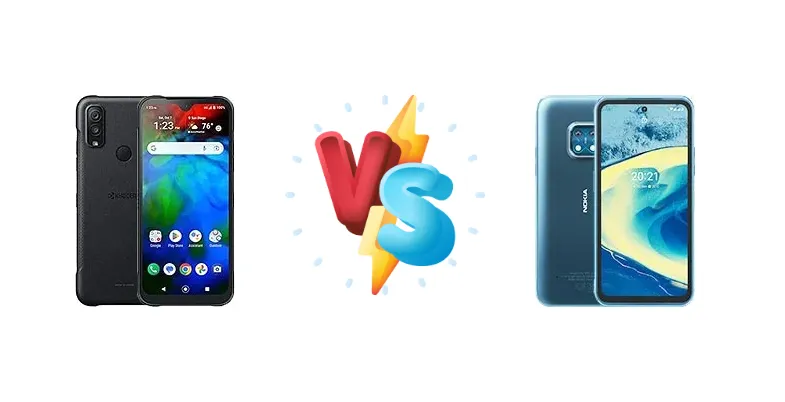
|
🏆 Quick Verdict
For the average user prioritizing faster charging and potentially a lower price point, the Kyocera DuraSport UW is the better choice. While both phones offer similar performance thanks to the Snapdragon 480 5G, the DuraSport UW’s 27W charging with Power Delivery and Quick Charge 4.0 significantly outperforms the Nokia XR20’s 18W charging.
| PHONES | ||
|---|---|---|
| Phone Names | Kyocera DuraSport UW | Nokia XR20 |
| Network | ||
|---|---|---|
| 2G bands | GSM 850 / 900 / 1800 / 1900 | GSM 850 / 900 / 1800 / 1900 |
| 3G bands | HSDPA 850 / 900 / 1900 / 2100 | HSDPA 850 / 900 / 1700(AWS) / 1900 / 2100 |
| 4G bands | 1, 2, 3, 4, 5, 7, 12, 13, 48, 66, 71 - unlocked | 1, 2, 3, 4, 5, 7, 8, 12, 13, 14, 20, 25, 26, 28, 30, 38, 40, 41, 48, 66, 71 |
| 5G bands | 2, 5, 48, 66, 71, 77, 260, 261 SA/NSA/Sub6/mmWave - unlocked | 2, 5, 25, 38, 41, 48, 66, 77, 78 SA/NSA |
| Speed | HSPA, LTE, 5G | HSPA, LTE, 5G |
| Technology | GSM / HSPA / LTE / 5G | GSM / CDMA / HSPA / EVDO / LTE / 5G |
| - | CDMA2000 1xEV-DO | |
| Launch | ||
|---|---|---|
| Announced | 2023, November | 2021, July 27 |
| Status | Available. Released 2023, December | Available. Released 2021, August 04 |
| Body | ||
|---|---|---|
| Dimensions | 154.7 x 70.7 x 9.9 mm (6.09 x 2.78 x 0.39 in) | 171.6 x 81.5 x 10.6 mm (6.76 x 3.21 x 0.42 in) |
| SIM | Nano SIM | · Nano-SIM· Nano-SIM + Nano-SIM |
| Weight | 185 g (6.53 oz) | 248 g (8.75 oz) |
| - | IP68 dust/water resistant (up to 1.5m for 60 min) Drop-to-concrete resistance from up to 1.8m MIL-STD-810H compliant | |
| Display | ||
|---|---|---|
| Protection | Shatter-Resistant Glass | Corning Gorilla Glass Victus |
| Resolution | 1080 x 2400 pixels, 20:9 ratio (~431 ppi density) | 1080 x 2400 pixels, 20:9 ratio (~395 ppi density) |
| Size | 6.1 inches, 89.8 cm2 (~82.1% screen-to-body ratio) | 6.67 inches, 107.4 cm2 (~76.8% screen-to-body ratio) |
| Type | IPS LCD | IPS LCD, 550 nits |
| Platform | ||
|---|---|---|
| CPU | Octa-core (2x2.0 GHz Kryo 460 & 6x1.8 GHz Kryo 460) | Octa-core (2x2.0 GHz Kryo 460 & 6x1.8 GHz Kryo 460) |
| Chipset | Qualcomm SM4350 Snapdragon 480 5G (8 nm) | Qualcomm SM4350 Snapdragon 480 5G (8 nm) |
| GPU | Adreno 619 | Adreno 619 |
| OS | Android 13 (unlocked), Android 12 (Verizon) | Android 11, upgradable to Android 13 |
| Memory | ||
|---|---|---|
| Card slot | microSDXC (dedicated slot) | microSDXC (uses shared SIM slot) |
| Internal | 64GB 4GB RAM | 64GB 4GB RAM, 128GB 6GB RAM |
| Main Camera | ||
|---|---|---|
| Dual | 48 MP, f/1.8, 25mm (wide), 0.8µm, PDAF 16 MP, f/2.0, 16mm, 117˚ (ultrawide), 1.0µm | 48 MP, f/1.8, (wide), 1/2.25", 0.8µm, PDAF 13 MP, f/2.4, 123˚ (ultrawide), 1/3.0", 1.12µm |
| Features | LED flash, HDR, panorama | Zeiss optics, Dual-LED dual-tone flash, second LED flash, HDR, panorama |
| Single | - | 8 MP, f/2.0 (wide), 1/4.0", 1.12µm |
| Video | 1080p@30fps | 1080p@30fps |
| Selfie camera | ||
|---|---|---|
| Single | 8 MP, f/2.0, 23mm (wide), 1/4.0", 1.12µm | 8 MP, f/2.0 (wide), 1/4.0", 1.12µm |
| Video | 1080p@30fps | 1080p@30fps |
| Sound | ||
|---|---|---|
| 3.5mm jack | - | Yes |
| 35mm jack | Unspecified | Yes |
| Loudspeaker | Yes | Yes, with stereo speakers |
| Comms | ||
|---|---|---|
| Bluetooth | 5.1, A2DP, LE | 5.1, A2DP, LE, aptX Adaptive |
| NFC | Yes | Yes |
| Positioning | GPS (L1+L5) | GPS (L1+L5), GLONASS, BDS, GALILEO, QZSS, NavIC |
| Radio | No | Unspecified |
| USB | USB Type-C 3.1 | USB Type-C 3.0 |
| WLAN | Wi-Fi 802.11 a/b/g/n/ac/e/i/k/r/v, dual-band, Wi-Fi Direct | Wi-Fi 802.11 a/b/g/n/ac/6, dual-band, Wi-Fi Direct |
| Features | ||
|---|---|---|
| Sensors | Fingerprint (rear-mounted); unspecified sensors | Fingerprint (side-mounted), accelerometer, gyro, proximity, compass, barometer |
| Battery | ||
|---|---|---|
| Charging | 27W wired, PD, QC4.0 8W wireless (Qi) | 18W wired 15W wireless |
| Type | Li-Po 4500 mAh | Li-Po 4630 mAh |
| Misc | ||
|---|---|---|
| Colors | Black | Ultra Blue, Granite Gray |
| Models | - | TA-1368, TA-1362 |
| Price | About 550 EUR | About 270 EUR |
| SAR EU | - | 1.13 W/kg (head) 1.43 W/kg (body) |
Kyocera DuraSport UW
- Faster 27W charging with PD and QC4.0
- Wireless charging support (8W Qi)
- Potentially better value for money
- Brand recognition may be lower than Nokia
- Software update commitment is unknown
Nokia XR20
- Strong brand reputation for reliability
- Guaranteed software updates (Nokia's strength)
- Clean Android experience
- Slower 18W charging
- No wireless charging support
- Potentially higher price
Display Comparison
Both devices are likely to feature LCD panels, typical for rugged phones prioritizing durability over advanced display tech. Specifics like resolution and peak brightness are not provided, but given the chipset and target market, expect 1080p+ resolution. The lack of LTPO or high refresh rate technology suggests a focus on power efficiency rather than visual fidelity. Bezels are likely to be substantial on both to provide impact protection.
Camera Comparison
Camera details are sparse, but the focus is unlikely to be on photographic excellence. Both phones will likely feature a multi-camera setup, but image quality will be dictated more by software processing than by high-end sensors. The absence of sensor size or aperture information suggests a similar level of camera capability on both devices. Expect a primary sensor for general photography and potentially an ultrawide or depth sensor. Any 2MP macro sensors are likely to offer limited practical benefit.
Performance
Both the Kyocera DuraSport UW and Nokia XR20 utilize the Qualcomm SM4350 Snapdragon 480 5G (8 nm) chipset, featuring an octa-core CPU configuration with 2x2.0 GHz Kryo 460 cores and 6x1.8 GHz Kryo 460 cores. This means performance will be virtually identical for everyday tasks and moderate gaming. RAM configurations are not specified, but the Snapdragon 480 5G typically pairs with 4GB or 6GB of RAM. Thermal management will be crucial; the 8nm process node is reasonably efficient, but rugged designs can sometimes limit heat dissipation. Neither phone is positioned as a performance leader, focusing instead on reliable operation.
Battery Life
Battery capacity is not specified for either device. However, the charging capabilities are a significant differentiator. The Kyocera DuraSport UW supports 27W wired charging with Power Delivery (PD) and Quick Charge 4.0 (QC4.0), enabling significantly faster charging times compared to the Nokia XR20’s 18W wired charging. The DuraSport UW also offers 8W wireless charging (Qi), a feature absent on the XR20. This means the DuraSport UW will likely achieve a 0-100% charge in considerably less time, a crucial advantage for users who need to quickly replenish their battery during work or outdoor activities.
Buying Guide
Buy the Kyocera DuraSport UW if you need a rugged phone for demanding work environments where quick power-ups are essential, and value fast charging standards like PD and QC4.0. Buy the Nokia XR20 if you prioritize software update guarantees and a more mainstream brand reputation, and are less concerned with maximizing charging speed. The XR20's focus on longevity through software support may appeal to users who plan to keep their device for several years.