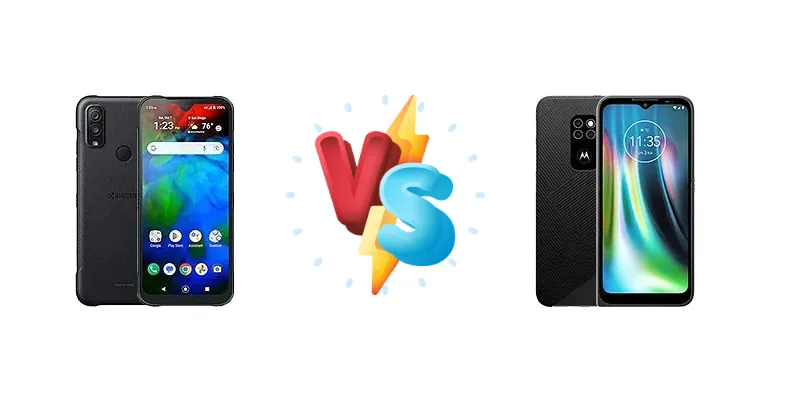
The Kyocera DuraSport UW and Motorola Defy (2021) both target a niche market: users needing a durable, reliable smartphone capable of withstanding harsh conditions. However, they approach this goal with different philosophies. The DuraSport UW leverages a newer 5G chipset for faster connectivity, while the Defy (2021) focuses on maximizing battery life and offering a more traditional rugged experience. This comparison dissects their key differences to determine which phone best suits your needs.
🏆 Quick Verdict
For the average user prioritizing future-proofing and faster data speeds, the Kyocera DuraSport UW is the better choice. Its Snapdragon 480 5G chipset offers a performance edge, and the inclusion of 27W fast charging and wireless charging provides convenience. However, those prioritizing maximum battery endurance will find the Motorola Defy (2021) a compelling option.
| Network |
|---|
| 2G bands | GSM 850 / 900 / 1800 / 1900 | GSM 850 / 900 / 1800 / 1900 |
| 3G bands | HSDPA 850 / 900 / 1900 / 2100 | HSDPA 850 / 900 / 1700(AWS) / 1900 / 2100 - LATAM |
| 4G bands | 1, 2, 3, 4, 5, 7, 12, 13, 48, 66, 71 - unlocked | 1, 2, 3, 5, 7, 8, 18, 19, 20, 26, 28, 38, 40, 41 - EMEA |
| 5G bands | 2, 5, 48, 66, 71, 77, 260, 261 SA/NSA/Sub6/mmWave - unlocked | - |
| Speed | HSPA, LTE, 5G | HSPA 42.2/5.76 Mbps, LTE Cat4 150/50 Mbps |
| Technology | GSM / HSPA / LTE / 5G | GSM / HSPA / LTE |
| | - | 1, 2, 3, 4, 5, 7, 8, 19, 28, 66 - LATAM |
| Launch |
|---|
| Announced | 2023, November | 2021, June 17 |
| Status | Available. Released 2023, December | Available. Released 2021, July 25 |
| Body |
|---|
| Build | - | Glass front (Gorilla Glass Victus), plastic frame, plastic back |
| Dimensions | 154.7 x 70.7 x 9.9 mm (6.09 x 2.78 x 0.39 in) | 169.8 x 78.2 x 10.9 mm (6.69 x 3.08 x 0.43 in) |
| SIM | Nano SIM | · Nano-SIM· Nano-SIM + Nano-SIM |
| Weight | 185 g (6.53 oz) | 232 g (8.18 oz) |
| | - | IP68 dust/water resistant (up to 1.5m for 35 min)
Drop-to-concrete resistance from up to 1.8m
MIL-SPEC 810H compliant |
| Display |
|---|
| Protection | Shatter-Resistant Glass | Corning Gorilla Glass Victus |
| Resolution | 1080 x 2400 pixels, 20:9 ratio (~431 ppi density) | 720 x 1600 pixels, 20:9 ratio (~270 ppi density) |
| Size | 6.1 inches, 89.8 cm2 (~82.1% screen-to-body ratio) | 6.5 inches, 102.0 cm2 (~76.8% screen-to-body ratio) |
| Type | IPS LCD | IPS LCD |
| Platform |
|---|
| CPU | Octa-core (2x2.0 GHz Kryo 460 & 6x1.8 GHz Kryo 460) | Octa-core (4x2.0 GHz Kryo 260 Gold & 4x1.8 GHz Kryo 260 Silver) |
| Chipset | Qualcomm SM4350 Snapdragon 480 5G (8 nm) | Qualcomm SM6115 Snapdragon 662 (11 nm) |
| GPU | Adreno 619 | Adreno 610 |
| OS | Android 13 (unlocked), Android 12 (Verizon) | Android 10 |
| Memory |
|---|
| Card slot | microSDXC (dedicated slot) | microSDXC (uses shared SIM slot) |
| Internal | 64GB 4GB RAM | 64GB 4GB RAM |
| Main Camera |
|---|
| Dual | 48 MP, f/1.8, 25mm (wide), 0.8µm, PDAF
16 MP, f/2.0, 16mm, 117˚ (ultrawide), 1.0µm | - |
| Features | LED flash, HDR, panorama | LED flash, HDR, panorama |
| Triple | - | 48 MP, f/1.8, (wide), PDAF
2 MP (macro)
Auxiliary lens |
| Video | 1080p@30fps | 1080p@30fps |
| Selfie camera |
|---|
| Single | 8 MP, f/2.0, 23mm (wide), 1/4.0", 1.12µm | 8 MP, f/2.2, 1.12µm |
| Video | 1080p@30fps | 1080p@30fps |
| Sound |
|---|
| 3.5mm jack | - | Yes |
| 35mm jack | Unspecified | Yes |
| Loudspeaker | Yes | Yes |
| Comms |
|---|
| Bluetooth | 5.1, A2DP, LE | 5.0, A2DP, LE |
| NFC | Yes | Yes |
| Positioning | GPS (L1+L5) | GPS |
| Radio | No | FM radio |
| USB | USB Type-C 3.1 | USB Type-C 2.0 |
| WLAN | Wi-Fi 802.11 a/b/g/n/ac/e/i/k/r/v, dual-band, Wi-Fi Direct | Wi-Fi 802.11 a/b/g/n/ac, dual-band, Wi-Fi Direct |
| Features |
|---|
| Sensors | Fingerprint (rear-mounted); unspecified sensors | Fingerprint (rear-mounted), accelerometer, gyro, proximity, compass |
| Battery |
|---|
| Charging | 27W wired, PD, QC4.0
8W wireless (Qi) | 20W wired |
| Type | Li-Po 4500 mAh | Li-Po 5000 mAh |
| Misc |
|---|
| Colors | Black | Black, Green |
| Models | - | XT2083-9 |
| Price | About 550 EUR | About 280 EUR |
| Tests |
|---|
| Battery life | - |
Endurance rating 129h
|
| Camera | - |
Photo / Video |
| Display | - |
Contrast ratio: 1896:1 (nominal) |
| Loudspeaker | - |
-29.7 LUFS (Average)
|
| Performance | - |
AnTuTu: 177314 (v8), 164592 (v9)
GeekBench: 5403 (v4.4), 1511 (v5.1)
GFXBench: 13fps (ES 3.1 onscreen) |
Kyocera DuraSport UW
- Faster 5G connectivity with Snapdragon 480
- Faster 27W wired charging with PD/QC4.0
- Wireless charging support (Qi)
- Battery capacity not specified, potentially lower than Defy
- Camera specifications are unknown
Motorola Defy (2021)
- Exceptional 129-hour battery endurance
- Bright 436 nit display for outdoor visibility
- Rugged design for durability
- Older Snapdragon 662 chipset with limited performance
- Slower 20W wired charging
Display Comparison
Both devices share a similar contrast ratio of 1896:1, suggesting comparable image quality in terms of blacks and whites. However, the Motorola Defy (2021) boasts a measured peak brightness of 436 nits, which is crucial for outdoor visibility. While the DuraSport UW’s brightness isn’t specified, the Defy’s figure provides a clear advantage in direct sunlight. Neither manufacturer details PWM dimming rates, a critical factor for users sensitive to screen flicker, leaving a gap in the information for those concerned about eye strain.
Camera Comparison
Both phones list 'Photo / Video' capabilities, but lack specific details regarding sensor size, aperture, or image stabilization. This omission makes a direct comparison difficult. However, the market segment suggests neither phone will excel in photography. Focusing on practical use, the absence of detailed camera specs implies both are geared towards functional documentation rather than high-quality image capture. The lack of information on OIS suggests image stabilization will rely heavily on software processing, potentially leading to softer images in low light.
Performance
The Kyocera DuraSport UW’s Qualcomm SM4350 Snapdragon 480 5G, built on an 8nm process, represents a significant architectural leap over the Motorola Defy’s Snapdragon 662 (11nm). The 8nm node inherently offers better power efficiency and thermal performance. While both utilize octa-core CPUs, the Snapdragon 480’s Kryo 460 cores, clocked at 2.0 GHz, are generally more efficient than the Kryo 260 Gold cores in the 662. This translates to snappier app loading times and smoother multitasking on the DuraSport UW, particularly when utilizing 5G networks. The Defy’s 662 is still capable for everyday tasks, but will struggle with demanding games or applications.
Battery Life
The Motorola Defy (2021) achieves an impressive endurance rating of 129 hours, indicating exceptional battery life. While the DuraSport UW’s battery capacity is not specified, its Snapdragon 480 chipset, despite offering 5G, benefits from the more efficient 8nm process. However, the Defy’s 20W wired charging is slower than the DuraSport UW’s 27W wired charging with Power Delivery (PD) and Quick Charge 4.0 (QC4.0). Furthermore, the DuraSport UW adds 8W wireless charging (Qi), a convenience the Defy lacks. This suggests the DuraSport UW can replenish its battery faster, even if its overall capacity is slightly lower.
Buying Guide
Buy the Kyocera DuraSport UW if you need 5G connectivity for remote work or streaming, frequently use data-intensive applications, and value faster charging speeds. Buy the Motorola Defy (2021) if you prioritize extended battery life for multi-day trips, work in areas with limited cellular coverage (where 5G is irrelevant), and prefer a more established, albeit slightly older, rugged design.
Frequently Asked Questions
❓ Does the Kyocera DuraSport UW's 5G connectivity significantly impact battery life compared to the Motorola Defy?
Yes, 5G inherently consumes more power than 4G LTE. However, the Snapdragon 480's 8nm process is more efficient than the Snapdragon 662's 11nm process, mitigating some of the battery drain. The DuraSport UW's faster charging capabilities also help offset this potential reduction in endurance.
❓ Is the Motorola Defy (2021) a good choice for users who frequently travel to areas with poor cellular reception?
Absolutely. The Defy's exceptional battery life makes it ideal for situations where you're away from power outlets for extended periods. While 5G is unavailable in many rural areas, the Defy's 4G LTE connectivity and long-lasting battery will ensure reliable communication.
❓ How does the Snapdragon 480 in the DuraSport UW handle demanding applications like video editing or gaming?
The Snapdragon 480 is a capable mid-range chipset, but it's not designed for intensive tasks. While it can handle basic video editing and some casual gaming, you may experience slowdowns or lag with more demanding applications. The Snapdragon 662 in the Defy is similarly limited.