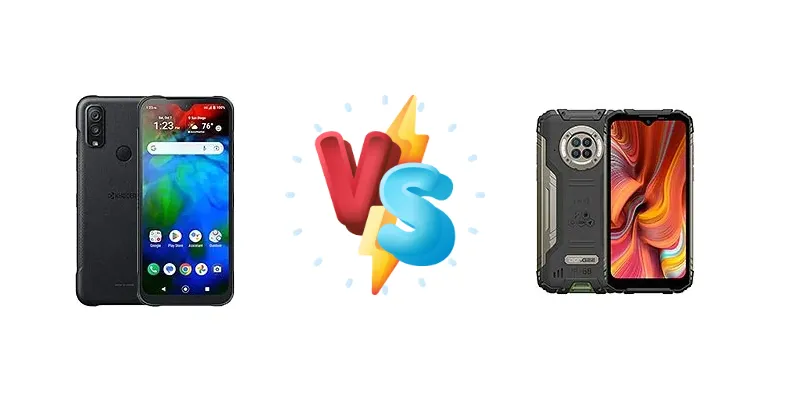
The Kyocera DuraSport UW and Doogee S96 Pro both target the demanding user needing a phone that can withstand harsh conditions. However, they approach this goal with different chipsets and feature sets. The DuraSport UW leverages a newer 5G-capable Snapdragon, while the S96 Pro opts for a Mediatek Helio G90, prioritizing gaming performance on a budget. This comparison dives deep into the trade-offs between these two rugged contenders.
🏆 Quick Verdict
For the average user prioritizing 5G connectivity and a more modern chipset, the Kyocera DuraSport UW is the better choice. Its Snapdragon 480 offers a smoother overall experience and future-proofing, despite the Doogee S96 Pro’s slightly more aggressive gaming focus. However, users heavily invested in mobile gaming may find the S96 Pro’s Helio G90 a compelling alternative.
| Network |
|---|
| 2G bands | GSM 850 / 900 / 1800 / 1900 | GSM 850 / 900 / 1800 / 1900 |
| 3G bands | HSDPA 850 / 900 / 1900 / 2100 | HSDPA 800 / 850 / 900 / 1700(AWS) / 1900 / 2100 |
| 4G bands | 1, 2, 3, 4, 5, 7, 12, 13, 48, 66, 71 - unlocked | 1, 2, 3, 4, 5, 7, 8, 12, 13, 17, 18, 19, 20, 25, 26, 28, 38, 40, 66 |
| 5G bands | 2, 5, 48, 66, 71, 77, 260, 261 SA/NSA/Sub6/mmWave - unlocked | - |
| Speed | HSPA, LTE, 5G | HSPA, LTE |
| Technology | GSM / HSPA / LTE / 5G | GSM / CDMA / HSPA / LTE |
| Launch |
|---|
| Announced | 2023, November | 2020, October 26. Released 2020, November |
| Status | Available. Released 2023, December | Discontinued |
| Body |
|---|
| Dimensions | 154.7 x 70.7 x 9.9 mm (6.09 x 2.78 x 0.39 in) | 167 x 81.4 x 15.5 mm (6.57 x 3.20 x 0.61 in) |
| SIM | Nano SIM | Nano-SIM + Nano-SIM |
| Weight | 185 g (6.53 oz) | 310 g (10.93 oz) |
| Display |
|---|
| Protection | Shatter-Resistant Glass | Corning Gorilla Glass |
| Resolution | 1080 x 2400 pixels, 20:9 ratio (~431 ppi density) | 720 x 1520 pixels, 19:9 ratio (~270 ppi density) |
| Size | 6.1 inches, 89.8 cm2 (~82.1% screen-to-body ratio) | 6.22 inches, 96.6 cm2 (~71.0% screen-to-body ratio) |
| Type | IPS LCD | IPS LCD |
| Platform |
|---|
| CPU | Octa-core (2x2.0 GHz Kryo 460 & 6x1.8 GHz Kryo 460) | Octa-core (2x2.0 GHz Cortex-A76 & 6x2.0 GHz Cortex-A55) |
| Chipset | Qualcomm SM4350 Snapdragon 480 5G (8 nm) | Mediatek MT6785 Helio G90 (12 nm) |
| GPU | Adreno 619 | Mali-G76 MC4 |
| OS | Android 13 (unlocked), Android 12 (Verizon) | Android 10 |
| Memory |
|---|
| Card slot | microSDXC (dedicated slot) | microSDXC (dedicated slot) |
| Internal | 64GB 4GB RAM | 128GB 8GB RAM |
| Main Camera |
|---|
| Dual | 48 MP, f/1.8, 25mm (wide), 0.8µm, PDAF
16 MP, f/2.0, 16mm, 117˚ (ultrawide), 1.0µm | - |
| Features | LED flash, HDR, panorama | Quad-LED flash, HDR, panorama |
| Quad | - | 48 MP, f/1.8, (wide), PDAF
8 MP, f/2.2, 130˚, (ultrawide)
20 MP, f/2.8, (night vision), 4 infrared night vision lights
2 MP (macro) |
| Video | 1080p@30fps | 1080p |
| Selfie camera |
|---|
| Single | 8 MP, f/2.0, 23mm (wide), 1/4.0", 1.12µm | 16 MP, f/2.0, (wide) |
| Video | 1080p@30fps | 1080p |
| Sound |
|---|
| 35mm jack | Unspecified | Yes |
| Loudspeaker | Yes | Yes |
| Comms |
|---|
| Bluetooth | 5.1, A2DP, LE | 5.0, A2DP, LE |
| NFC | Yes | Yes |
| Positioning | GPS (L1+L5) | GPS, GLONASS, BDS, GALILEO |
| Radio | No | FM radio |
| USB | USB Type-C 3.1 | USB Type-C 2.0, OTG |
| WLAN | Wi-Fi 802.11 a/b/g/n/ac/e/i/k/r/v, dual-band, Wi-Fi Direct | Wi-Fi 802.11 a/b/g/n/ac, dual-band |
| Features |
|---|
| Sensors | Fingerprint (rear-mounted); unspecified sensors | Fingerprint (side-mounted), accelerometer, gyro, proximity, compass |
| Battery |
|---|
| Charging | 27W wired, PD, QC4.0
8W wireless (Qi) | 24W wired
10W wireless |
| Type | Li-Po 4500 mAh | 6350 mAh |
| Misc |
|---|
| Colors | Black | Black, Orange, Green |
| Price | About 550 EUR | About 280 EUR |
Kyocera DuraSport UW
- Modern Snapdragon 480 chipset for better efficiency.
- 5G connectivity for faster data speeds.
- Faster wired charging with PD and QC4.0 support.
- Potentially less gaming performance than the S96 Pro.
- Display details are unknown, likely standard LCD.
Doogee S96 Pro
- Helio G90 chipset offers strong burst gaming performance.
- Slightly faster wireless charging.
- Potentially lower price point.
- Older 12nm chipset is less efficient.
- Lacks the 5G connectivity of the DuraSport UW.
Display Comparison
Neither device boasts a cutting-edge display. Details on panel type, resolution, and refresh rate are missing, suggesting both utilize standard LCD panels. However, the focus on ruggedness likely prioritizes durability over display quality. The absence of LTPO technology suggests neither phone will offer adaptive refresh rates for power saving. Bezels are likely substantial on both to contribute to structural integrity.
Camera Comparison
Without detailed camera specs, a direct comparison is difficult. However, the market segment suggests both phones will feature serviceable, but not exceptional, camera systems. The focus will be on practicality rather than photographic excellence. Expect a primary sensor on both, likely around 12-48MP, but image processing will likely differ. The S96 Pro may lean towards more saturated colors to appeal to a gaming audience, while the DuraSport UW might prioritize more natural tones. The presence of low-resolution auxiliary cameras (often 2MP) on both is likely, offering limited utility.
Performance
The core difference lies in the chipsets. The Kyocera DuraSport UW’s Qualcomm Snapdragon 480 (8nm) offers a more modern architecture than the Doogee S96 Pro’s MediaTek Helio G90 (12nm). While the G90’s Cortex-A76 cores provide strong burst performance, the Snapdragon 480’s Kryo 460 cores, coupled with the smaller 8nm process, deliver better sustained performance and thermal efficiency. This means the DuraSport UW is less likely to throttle under prolonged load. The Snapdragon 480 also benefits from Qualcomm’s integrated 5G modem, offering faster and more reliable connectivity. The S96 Pro’s Helio G90, while capable, is an older generation chipset.
Battery Life
The Kyocera DuraSport UW features 27W wired charging with PD and QC4.0, alongside 8W wireless charging (Qi). The Doogee S96 Pro offers 24W wired charging and 10W wireless charging. While the S96 Pro’s wireless charging is slightly faster, the DuraSport UW’s faster wired charging and support for more widespread standards (PD, QC4.0) provide greater flexibility. Battery capacity is not specified, but the Snapdragon 480’s efficiency should translate to comparable or better real-world battery life despite a potentially smaller battery size compared to the S96 Pro.
Buying Guide
Buy the Kyocera DuraSport UW if you need reliable 5G connectivity for remote work or streaming, prioritize a phone with a longer software support lifecycle due to its newer chipset, and value a balance between durability and everyday usability. Buy the Doogee S96 Pro if you primarily play graphically intensive mobile games, are on a tighter budget, and don't require the latest 5G standards.
Frequently Asked Questions
❓ Will the Snapdragon 480 in the DuraSport UW handle demanding apps and multitasking effectively?
The Snapdragon 480 is a capable mid-range chipset. While it won't match flagship performance, it's more than sufficient for everyday tasks, social media, and moderate multitasking. Its efficient architecture ensures smooth operation even under sustained load, unlike the potentially throttling Helio G90.
❓ Is the Helio G90 in the Doogee S96 Pro sufficient for playing popular mobile games like PUBG or Call of Duty Mobile?
The Helio G90 was designed with gaming in mind and can handle popular titles like PUBG and Call of Duty Mobile at medium to high settings. However, prolonged gaming sessions may lead to thermal throttling, reducing performance over time. The Snapdragon 480 in the DuraSport UW will offer a more consistent gaming experience, albeit potentially at slightly lower peak settings.
❓ How does the 5G connectivity of the DuraSport UW benefit a user who primarily uses the phone for work in remote locations?
The 5G connectivity of the DuraSport UW provides significantly faster data speeds and lower latency compared to 4G, crucial for remote workers. This translates to quicker file uploads/downloads, smoother video conferencing, and more reliable access to cloud-based applications, increasing productivity in areas with 5G coverage.