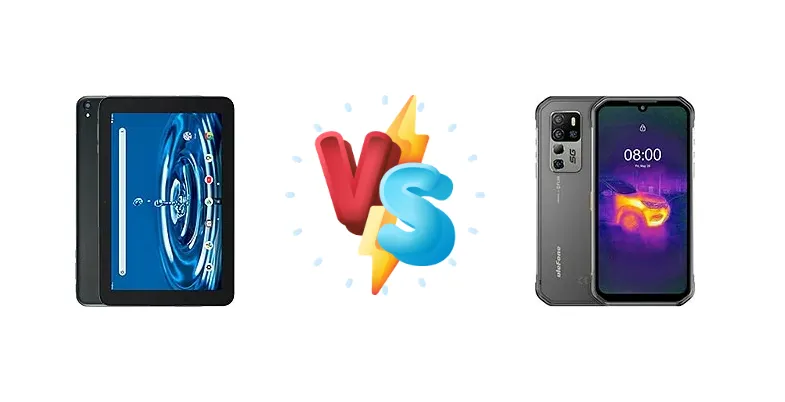
The rugged smartphone market caters to users needing durability, but performance and features vary greatly. We pit the Kyocera DuraSlate, a workhorse known for reliability, against the Ulefone Armor 11T 5G, a newer contender boasting 5G connectivity and a more powerful chipset. This comparison focuses on how these differences translate to real-world usability.
🏆 Quick Verdict
For the average user prioritizing performance and future-proofing, the Ulefone Armor 11T 5G is the clear winner. Its Dimensity 800 chipset delivers a substantial performance leap over the DuraSlate’s Helio P35. However, the DuraSlate remains a viable option for those needing a proven, reliable device where raw speed isn't paramount.
| Network |
|---|
| 2G bands | N/A | GSM 850 / 900 / 1800 / 1900 |
| 3G bands | N/A | HSDPA 850 / 900 / 1700(AWS) / 1900 / 2100 |
| 4G bands | N/A | 1, 2, 3, 4, 5, 7, 8, 12, 13, 17, 18, 19, 20, 25, 26, 28, 34, 38, 39, 40, 41, 66 |
| 5G bands | - | 1, 3, 5, 8, 20, 28, 38, 41, 77, 78, 79 SA/NSA |
| EDGE | No | - |
| GPRS | No | - |
| Speed | - | HSPA, LTE, 5G |
| Technology | No cellular connectivity | GSM / CDMA / HSPA / EVDO / LTE / 5G |
| | - | CDMA2000 1xEV-DO |
| Launch |
|---|
| Announced | 2023, October | 2021, May 29 |
| Status | Available. Released 2023, October | Available. Released 2021, June 07 |
| Body |
|---|
| Build | - | Front glass, aluminum back with rubber, aluminum frame |
| Dimensions | 259 x 168 x 8.6 mm (10.20 x 6.61 x 0.34 in) | 163.8 x 81.6 x 14.2 mm (6.45 x 3.21 x 0.56 in) |
| SIM | No | Nano-SIM + Nano-SIM |
| Weight | 488 g (1.08 lb) | 293 g (10.34 oz) |
| | - | IP69K dust/water resistant (up to 1.5m for 30 min)
Drop-to-concrete resistance from up to 1.2m
MIL-STD-810G compliant |
| Display |
|---|
| Protection | Dragontrail Pro Glass | Oleophobic coating |
| Resolution | 1200 x 1920 pixels, 16:10 ratio (~224 ppi density) | 720 x 1560 pixels, 19.5:9 ratio (~282 ppi density) |
| Size | 10.1 inches, 295.8 cm2 (~68.0% screen-to-body ratio) | 6.1 inches, 91.3 cm2 (~68.3% screen-to-body ratio) |
| Type | IPS LCD | IPS LCD |
| Platform |
|---|
| CPU | Octa-core (4x2.35 GHz Cortex-A53 & 4x1.8 GHz Cortex-A53) | Octa-core (4x2.0 GHz Cortex-A76 & 4x2.0 GHz Cortex-A55) |
| Chipset | Mediatek MT6765 Helio P35 (12 nm) | Mediatek Dimensity 800 (7 nm) |
| GPU | PowerVR GE8320 | Mali-G57 MP4 |
| OS | Android 12 | Android 11 |
| Memory |
|---|
| Card slot | microSDXC (dedicated slot) | No |
| Internal | 32GB 3GB RAM | 256GB 8GB RAM |
| | - | UFS 2.1 |
| Main Camera |
|---|
| Features | LED flash | Dual-LED dual-tone flash, HDR, panorama |
| Penta | - | 48 MP, f/1.8, 26mm (wide), 1/2.0", 0.8µm, PDAF
FLIR thermal camera (Lepton module)
5 MP
2 MP (macro)
Auxiliary lens |
| Single | 8 MP, f/2.4, (wide), 1/4.0", 1.12µm, AF | 16 MP, f/2.0 |
| Video | 1080p@30fps | 4K@30fps, 1080p@30fps |
| Selfie camera |
|---|
| Features | - | HDR, panorama |
| Single | 5 MP, f/2.4 | 16 MP, f/2.0 |
| Video | Yes | 1080p@30fps |
| Sound |
|---|
| 3.5mm jack | - | Yes |
| 35mm jack | Yes | Yes |
| Loudspeaker | Yes, with stereo speakers | Yes |
| Comms |
|---|
| Bluetooth | 5.1, A2DP, LE | 5.0, A2DP, LE |
| NFC | No | Yes |
| Positioning | GPS, GALILEO, GLONASS, BDS, QZSS | GPS, GLONASS, GALILEO, BDS |
| Radio | Unspecified | FM radio, RDS, recording |
| USB | USB Type-C 2.0 | USB Type-C 2.0, OTG |
| WLAN | Wi-Fi 802.11 a/b/g/n/ac/d/e/i/k/r/v, dual-band, Wi-Fi Direct | Wi-Fi 802.11 a/b/g/n/ac, Wi-Fi Direct |
| Features |
|---|
| Sensors | Accelerometer, gyro, proximity, compass | Fingerprint (side-mounted), accelerometer, gyro, proximity, compass, baroceptor |
| Battery |
|---|
| Charging | 45W wired, PD2 | 18W wired
10W wireless |
| Type | Li-Ion 7000 mAh | Li-Po 5200 mAh |
| Misc |
|---|
| Colors | Black | Black |
| Models | KC-T304C | - |
| Price | About 360 EUR | About 590 EUR |
Kyocera DuraSlate
- Proven reliability and durability.
- 45W wired charging with PD2 (potential for fast charging).
- Likely lower price point due to age.
- Significantly weaker processor performance.
- Older chipset limits future software updates.
- Likely lower-quality display.
Ulefone Armor 11T 5G
- Much faster processor (Dimensity 800).
- 5G connectivity for faster data speeds.
- Wireless charging for added convenience.
- Lower wired charging wattage (18W).
- Potentially higher price.
- May not be as battle-tested as the DuraSlate.
Display Comparison
Neither device’s display specifications are provided, so a direct comparison is limited. However, given the DuraSlate’s age and target market, it likely features a lower-resolution panel with standard LCD technology. The Armor 11T 5G, being a newer device, likely benefits from a more modern display, potentially with higher brightness and improved color accuracy. The lack of information on refresh rates or PWM dimming makes it difficult to assess eye strain potential.
Camera Comparison
Without detailed camera specifications, a precise comparison is challenging. However, the Armor 11T 5G’s newer chipset likely supports more advanced image processing algorithms. The DuraSlate, with its older chipset, will likely struggle with dynamic range and low-light performance compared to the Armor 11T 5G. The presence of a 5G modem in the Armor 11T 5G suggests a more modern ISP (Image Signal Processor) is also present, further enhancing image quality.
Performance
The performance gap between these two devices is significant. The Ulefone Armor 11T 5G’s Mediatek Dimensity 800 (7nm) is a substantial upgrade over the Kyocera DuraSlate’s Mediatek MT6765 Helio P35 (12nm). The Dimensity 800 utilizes Cortex-A76 cores, offering a considerable IPC (Instructions Per Clock) improvement over the DuraSlate’s Cortex-A53 cores. The 7nm process node also contributes to better thermal efficiency, meaning the Armor 11T 5G can sustain higher performance for longer periods. This translates to faster app loading times, smoother multitasking, and a more responsive user experience on the Ulefone.
Battery Life
Battery capacity isn’t specified for either device. However, the Ulefone Armor 11T 5G offers both 18W wired and 10W wireless charging, providing greater convenience. The DuraSlate supports 45W wired charging with PD2, which *could* result in faster charging times *if* paired with a compatible charger and a similarly sized battery. The Armor 11T 5G’s wireless charging is a significant advantage for users who prefer cable-free charging.
Buying Guide
Buy the Kyocera DuraSlate if you need a dependable, no-frills rugged phone for essential tasks and prioritize long-term reliability over cutting-edge performance. It’s ideal for field workers who need a phone that simply *works*. Buy the Ulefone Armor 11T 5G if you prefer a faster, more versatile device with 5G connectivity, better suited for multimedia consumption, and occasional gaming. It’s a good fit for users who want a rugged phone that doesn’t compromise on modern features.
Frequently Asked Questions
❓ Will the Ulefone Armor 11T 5G overheat during prolonged use of 5G or gaming?
The Mediatek Dimensity 800’s 7nm process node is more efficient than the DuraSlate’s Helio P35’s 12nm node. This means the Armor 11T 5G is less prone to overheating under load, though sustained heavy use will still generate heat. The device likely incorporates thermal management solutions to mitigate throttling.
❓ Is the Kyocera DuraSlate still a good choice for basic communication and field work where speed isn't critical?
Absolutely. The DuraSlate’s strength lies in its proven reliability and ruggedness. If your primary needs are making calls, sending texts, and using basic apps in challenging environments, the DuraSlate remains a viable and cost-effective option. It’s built to withstand abuse, which is its core value proposition.
❓ Does the Ulefone Armor 11T 5G support VoLTE and Wi-Fi calling on all carriers?
Compatibility with VoLTE and Wi-Fi calling varies by carrier. While the Armor 11T 5G supports these features, it’s crucial to check with your specific carrier to ensure compatibility before purchasing. Ulefone’s website or customer support can provide more detailed information.