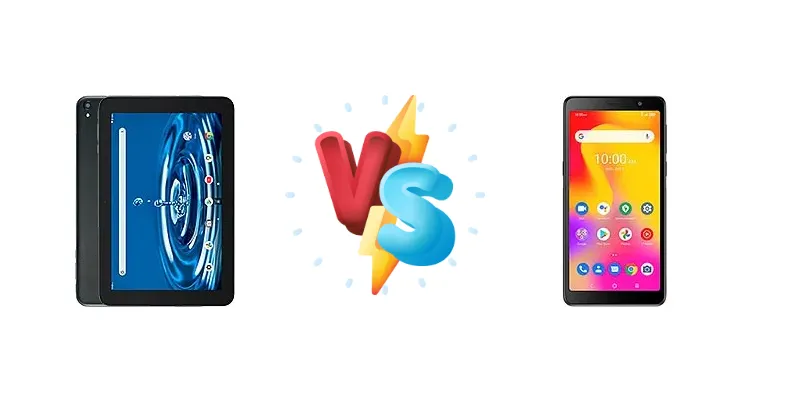
The Kyocera DuraSlate and TCL A30 represent opposite ends of the smartphone spectrum. The DuraSlate prioritizes extreme durability for demanding work environments, while the A30 focuses on delivering the most smartphone functionality for the lowest possible price. This comparison dissects their core components to determine which device best suits your needs.
🏆 Quick Verdict
For users needing a truly rugged device capable of withstanding harsh conditions, the Kyocera DuraSlate is the clear winner. Its more powerful Mediatek Helio P35 chipset and 45W PD2 charging offer a smoother experience, despite the TCL A30’s lower price point. However, the A30 is a viable option for basic smartphone tasks.
| Network |
|---|
| 2G bands | N/A | GSM 850 / 900 / 1800 / 1900 |
| 3G bands | N/A | HSDPA 850 / 1700(AWS) / 1900 |
| 4G bands | N/A | 2, 4, 5, 12, 13, 25, 26, 41, 66, 71 |
| EDGE | No | - |
| GPRS | No | - |
| Speed | - | HSPA 42.2/5.76 Mbps, LTE Cat4 150/50 Mbps |
| Technology | No cellular connectivity | GSM / HSPA / LTE |
| Launch |
|---|
| Announced | 2023, October | 2021, October 05 |
| Status | Available. Released 2023, October | Available. Released 2021, October 05 |
| Body |
|---|
| Dimensions | 259 x 168 x 8.6 mm (10.20 x 6.61 x 0.34 in) | 145.8 x 71.1 x 9.9 mm (5.74 x 2.80 x 0.39 in) |
| SIM | No | Nano-SIM |
| Weight | 488 g (1.08 lb) | 171 g (6.03 oz) |
| Display |
|---|
| Protection | Dragontrail Pro Glass | Asahi Glass |
| Resolution | 1200 x 1920 pixels, 16:10 ratio (~224 ppi density) | 720 x 1440 pixels, 18:9 ratio (~293 ppi density) |
| Size | 10.1 inches, 295.8 cm2 (~68.0% screen-to-body ratio) | 5.5 inches, 78.1 cm2 (~75.3% screen-to-body ratio) |
| Type | IPS LCD | TFT LCD |
| Platform |
|---|
| CPU | Octa-core (4x2.35 GHz Cortex-A53 & 4x1.8 GHz Cortex-A53) | Octa-core 2.0 GHz Cortex-A53 |
| Chipset | Mediatek MT6765 Helio P35 (12 nm) | Mediatek MT6762 Helio P22 (12 nm) |
| GPU | PowerVR GE8320 | PowerVR GE8320 |
| OS | Android 12 | Android 11 |
| Memory |
|---|
| Card slot | microSDXC (dedicated slot) | microSDXC (dedicated slot) |
| Internal | 32GB 3GB RAM | 32GB 3GB RAM |
| Main Camera |
|---|
| Features | LED flash | LED flash |
| Single | 8 MP, f/2.4, (wide), 1/4.0", 1.12µm, AF | 8 MP, 1/4.0", 1.12µm |
| Video | 1080p@30fps | 1080p@30fps |
| Selfie camera |
|---|
| Single | 5 MP, f/2.4 | 5 MP, 1/5.0", 1.12µm |
| Video | Yes | 1080p@30fps |
| Sound |
|---|
| 35mm jack | Yes | Yes |
| Loudspeaker | Yes, with stereo speakers | Yes |
| Comms |
|---|
| Bluetooth | 5.1, A2DP, LE | 5.0, A2DP, LE |
| NFC | No | No |
| Positioning | GPS, GALILEO, GLONASS, BDS, QZSS | GPS |
| Radio | Unspecified | Unspecified |
| USB | USB Type-C 2.0 | microUSB 2.0 |
| WLAN | Wi-Fi 802.11 a/b/g/n/ac/d/e/i/k/r/v, dual-band, Wi-Fi Direct | Wi-Fi 802.11 b/g/n, Wi-Fi Direct |
| Features |
|---|
| Sensors | Accelerometer, gyro, proximity, compass | Accelerometer, proximity |
| Battery |
|---|
| Charging | 45W wired, PD2 | - |
| Type | Li-Ion 7000 mAh | Li-Ion 3000 mAh |
| Misc |
|---|
| Colors | Black | Black |
| Models | KC-T304C | 5102, 5102L |
| Price | About 360 EUR | About 90 EUR |
Kyocera DuraSlate
- More powerful Mediatek Helio P35 processor
- Faster 45W PD2 charging
- Ruggedized design for extreme durability
- Likely higher price point
- Potentially less vibrant display due to ruggedization
TCL A30
- Significantly lower price
- Potentially larger battery capacity
- Acceptable performance for basic tasks
- Slower Mediatek Helio P22 processor
- Slower charging speeds
- Lacks ruggedization for harsh environments
Display Comparison
Neither device's display specifications are provided, so a direct comparison is limited. However, given the DuraSlate's rugged focus, it likely features a thicker, more impact-resistant display, potentially sacrificing some color vibrancy compared to the A30. The A30, aiming for cost-effectiveness, may utilize a lower-quality panel. Expect the DuraSlate to prioritize visibility in direct sunlight due to its target user base.
Camera Comparison
Without specific camera sensor details, a detailed comparison is difficult. However, given the DuraSlate’s rugged positioning, its camera is likely optimized for quick documentation in the field, prioritizing functionality over image quality. The TCL A30, in the budget segment, likely features a more standard camera setup focused on providing acceptable results in good lighting conditions. It's reasonable to assume the A30 will offer more camera features, but the DuraSlate will be more durable.
Performance
The Kyocera DuraSlate’s Mediatek Helio P35 chipset, built on a 12nm process, offers a performance advantage over the TCL A30’s Helio P22. The P35’s octa-core configuration (4x2.35 GHz Cortex-A53 & 4x1.8 GHz Cortex-A53) provides a higher clock speed and a more balanced core distribution than the A30’s 2.0 GHz Cortex-A53 cores. This translates to snappier app loading times and smoother multitasking on the DuraSlate. While both chips are 12nm, the P35’s architecture is more capable, benefiting users who frequently switch between applications or use moderately demanding apps. The A30 will be sufficient for basic tasks, but will struggle with heavier workloads.
Battery Life
Battery capacity isn't specified for either device. However, the DuraSlate’s 45W wired charging with PD2 support is a significant advantage. This allows for much faster charging times compared to the A30, which likely utilizes a slower charging standard. While the A30 might have a larger battery capacity, the DuraSlate’s faster charging mitigates the impact of a potentially smaller battery, ensuring less downtime for users who rely on their phone throughout the day. PD2 also offers more efficient charging, reducing heat generation.
Buying Guide
Buy the Kyocera DuraSlate if you require a phone that can survive drops, dust, and water exposure – ideal for construction workers, field technicians, or anyone in a demanding profession. Buy the TCL A30 if you prioritize affordability and need a functional smartphone for basic communication, social media, and light web browsing, and don't require robust physical protection.
Frequently Asked Questions
❓ Is the Kyocera DuraSlate’s Helio P35 capable of running demanding apps like mapping software or CAD viewers?
The Helio P35 is a capable mid-range processor. While it won't deliver flagship-level performance, it should handle most mapping and basic CAD applications adequately. However, complex 3D models or highly detailed maps may experience some lag. The DuraSlate’s rugged build is more critical for these use cases than raw processing power.
❓ How does the TCL A30 perform with multiple apps open simultaneously?
The TCL A30’s Helio P22, with its lower clock speed and less efficient architecture, will struggle with heavy multitasking. Expect noticeable slowdowns when switching between several apps. It’s best suited for running one app at a time or a limited number of lightweight applications.
❓ Does the DuraSlate’s ruggedization add significant bulk or weight to the device?
Yes, the DuraSlate’s rugged construction inevitably adds bulk and weight compared to the TCL A30. This is a trade-off for its enhanced durability. It’s designed to be functional and withstand abuse, not to be sleek and lightweight.
❓ Is the TCL A30 a good choice for someone who frequently drops their phone?
No, the TCL A30 is not designed for drop protection. Its plastic construction is susceptible to damage from even moderate falls. If you are prone to dropping your phone, the Kyocera DuraSlate is a far more suitable option.