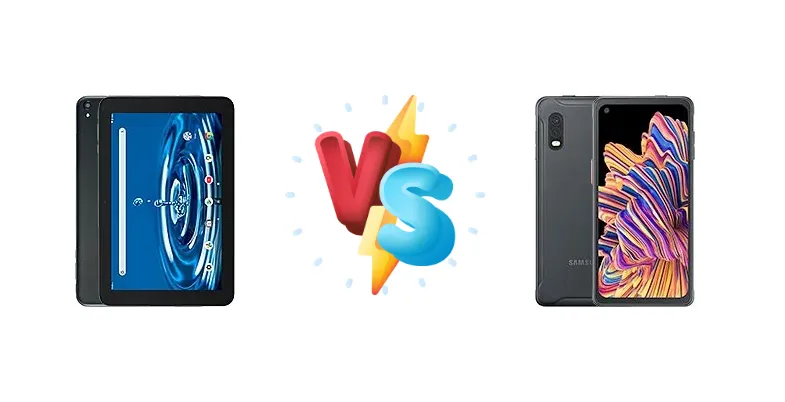
The Kyocera DuraSlate and Samsung Galaxy XCover Pro occupy a niche market: durable smartphones built to withstand harsh conditions. While both aim for resilience, they diverge significantly in internal hardware and target user. This comparison dissects their core components to determine which device delivers the best blend of performance, longevity, and value for demanding professionals and outdoor enthusiasts.
🏆 Quick Verdict
For users prioritizing raw processing power and faster software updates, the Samsung Galaxy XCover Pro is the better choice. However, the Kyocera DuraSlate’s 45W PD2 charging and potentially lower cost make it compelling for those needing rapid replenishment and a more budget-conscious rugged solution.
| Network |
|---|
| 2G bands | N/A | GSM 850 / 900 / 1800 / 1900 |
| 3G bands | N/A | HSDPA 850 / 900 / 1900 / 2100 - International |
| 4G bands | N/A | 1, 2, 3, 5, 7, 8, 20, 28, 38, 40, 41 - International |
| EDGE | No | - |
| GPRS | No | - |
| Speed | - | HSPA 42.2/5.76 Mbps, LTE (3CA) Cat11 600/50 Mbps |
| Technology | No cellular connectivity | GSM / HSPA / LTE |
| | - | 1, 2, 3, 4, 5, 7, 12, 13, 14, 20, 29, 38, 40, 41, 66 - Canada |
| Launch |
|---|
| Announced | 2023, October | 2020, January |
| Status | Available. Released 2023, October | Available. Released 2020, January |
| Body |
|---|
| Dimensions | 259 x 168 x 8.6 mm (10.20 x 6.61 x 0.34 in) | 159.9 x 76.7 x 10 mm (6.30 x 3.02 x 0.39 in) |
| SIM | No | · Nano-SIM· Nano-SIM + Nano-SIM |
| Weight | 488 g (1.08 lb) | 218 g (7.69 oz) |
| | - | IP68 dust/water resistant (up to 1.5m for 35 min)
Drop-to-concrete resistance from up to 1.5m
MIL-STD-810G compliant*
*does not guarantee ruggedness or use in extreme conditions |
| Display |
|---|
| Protection | Dragontrail Pro Glass | Corning Gorilla Glass 5 |
| Resolution | 1200 x 1920 pixels, 16:10 ratio (~224 ppi density) | 1080 x 2340 pixels, 19.5:9 ratio (~409 ppi density) |
| Size | 10.1 inches, 295.8 cm2 (~68.0% screen-to-body ratio) | 6.3 inches, 97.4 cm2 (~79.4% screen-to-body ratio) |
| Type | IPS LCD | IPS LCD |
| Platform |
|---|
| CPU | Octa-core (4x2.35 GHz Cortex-A53 & 4x1.8 GHz Cortex-A53) | Octa-core (4x2.3 GHz Cortex-A73 & 4x1.7 GHz Cortex-A53) |
| Chipset | Mediatek MT6765 Helio P35 (12 nm) | Exynos 9611 (10 nm) |
| GPU | PowerVR GE8320 | Mali-G72 MP3 |
| OS | Android 12 | Android 10, upgradable to Android 13, One UI 5 |
| Memory |
|---|
| Card slot | microSDXC (dedicated slot) | microSDXC (dedicated slot) |
| Internal | 32GB 3GB RAM | 64GB 4GB RAM |
| Main Camera |
|---|
| Dual | - | 25 MP, f/1.7, 26mm (wide), PDAF
8 MP, f/2.2, 123˚ (ultrawide), 1/4.0", 1.12µm |
| Features | LED flash | Dual-LED flash, HDR, panorama |
| Single | 8 MP, f/2.4, (wide), 1/4.0", 1.12µm, AF | - |
| Video | 1080p@30fps | 1080p@30fps |
| Selfie camera |
|---|
| Features | - | HDR |
| Single | 5 MP, f/2.4 | 13 MP, f/2.0, (wide), 1/3.1", 1.12µm |
| Video | Yes | 1080p@30fps |
| Sound |
|---|
| 3.5mm jack | - | Yes |
| 35mm jack | Yes | Yes |
| Loudspeaker | Yes, with stereo speakers | Yes |
| Comms |
|---|
| Bluetooth | 5.1, A2DP, LE | 5.0, A2DP, LE |
| NFC | No | Yes |
| Positioning | GPS, GALILEO, GLONASS, BDS, QZSS | GPS, GLONASS, GALILEO, BDS |
| Radio | Unspecified | FM radio (market/region dependent) |
| USB | USB Type-C 2.0 | USB Type-C 2.0 |
| WLAN | Wi-Fi 802.11 a/b/g/n/ac/d/e/i/k/r/v, dual-band, Wi-Fi Direct | Wi-Fi 802.11 a/b/g/n/ac/k/v/r, dual-band, Wi-Fi Direct |
| Features |
|---|
| Sensors | Accelerometer, gyro, proximity, compass | Fingerprint (side-mounted), accelerometer, gyro, proximity, compass |
| | - | ANT+ |
| Battery |
|---|
| Charging | 45W wired, PD2 | 15W wired |
| Type | Li-Ion 7000 mAh | Li-Po 4050 mAh, removable |
| Misc |
|---|
| Colors | Black | Black |
| Models | KC-T304C | SM-G715FN/DS, SM-G715FN, SM-G715F, SM-G715W, SM-G715U, SM-G715U1 |
| Price | About 360 EUR | About 120 EUR |
| SAR EU | - | 0.47 W/kg (head) 1.23 W/kg (body) |
Kyocera DuraSlate
- 45W PD2 Fast Charging: Significantly reduces downtime.
- Potentially Lower Cost: Likely more affordable than the Samsung.
- Rugged Design: Built to withstand harsh environments.
- Inferior Processor: Helio P35 struggles with demanding tasks.
- Older CPU Architecture: Cortex-A53 cores are less efficient.
Samsung Galaxy XCover Pro
- More Powerful Processor: Exynos 9611 offers better performance.
- Modern CPU Architecture: Cortex-A73 cores provide a smoother experience.
- Samsung Ecosystem: Access to Samsung’s software and services.
- Slower Charging: 15W charging is significantly slower than the DuraSlate.
- Potentially Higher Price: Likely more expensive than the Kyocera.
Display Comparison
Neither device boasts a cutting-edge display. Details on panel type (IPS, AMOLED) and resolution are missing, but both are likely optimized for visibility under direct sunlight rather than color accuracy. The focus is on durability, meaning tempered glass and potentially thicker bezels. Without specific brightness data, it's difficult to declare a winner, but Samsung generally employs better display calibration even on its lower-tier devices.
Camera Comparison
Camera details are sparse, but the market positioning suggests neither phone prioritizes photographic excellence. The absence of information regarding sensor size and image stabilization makes a direct comparison difficult. However, the Exynos 9611 typically includes an ISP capable of better image processing than the Helio P35’s equivalent. Any claims of advanced features on either device should be viewed skeptically; these are work-focused phones, not camera-focused ones. The presence of a 2MP macro lens on either device is likely a marketing gimmick with limited practical value.
Performance
The Samsung Galaxy XCover Pro holds a clear advantage in processing power. Its Exynos 9611, fabricated on a 10nm process, features Cortex-A73 cores clocked at 2.3 GHz, offering significantly better single-core performance than the Kyocera DuraSlate’s Mediatek Helio P35. The Helio P35, built on a 12nm process, relies on older Cortex-A53 cores, making it suitable for basic tasks but potentially struggling with demanding applications or heavy multitasking. The Exynos’s architecture translates to a smoother user experience and faster app loading times. While RAM details are missing, the Exynos chip's superior architecture will likely yield better overall responsiveness.
Battery Life
Battery capacity is not specified, but the charging capabilities reveal a significant difference. The Kyocera DuraSlate’s 45W wired charging with PD2 support allows for substantially faster replenishment than the Samsung Galaxy XCover Pro’s 15W charging. This is a critical advantage for users who need to minimize downtime in the field. While a larger battery capacity on the XCover Pro could offset the slower charging, the DuraSlate’s faster charging is a more impactful benefit for the target demographic. The PD2 standard also ensures compatibility with a wider range of chargers.
Buying Guide
Buy the Kyocera DuraSlate if you need a highly durable phone with fast charging capabilities and are less concerned with top-tier processing performance. This device is ideal for field workers who prioritize battery turnaround time and cost-effectiveness. Buy the Samsung Galaxy XCover Pro if you prefer a more powerful processor for multitasking and demanding applications, along with the benefits of Samsung’s software ecosystem and potentially longer software support.
Frequently Asked Questions
❓ Does the Exynos 9611 in the Galaxy XCover Pro tend to overheat under sustained load, like during prolonged navigation or video recording?
The Exynos 9611 is known to throttle under sustained load, but its thermal management is generally adequate for typical smartphone usage. While it won't match the performance of flagship chips, it's unlikely to experience critical overheating during navigation or moderate video recording. However, demanding gaming sessions may lead to noticeable performance drops.
❓ Is the 45W charging on the Kyocera DuraSlate compatible with standard USB-PD chargers, or does it require a specific Kyocera charger?
The Kyocera DuraSlate supports the USB Power Delivery (USB-PD) 2.0 standard, meaning it *should* be compatible with any USB-PD charger capable of delivering 45W. However, to ensure optimal charging speeds and safety, using a certified USB-PD charger is recommended. Using a non-compliant charger may result in slower charging or, in rare cases, compatibility issues.
❓ How does the software update policy differ between Kyocera and Samsung for these devices?
Samsung generally provides longer software support for its devices than Kyocera. The Galaxy XCover Pro is likely to receive more frequent security updates and potentially one or two major Android version updates. Kyocera’s update policy is less predictable, and the DuraSlate may receive fewer updates over its lifespan.