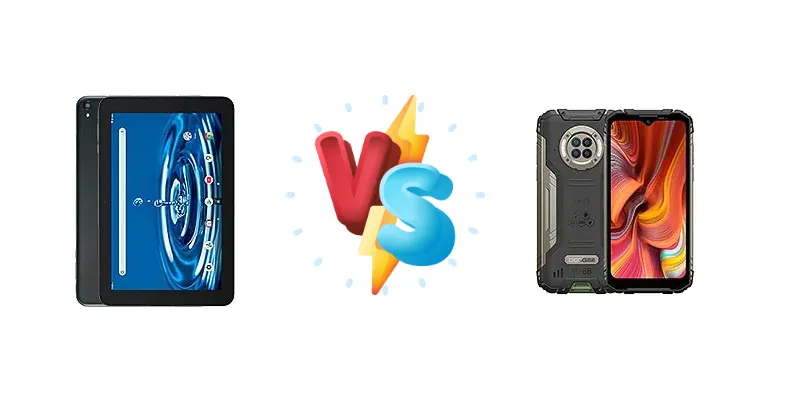
The rugged smartphone market caters to a specific need: durability. Both the Kyocera DuraSlate and Doogee S96 Pro aim to deliver on that promise, but they diverge significantly in their approach to internal hardware. The DuraSlate prioritizes a balance of affordability and robustness, while the S96 Pro leans towards offering a more powerful, albeit slightly pricier, experience. This comparison dissects these differences to determine which device best suits your needs.
🏆 Quick Verdict
For the average user prioritizing raw performance and faster charging, the Doogee S96 Pro is the clear winner. Its Helio G90 chipset provides a substantial upgrade over the DuraSlate’s Helio P35. However, the DuraSlate remains a viable option for those on a tighter budget who don't require intensive processing power.
| Network |
|---|
| 2G bands | N/A | GSM 850 / 900 / 1800 / 1900 |
| 3G bands | N/A | HSDPA 800 / 850 / 900 / 1700(AWS) / 1900 / 2100 |
| 4G bands | N/A | 1, 2, 3, 4, 5, 7, 8, 12, 13, 17, 18, 19, 20, 25, 26, 28, 38, 40, 66 |
| EDGE | No | - |
| GPRS | No | - |
| Speed | - | HSPA, LTE |
| Technology | No cellular connectivity | GSM / CDMA / HSPA / LTE |
| Launch |
|---|
| Announced | 2023, October | 2020, October 26. Released 2020, November |
| Status | Available. Released 2023, October | Discontinued |
| Body |
|---|
| Dimensions | 259 x 168 x 8.6 mm (10.20 x 6.61 x 0.34 in) | 167 x 81.4 x 15.5 mm (6.57 x 3.20 x 0.61 in) |
| SIM | No | Nano-SIM + Nano-SIM |
| Weight | 488 g (1.08 lb) | 310 g (10.93 oz) |
| Display |
|---|
| Protection | Dragontrail Pro Glass | Corning Gorilla Glass |
| Resolution | 1200 x 1920 pixels, 16:10 ratio (~224 ppi density) | 720 x 1520 pixels, 19:9 ratio (~270 ppi density) |
| Size | 10.1 inches, 295.8 cm2 (~68.0% screen-to-body ratio) | 6.22 inches, 96.6 cm2 (~71.0% screen-to-body ratio) |
| Type | IPS LCD | IPS LCD |
| Platform |
|---|
| CPU | Octa-core (4x2.35 GHz Cortex-A53 & 4x1.8 GHz Cortex-A53) | Octa-core (2x2.0 GHz Cortex-A76 & 6x2.0 GHz Cortex-A55) |
| Chipset | Mediatek MT6765 Helio P35 (12 nm) | Mediatek MT6785 Helio G90 (12 nm) |
| GPU | PowerVR GE8320 | Mali-G76 MC4 |
| OS | Android 12 | Android 10 |
| Memory |
|---|
| Card slot | microSDXC (dedicated slot) | microSDXC (dedicated slot) |
| Internal | 32GB 3GB RAM | 128GB 8GB RAM |
| Main Camera |
|---|
| Features | LED flash | Quad-LED flash, HDR, panorama |
| Quad | - | 48 MP, f/1.8, (wide), PDAF
8 MP, f/2.2, 130˚, (ultrawide)
20 MP, f/2.8, (night vision), 4 infrared night vision lights
2 MP (macro) |
| Single | 8 MP, f/2.4, (wide), 1/4.0", 1.12µm, AF | - |
| Video | 1080p@30fps | 1080p |
| Selfie camera |
|---|
| Single | 5 MP, f/2.4 | 16 MP, f/2.0, (wide) |
| Video | Yes | 1080p |
| Sound |
|---|
| 35mm jack | Yes | Yes |
| Loudspeaker | Yes, with stereo speakers | Yes |
| Comms |
|---|
| Bluetooth | 5.1, A2DP, LE | 5.0, A2DP, LE |
| NFC | No | Yes |
| Positioning | GPS, GALILEO, GLONASS, BDS, QZSS | GPS, GLONASS, BDS, GALILEO |
| Radio | Unspecified | FM radio |
| USB | USB Type-C 2.0 | USB Type-C 2.0, OTG |
| WLAN | Wi-Fi 802.11 a/b/g/n/ac/d/e/i/k/r/v, dual-band, Wi-Fi Direct | Wi-Fi 802.11 a/b/g/n/ac, dual-band |
| Features |
|---|
| Sensors | Accelerometer, gyro, proximity, compass | Fingerprint (side-mounted), accelerometer, gyro, proximity, compass |
| Battery |
|---|
| Charging | 45W wired, PD2 | 24W wired
10W wireless |
| Type | Li-Ion 7000 mAh | 6350 mAh |
| Misc |
|---|
| Colors | Black | Black, Orange, Green |
| Models | KC-T304C | - |
| Price | About 360 EUR | About 280 EUR |
Kyocera DuraSlate
- Faster Wired Charging (45W with PD2)
- Potentially Lower Price Point
- Rugged Build Quality
- Significantly Weaker Processor
- Likely Less Feature-Rich Camera
- No Wireless Charging
Doogee S96 Pro
- Much More Powerful Processor (Helio G90)
- Wireless Charging Support
- Potentially Better Camera System
- Slower Wired Charging (24W)
- Likely Higher Price
- Battery life may be impacted by the more powerful processor
Display Comparison
Neither device's display specifications are provided, so a direct comparison is limited. However, given the DuraSlate's focus on cost-effectiveness, it likely utilizes a standard IPS LCD panel. The S96 Pro, positioned as a more feature-rich device, *may* incorporate a higher-quality panel with improved color accuracy and viewing angles. The absence of details like resolution and refresh rate makes a definitive statement impossible, but the S96 Pro's higher tier suggests a potentially superior visual experience.
Camera Comparison
Without specific camera sensor details, a detailed comparison is challenging. However, the S96 Pro’s positioning suggests a more advanced camera system. The focus should be on the main sensor's megapixel count and aperture. The absence of OIS information for either device is a drawback. Given the S96 Pro's overall feature set, it's reasonable to assume a larger sensor and potentially more sophisticated image processing algorithms, resulting in better low-light performance and dynamic range. The DuraSlate likely prioritizes functionality over photographic excellence.
Performance
The core difference lies in the chipsets. The Doogee S96 Pro’s Mediatek Helio G90 (12nm) is a significant leap forward from the Kyocera DuraSlate’s Helio P35 (12nm). The G90 features a more modern CPU architecture – 2x2.0 GHz Cortex-A76 cores alongside 6x2.0 GHz Cortex-A55 cores – compared to the DuraSlate’s 4x2.35 GHz Cortex-A53 and 4x1.8 GHz Cortex-A53 configuration. The Cortex-A76 cores in the G90 offer substantially better single-core performance, crucial for responsive app loading and smoother multitasking. While both are 12nm chips, the G90’s architecture is more efficient, translating to better sustained performance under load. This means the S96 Pro will handle demanding games and applications with far greater ease.
Battery Life
Battery capacity isn't specified for either device, making a direct mAh comparison impossible. However, the charging capabilities reveal a key difference. The Doogee S96 Pro supports 24W wired charging *and* 10W wireless charging, offering greater convenience. The Kyocera DuraSlate, with its 45W wired charging and PD2 support, boasts significantly faster wired charging speeds. This means the DuraSlate can replenish its battery more quickly when plugged in, potentially offsetting a smaller battery capacity. The S96 Pro’s wireless charging is a notable advantage for users who prefer cable-free charging.
Buying Guide
Buy the Kyocera DuraSlate if you need a highly durable, reliable device for basic tasks like communication, field work requiring long standby times, and aren't concerned with demanding applications. Buy the Doogee S96 Pro if you prefer a rugged phone capable of handling gaming, video editing, and other resource-intensive activities, and value faster charging speeds and the convenience of wireless charging.
Frequently Asked Questions
❓ Will the Doogee S96 Pro's Helio G90 handle demanding games like PUBG or Call of Duty Mobile at high settings?
The Helio G90 is specifically designed for gaming. It should be capable of running PUBG and Call of Duty Mobile at high settings with playable frame rates, though sustained performance may be affected by thermal throttling. The G90's Mali-G76 MC4 GPU is a significant upgrade over the P35's GPU.
❓ Does the Kyocera DuraSlate's 45W charging significantly reduce battery degradation over time compared to the Doogee S96 Pro's 24W charging?
Faster charging doesn't inherently cause more battery degradation. Modern smartphones employ charging management systems to protect the battery. However, the DuraSlate's faster charging *could* mean shorter overall charging times, potentially reducing the amount of time the battery spends at 100% charge, which is a factor in long-term degradation. The difference is likely minimal.
❓ Are either of these phones compatible with 5G networks?
Neither the Helio P35 nor the Helio G90 support 5G connectivity. Both chipsets are 4G LTE only. If 5G is a requirement, these phones are not suitable options.