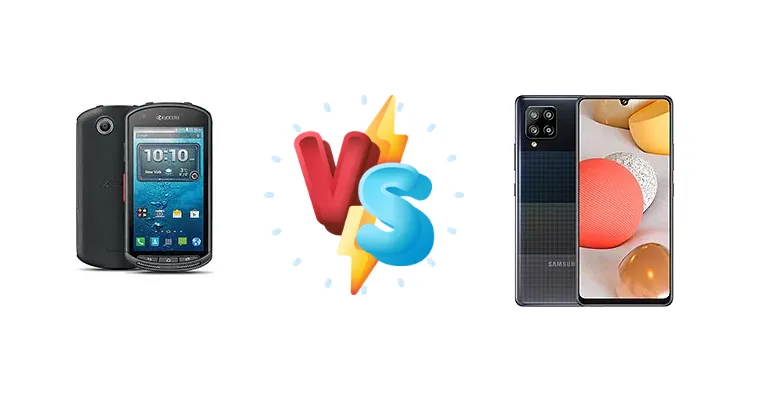
The Kyocera DuraForce and Samsung Galaxy A42 5G represent opposite ends of the smartphone spectrum. The DuraForce prioritizes extreme durability for demanding work environments, while the Galaxy A42 5G aims to deliver 5G connectivity and a modern feature set at an accessible price point. This comparison dissects their core differences to help you determine which device best suits your needs.
🏆 Quick Verdict
For the average user prioritizing modern features and 5G connectivity, the Samsung Galaxy A42 5G is the clear winner. Its Snapdragon 750 5G chipset offers significantly better performance and future-proofing than the DuraForce’s aging Snapdragon 400. However, if your work or lifestyle demands a virtually indestructible phone, the DuraForce remains a compelling, albeit limited, option.
| Network |
|---|
| 2G bands | GSM 850 / 900 / 1800 / 1900 | GSM 850 / 900 / 1800 / 1900 |
| 3G bands | HSDPA 850 / 900 / 1900 / 2100 | HSDPA 850 / 900 / 1700(AWS) / 1900 / 2100 |
| 4G bands | 1, 2, 4, 5, 7, 17 | 1, 2, 3, 4, 5, 7, 8, 12, 17, 20, 28, 38, 40, 41 - Europe |
| 5G bands | - | 1, 3, 5, 7, 8, 28, 40, 41, 78 SA/NSA/Sub6 - Europe |
| Speed | HSPA 42.2/5.76 Mbps, LTE Cat4 150/50 Mbps | HSPA, LTE, 5G |
| Technology | GSM / HSPA / LTE | GSM / HSPA / LTE / 5G |
| Launch |
|---|
| Announced | 2014, November. Released 2014, November | 2020, September 02 |
| Status | Discontinued | Available. Released 2020, November 11 |
| Body |
|---|
| Dimensions | 136.9 x 70.6 x 14 mm (5.39 x 2.78 x 0.55 in) | 164.4 x 75.9 x 8.6 mm (6.47 x 2.99 x 0.34 in) |
| SIM | Nano-SIM | · Nano-SIM· Nano-SIM + Nano-SIM |
| Weight | 200 g (7.05 oz) | 193 g (6.81 oz) |
| | IP68 dust/water resistant (up to 1.5m for 30 mins)
MIL-STD-810G compliant | - |
| Display |
|---|
| Protection | Yes | - |
| Resolution | 720 x 1280 pixels, 16:9 ratio (~326 ppi density) | 720 x 1600 pixels, 20:9 ratio (~266 ppi density) |
| Size | 4.5 inches, 55.8 cm2 (~57.8% screen-to-body ratio) | 6.6 inches, 105.2 cm2 (~84.3% screen-to-body ratio) |
| Type | IPS LCD | Super AMOLED |
| Platform |
|---|
| CPU | Quad-core 1.4 GHz Cortex-A7 | Octa-core (2x2.2 GHz Kryo 570 & 6x1.8 GHz Kryo 570) |
| Chipset | Qualcomm MSM8928 Snapdragon 400 (28 nm) | Qualcomm SM7225 Snapdragon 750 5G (8 nm) |
| GPU | Adreno 305 | Adreno 619 |
| OS | Android 4.4.2 (KitKat) | Android 10, upgradable to Android 13, One UI 5 |
| Memory |
|---|
| Card slot | microSDHC (dedicated slot) | microSDXC (uses shared SIM slot) |
| Internal | 16GB 2GB RAM | 128GB 4GB RAM, 128GB 6GB RAM, 128GB 8GB RAM |
| | eMMC 4.5 | - |
| Main Camera |
|---|
| Features | LED flash, HDR, panorama | LED flash, panorama, HDR |
| Quad | - | 48 MP, f/1.8, 24mm (wide), 1/2.0", 0.8µm, PDAF
8 MP, f/2.2, 13mm, 123˚ (ultrawide), 1/3.94", 0.8µm
5 MP (macro)
Auxiliary lens |
| Single | 8 MP, AF | - |
| Video | 1080p@30fps | 4K@30fps, 1080p@30fps, 720p@480fps |
| Selfie camera |
|---|
| Features | - | HDR |
| Single | 2 MP | 20 MP, f/2.2, 25mm (wide), 1/2.78", 1.0µm |
| Video | - | 1080p@30fps |
| Sound |
|---|
| 3.5mm jack | Yes | Yes |
| 35mm jack | Yes | Yes |
| Loudspeaker | Yes, with stereo speakers | Yes |
| | Smart Sonic Receiver
| - |
| Comms |
|---|
| Bluetooth | 4.0, A2DP, EDR, LE | 5.0, A2DP, LE |
| NFC | Yes | Yes |
| Positioning | GPS | GPS, GLONASS, GALILEO, BDS |
| Radio | No | FM radio |
| USB | microUSB 2.0 | USB Type-C 2.0 |
| WLAN | Wi-Fi 802.11 a/b/g/n/ac, dual-band, hotspot | Wi-Fi 802.11 a/b/g/n/ac, dual-band, Wi-Fi Direct |
| Features |
|---|
| Sensors | Accelerometer, proximity, compass, barometer | Fingerprint (under display, optical), accelerometer, gyro, proximity, compass |
| Battery |
|---|
| Charging | - | 15W wired |
| Stand-by | Up to 504 h | - |
| Talk time | Up to 17 h | - |
| Type | Li-Ion 3100 mAh, non-removable | Li-Po 5000 mAh |
| Misc |
|---|
| Colors | Black | Prism Dot Black, Prism Dot White, Prism Dot Gray |
| Models | - | SM-A426B, SM-A426B/DS, SM-A4260, SM-A426U, SM-A426U1, SM-A426N |
| Price | About 320 EUR | € 279.99 / £ 139.10 |
| SAR EU | - | 1.15 W/kg (head) 1.33 W/kg (body) |
| Tests |
|---|
| Battery life | - | Endurance rating 144h |
| Camera | - |
Photo / Video |
| Display | - |
Contrast ratio: Infinite (nominal) |
| Loudspeaker | - |
-30.1 LUFS (Below average) |
| Performance | - |
AnTuTu: 324686 (v8)
GeekBench: 1910 (v5.1)
GFXBench: 33fps (ES 3.1 onscreen) |
Kyocera DuraForce
- Exceptional durability and ruggedness
- Designed for harsh environments
- Long-lasting battery (144h endurance)
- Outdated Snapdragon 400 processor
- Likely inferior display quality
- Limited camera capabilities
Samsung Galaxy A42 5G
- Modern Snapdragon 750 5G processor
- Bright and vibrant AMOLED display (estimated)
- 5G connectivity for faster data speeds
- Less durable than the DuraForce
- Plastic build may feel less premium
- 15W charging is relatively slow
Display Comparison
The Samsung Galaxy A42 5G boasts a significantly more modern display experience. While both lack detailed specifications beyond the 570 nits peak brightness of the A42 5G, the contrast ratio being 'infinite' (typical for AMOLED) suggests a far superior viewing experience compared to the DuraForce’s likely LCD panel. The A42 5G’s higher brightness ensures better visibility outdoors, and the AMOLED technology delivers richer colors and deeper blacks. The DuraForce’s display is likely optimized for readability under direct sunlight, but sacrifices color accuracy and vibrancy.
Camera Comparison
Both phones offer 'Photo / Video' capabilities, but the details are sparse. Given the A42 5G’s positioning, it likely features a more sophisticated camera system with multiple lenses and advanced image processing. The DuraForce’s camera is likely a basic module focused on functionality rather than image quality. Without specific sensor sizes or aperture information, it’s difficult to make a precise comparison, but the A42 5G’s modern chipset likely supports more advanced computational photography features.
Performance
The performance gap between these devices is substantial. The Samsung Galaxy A42 5G’s Qualcomm SM7225 Snapdragon 750 5G (8nm) is a modern, octa-core processor designed for 5G connectivity and efficient multitasking. Its Kryo 570 cores, clocked up to 2.2 GHz, provide a significant performance uplift over the Kyocera DuraForce’s quad-core 1.4 GHz Snapdragon 400 (28nm). The 8nm process node of the Snapdragon 750 5G also translates to better thermal efficiency, reducing the likelihood of performance throttling during sustained use. The DuraForce’s Snapdragon 400 is adequate for basic tasks, but will struggle with demanding apps and games.
Battery Life
Both devices share an endurance rating of 144 hours, suggesting comparable battery life under similar usage scenarios. However, the Snapdragon 750 5G’s improved power efficiency could give the A42 5G a slight edge in real-world usage, especially when utilizing 5G connectivity. The A42 5G supports 15W wired charging, offering a faster recharge time than what the DuraForce likely provides, though specific charging speeds for the DuraForce are unknown. The endurance rating suggests both are designed for all-day use, but the A42 5G’s faster charging is a convenience advantage.
Buying Guide
Buy the Kyocera DuraForce if you require a phone that can withstand drops, extreme temperatures, and harsh conditions – ideal for construction, field work, or anyone prone to accidents. Buy the Samsung Galaxy A42 5G if you prioritize a smoother user experience, 5G connectivity, a brighter display, and a more versatile camera system for everyday use and entertainment.
Frequently Asked Questions
❓ Is the Kyocera DuraForce a good choice for someone who frequently works outdoors in challenging conditions?
Absolutely. The DuraForce is specifically engineered for durability, with a ruggedized design that can withstand drops, dust, water, and extreme temperatures. It's ideal for construction workers, first responders, or anyone who needs a phone that can survive harsh environments.
❓ Will the Samsung Galaxy A42 5G's 5G connectivity actually make a noticeable difference in my daily usage?
The benefit of 5G depends on your location and carrier coverage. If you live in an area with robust 5G infrastructure, you'll experience significantly faster download and upload speeds, lower latency, and a more responsive online experience. However, if 5G coverage is limited, you'll primarily connect to 4G LTE, diminishing the advantage.
❓ Can the Kyocera DuraForce handle demanding mobile games?
The Snapdragon 400 processor in the DuraForce is not well-suited for demanding mobile games. You may experience significant lag and frame rate drops, even on lower graphics settings. The A42 5G's Snapdragon 750 5G is a much better choice for gaming.
❓ How does the battery life of the Galaxy A42 5G hold up with 5G enabled?
While 5G offers faster speeds, it can also consume more battery power. The Galaxy A42 5G's 144-hour endurance rating suggests it can handle moderate 5G usage without significant battery drain. However, prolonged gaming or streaming over 5G will naturally reduce battery life.