
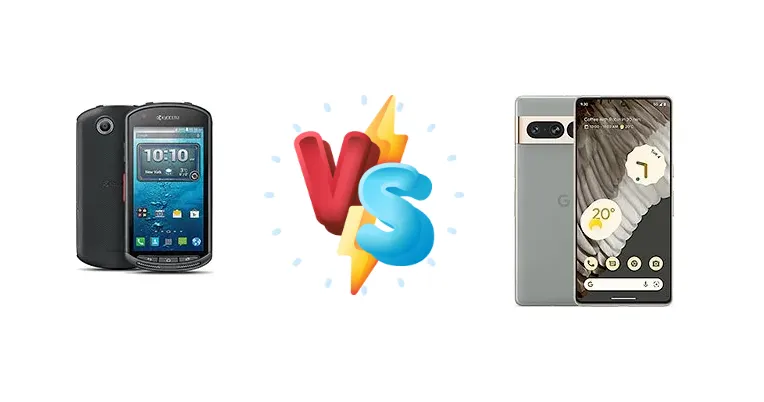
Kyocera DuraForce vs. Google Pixel 7 Pro: A Clash of Priorities
| Phones Images | |||||
|---|---|---|---|---|---|
|
🏆 Quick Verdict
For the average user prioritizing camera quality, performance, and a modern software experience, the Google Pixel 7 Pro is the clear winner. However, if your work or lifestyle demands a virtually indestructible phone, the Kyocera DuraForce remains a compelling, albeit significantly less powerful, option.
| PHONES | ||
|---|---|---|
| Phone Names | Kyocera DuraForce | Google Pixel 7 Pro |
| Network | ||
|---|---|---|
| 2G bands | GSM 850 / 900 / 1800 / 1900 | GSM 850 / 900 / 1800 / 1900 |
| 3G bands | HSDPA 850 / 900 / 1900 / 2100 | HSDPA 800 / 850 / 900 / 1700(AWS) / 1900 / 2100 |
| 4G bands | 1, 2, 4, 5, 7, 17 | 1, 2, 3, 4, 5, 7, 8, 12, 13, 14, 17, 18, 19, 20, 25, 26, 28, 29, 30, 38, 39, 40, 41, 42, 46, 48, 66, 71 - GE2AE |
| 5G bands | - | 1, 2, 3, 5, 7, 8, 12, 14, 20, 25, 28, 30, 38, 40, 41, 48, 66, 71, 77, 78, 257, 258, 260, 261 SA/NSA/Sub6/mmWave - GE2AE |
| Speed | HSPA 42.2/5.76 Mbps, LTE Cat4 150/50 Mbps | HSPA, LTE, 5G |
| Technology | GSM / HSPA / LTE | GSM / CDMA / HSPA / EVDO / LTE / 5G |
| - | 1, 2, 3, 5, 7, 8, 12, 14, 20, 25, 28, 30, 38, 40, 41, 48, 66, 71, 75, 76, 77, 78 SA/NSA/Sub6 - GP4BC | |
| Launch | ||
|---|---|---|
| Announced | 2014, November. Released 2014, November | 2022, October 06 |
| Status | Discontinued | Available. Released 2022, October 13 |
| Body | ||
|---|---|---|
| Build | - | Glass front (Gorilla Glass Victus), glass back (Gorilla Glass Victus), aluminum frame |
| Dimensions | 136.9 x 70.6 x 14 mm (5.39 x 2.78 x 0.55 in) | 162.9 x 76.6 x 8.9 mm (6.41 x 3.02 x 0.35 in) |
| SIM | Nano-SIM | Nano-SIM + eSIM |
| Weight | 200 g (7.05 oz) | 212 g (7.48 oz) |
| IP68 dust/water resistant (up to 1.5m for 30 mins) MIL-STD-810G compliant | IP68 dust/water resistant (up to 1.5m for 30 min) | |
| Display | ||
|---|---|---|
| Protection | Yes | Corning Gorilla Glass Victus |
| Resolution | 720 x 1280 pixels, 16:9 ratio (~326 ppi density) | 1440 x 3120 pixels, 19.5:9 ratio (~512 ppi density) |
| Size | 4.5 inches, 55.8 cm2 (~57.8% screen-to-body ratio) | 6.7 inches, 110.6 cm2 (~88.7% screen-to-body ratio) |
| Type | IPS LCD | LTPO AMOLED, 120Hz, HDR10+, 1000 nits (HBM), 1500 nits (peak) |
| - | Always-on display | |
| Platform | ||
|---|---|---|
| CPU | Quad-core 1.4 GHz Cortex-A7 | Octa-core (2x2.85 GHz Cortex-X1 & 2x2.35 GHz Cortex-A78 & 4x1.80 GHz Cortex-A55) |
| Chipset | Qualcomm MSM8928 Snapdragon 400 (28 nm) | Google Tensor G2 (5 nm) |
| GPU | Adreno 305 | Mali-G710 MP7 |
| OS | Android 4.4.2 (KitKat) | Android 13, upgradable to Android 15, up to 5 major Android upgrades |
| Memory | ||
|---|---|---|
| Card slot | microSDHC (dedicated slot) | No |
| Internal | 16GB 2GB RAM | 128GB 8GB RAM, 256GB 8GB RAM, 128GB 12GB RAM, 256GB 12GB RAM, 512GB 12GB RAM |
| eMMC 4.5 | UFS 3.1 | |
| Main Camera | ||
|---|---|---|
| Features | LED flash, HDR, panorama | Laser AF, Dual-LED flash, Pixel Shift, Auto-HDR, panorama |
| Single | 8 MP, AF | 10.8 MP, f/2.2, 21mm (ultrawide), 1/3.1", 1.22µm |
| Triple | - | 50 MP, f/1.9, 25mm (wide), 1/1.31", 1.2µm, dual pixel PDAF, OIS 48 MP, f/3.5, 120mm (periscope telephoto), 1/2.55", 0.7µm, dual pixel PDAF, OIS, 5x optical zoom 12 MP, f/2.2, 126˚ (ultrawide), 1/2.9", 1.25µm, AF |
| Video | 1080p@30fps | 4K@30/60fps, 1080p@30/60/120/240fps; gyro-EIS, OIS, 10-bit HDR |
| Selfie camera | ||
|---|---|---|
| Features | - | HDR, panorama |
| Single | 2 MP | 10.8 MP, f/2.2, 21mm (ultrawide), 1/3.1", 1.22µm |
| Video | - | 4K@30/60fps, 1080p@30/60fps |
| Sound | ||
|---|---|---|
| 3.5mm jack | Yes | No |
| 35mm jack | Yes | No |
| Loudspeaker | Yes, with stereo speakers | Yes, with stereo speakers |
| Smart Sonic Receiver | - | |
| Comms | ||
|---|---|---|
| Bluetooth | 4.0, A2DP, EDR, LE | 5.2, A2DP, LE, aptX HD |
| NFC | Yes | Yes |
| Positioning | GPS | GPS (L1+L5), GLONASS (G1), BDS (B1I+B1c+B2a), GALILEO (E1+E5a), QZSS (L1+L5) |
| Radio | No | No |
| USB | microUSB 2.0 | USB Type-C 3.2 |
| WLAN | Wi-Fi 802.11 a/b/g/n/ac, dual-band, hotspot | Wi-Fi 802.11 a/b/g/n/ac/6e, tri-band, Wi-Fi Direct |
| Features | ||
|---|---|---|
| Sensors | Accelerometer, proximity, compass, barometer | Fingerprint (under display, optical), accelerometer, gyro, proximity, compass, barometer |
| - | Ultra Wideband (UWB) support | |
| Battery | ||
|---|---|---|
| Charging | - | 23W wired, PD3.0, 50% in 30 min 23W wireless Reverse wireless |
| Stand-by | Up to 504 h | - |
| Talk time | Up to 17 h | - |
| Type | Li-Ion 3100 mAh, non-removable | Li-Ion 5000 mAh |
| Misc | ||
|---|---|---|
| Colors | Black | Obsidian, Snow, Hazel |
| Models | - | GP4BC, GE2AE, GFE4J |
| Price | About 320 EUR | € 248.84 / $ 204.00 / £ 259.99 / ₹ 36,999 |
| Tests | ||
|---|---|---|
| Battery life | - | Endurance rating 83h |
| Camera | - | Photo / Video |
| Display | - | Contrast ratio: Infinite (nominal) |
| Loudspeaker | - | -24.8 LUFS (Very good) |
| Performance | - | AnTuTu: 796369 (v9) GeekBench: 3187 (v5.1) GFXBench: 34fps (ES 3.1 onscreen) |
Kyocera DuraForce
- Extremely durable and ruggedized design
- Long battery life (83h endurance)
- Affordable price point
- Outdated processor and limited performance
- Low-resolution display
- Basic camera capabilities
Google Pixel 7 Pro
- Powerful Google Tensor G2 processor
- Stunning display with high brightness and contrast
- Exceptional camera system with advanced features
- Less durable than the DuraForce
- Higher price point
- Requires more careful handling
Display Comparison
The Pixel 7 Pro boasts a significantly more advanced display, reaching a measured peak brightness of 1090 nits, compared to the DuraForce’s unspecified brightness. While the DuraForce’s display is likely optimized for visibility in direct sunlight due to its ruggedized nature, it lacks the Pixel 7 Pro’s infinite contrast ratio and likely lacks features like LTPO for variable refresh rates, resulting in a less fluid and vibrant viewing experience. The Pixel 7 Pro’s larger screen size and higher resolution also contribute to a more immersive experience.
Camera Comparison
Both devices offer photo and video capabilities, but the Pixel 7 Pro’s camera system is in a different league. While specific sensor details are missing for both, the Pixel 7 Pro benefits from Google’s renowned computational photography expertise and advanced image processing algorithms. The Pixel 7 Pro’s larger sensor and more sophisticated optics will deliver superior image quality, especially in low-light conditions. The DuraForce’s camera is likely geared towards basic documentation rather than artistic photography.
Performance
The performance gap between these devices is substantial. The Google Pixel 7 Pro’s Google Tensor G2, fabricated on a 5nm process, features an octa-core CPU with high-performance Cortex-X1 cores, delivering significantly faster processing speeds than the Kyocera DuraForce’s Qualcomm MSM8928 Snapdragon 400. The Snapdragon 400, built on a 28nm node, utilizes a quad-core Cortex-A7 CPU. This translates to a dramatically slower experience on the DuraForce for tasks like app loading, multitasking, and gaming. The Tensor G2’s advanced AI capabilities also enable features like Magic Eraser and Real Tone, unavailable on the DuraForce.
Battery Life
Both phones share an endurance rating of 83 hours, suggesting comparable battery life under similar usage scenarios. However, the Pixel 7 Pro offers significantly faster charging with 23W wired charging (PD3.0, 50% in 30 min) and 23W wireless charging, including reverse wireless charging. The DuraForce’s charging specifications are unknown, but are likely much slower. While both may last a similar amount of time on a single charge, the Pixel 7 Pro offers greater convenience with its rapid charging capabilities.
Buying Guide
Buy the Kyocera DuraForce if you need a phone that can withstand drops, extreme temperatures, and harsh conditions – a true tool for construction, field work, or anyone prone to accidents. Buy the Google Pixel 7 Pro if you prefer a flagship experience with a stunning display, exceptional camera capabilities, and the latest Android features, even if it requires more careful handling.