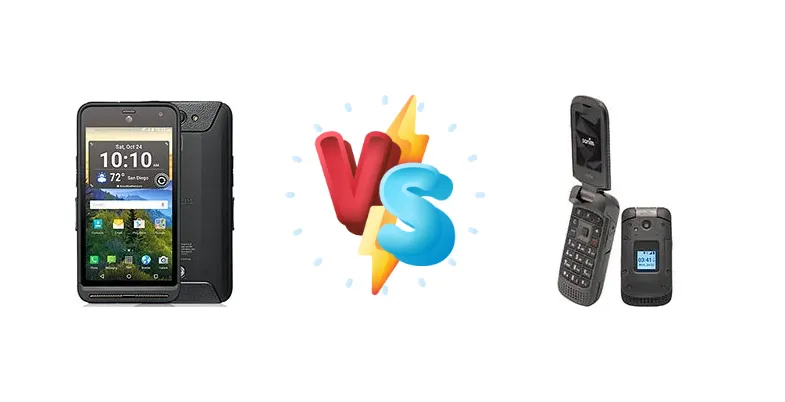
The Kyocera DuraForce XD and Sonim XP3 represent two distinct approaches to the rugged smartphone market. While both prioritize durability for demanding environments, they differ significantly in their internal hardware and resulting performance. This comparison dissects these differences, helping users determine which device best suits their needs – from construction sites to emergency services.
🏆 Quick Verdict
For the average user prioritizing responsiveness and a smoother experience, the Kyocera DuraForce XD emerges as the better choice. Its Snapdragon 400 chipset, clocked at 1.6 GHz, provides a noticeable performance advantage over the Sonim XP3’s 1.1 GHz Snapdragon 210, making it more suitable for multitasking and app-heavy workflows.
| Network |
|---|
| 2G bands | GSM 850 / 900 / 1800 / 1900 | GSM 850 / 900 / 1800 / 1900 |
| 3G bands | HSDPA 850 / 900 / 1900 / 2100 - AT&T, T-Mobile | HSDPA 800 / 850 / 900 / 1700(AWS) / 2100 |
| 4G bands | 1, 2, 3, 4, 5, 7, 17, 20, 29 - AT&T | 1, 2, 3, 4, 5, 8, 12, 13, 14, 25, 26, 38, 41, 66 |
| Speed | HSPA, LTE | HSPA, LTE |
| Technology | GSM / HSPA / LTE | GSM / CDMA / HSPA / EVDO / LTE |
| | 1, 2, 3, 4, 5, 7, 12, 20, 29 - T-Mobile | CDMA2000 1xEV-DO |
| Launch |
|---|
| Announced | 2015, October. Released 2015, November | 2019, March. Released 2019, March |
| Status | Discontinued | Discontinued |
| Body |
|---|
| Dimensions | 166.8 x 86.4 x 13.9 mm (6.57 x 3.40 x 0.55 in) | 112 x 58 x 27 mm (4.41 x 2.28 x 1.06 in) |
| SIM | Nano-SIM | Nano-SIM |
| Weight | 307 g (10.83 oz) | 195 g (6.88 oz) |
| | IP68 dust/water resistant (up to 1.5m for 30 mins)
MIL-STD-810G compliant | IP68 dust/water resistant (up to 1.5m for 30 min)
MIL-STD-810G |
| Display |
|---|
| Protection | Yes | - |
| Resolution | 720 x 1280 pixels, 16:9 ratio (~258 ppi density) | 240 x 320 pixels, 4:3 ratio (~154 ppi density) |
| Size | 5.7 inches, 89.6 cm2 (~62.1% screen-to-body ratio) | 2.6 inches, 20.9 cm2 (~32.2% screen-to-body ratio) |
| Type | IPS LCD | TFT LCD |
| | - | Cover display:
TN LCD, 1.08 inches, 96 x 96 pixels |
| Platform |
|---|
| CPU | Quad-core 1.6 GHz Cortex-A7 | Quad-core 1.1 GHz Cortex-A7 |
| Chipset | Qualcomm MSM8928 Snapdragon 400 (28 nm) | Qualcomm MSM8909 Snapdragon 210 (28 nm) |
| GPU | Adreno 305 | Adreno 304 |
| OS | Android 5.1 (Lollipop) | Sonim OS (based on AOSP Android 8.1) |
| Memory |
|---|
| Card slot | microSDXC (dedicated slot) | microSDXC (dedicated slot) |
| Internal | 16GB 2GB RAM | 8GB 1GB RAM |
| | eMMC 4.5 | - |
| Main Camera |
|---|
| Features | LED flash, HDR, panorama | LED flash |
| Single | 8 MP, AF | 5 MP |
| Video | 1080p@30fps | - |
| Sound |
|---|
| 3.5mm jack | Yes | Yes |
| 35mm jack | Yes | Yes |
| Loudspeaker | Yes | Yes |
| Comms |
|---|
| Bluetooth | 4.1, A2DP, EDR, LE | 4.2, A2DP, LE |
| NFC | Yes | No |
| Positioning | GPS | GPS, GLONASS, GALILEO |
| Radio | No | FM Radio |
| USB | microUSB 2.0 | USB Type-C |
| WLAN | Wi-Fi 802.11 a/b/g/n/ac//r/k, dual-band, Wi-Fi Direct, hotspot | Wi-Fi 802.11 a/b/g/n/r, dual-band |
| Features |
|---|
| Sensors | Accelerometer, gyro, proximity, compass, barometer | Barometer |
| Battery |
|---|
| Charging | 10W wired | - |
| Stand-by | Up to 816 h (3G) | - |
| Talk time | Up to 23 h (3G) | - |
| Type | Li-Ion 3700 mAh, removable | Li-Ion 1500 mAh, removable |
| Misc |
|---|
| Colors | Black | Black |
| Price | - | About 190 EUR |
Kyocera DuraForce XD
- Faster processor for smoother performance
- More responsive user experience
- Potentially better image processing
- Likely shorter battery life under heavy use
- May generate more heat during sustained tasks
Sonim XP3
- Potentially longer battery life due to efficient chipset
- Extreme durability and ruggedness
- Lower power consumption
- Significantly slower processor
- Laggy performance with multiple apps
- Limited multitasking capabilities
Display Comparison
Neither device boasts a cutting-edge display. Given the focus on ruggedness, both likely utilize LCD panels prioritizing visibility and durability over color accuracy. Specifics like resolution and brightness are unavailable, but the emphasis is on functionality over aesthetics. Bezels are expected to be substantial on both to contribute to shock absorption.
Camera Comparison
Camera details are sparse, but given the target audience, image quality isn’t a primary focus. Both phones likely feature basic camera sensors suitable for documentation purposes. Without specific megapixel counts or aperture information, it’s difficult to make a direct comparison. However, the more powerful ISP (Image Signal Processor) within the Snapdragon 400 of the DuraForce XD *may* result in slightly better image processing, even with similar sensors.
Performance
The core difference lies in the chipsets. The Kyocera DuraForce XD’s Qualcomm MSM8928 Snapdragon 400, with its quad-core 1.6 GHz Cortex-A7 CPU, offers a significant performance uplift compared to the Sonim XP3’s MSM8909 Snapdragon 210 (quad-core 1.1 GHz Cortex-A7). While both are based on the 28nm process, the higher clock speed and architectural refinements in the Snapdragon 400 translate to faster app loading times and smoother multitasking. The Snapdragon 210 is an entry-level chipset designed for basic functionality, and will struggle with demanding applications. The XD will be noticeably more responsive.
Battery Life
Battery capacity isn’t specified for either device. However, the Snapdragon 210 in the Sonim XP3 is more power-efficient due to its lower clock speed and simpler architecture. This could translate to longer standby times, even with a smaller battery. The DuraForce XD’s 10W wired charging is a standard rate, and likely represents a similar charging experience to the XP3, assuming it also supports standard wired charging. Real-world battery life will heavily depend on usage patterns, but the XP3 has a potential edge in longevity.
Buying Guide
Buy the Kyocera DuraForce XD if you need a rugged phone capable of handling moderate multitasking, streaming, and occasional app usage without significant lag. It’s ideal for field workers who rely on basic smartphone functionality alongside durability. Buy the Sonim XP3 if your primary need is extreme durability and long standby time, and you primarily use the phone for calls, texts, and very basic applications. It’s best suited for environments where even minimal performance demands are secondary to survivability.
Frequently Asked Questions
❓ Will the Sonim XP3 struggle with modern apps like WhatsApp or Facebook?
Yes, the Snapdragon 210 is a very basic chipset. While it can run these apps, expect significant lag, slow loading times, and a generally frustrating experience. The XP3 is best suited for calls, texts, and very simple applications.
❓ Is the Kyocera DuraForce XD suitable for running push-to-talk (PTT) applications?
The Snapdragon 400 offers sufficient processing power to handle most PTT applications. However, performance will depend on the specific app and the number of concurrent users. It's a more viable option than the XP3 for PTT functionality.
❓ How does the durability of the Sonim XP3 compare to other rugged phones?
Sonim is renowned for its extreme durability. The XP3 is built to withstand drops, dust, water, and extreme temperatures, exceeding typical rugged phone standards. It's designed for harsh environments where failure isn't an option.
❓ Can I expect to play games on the Kyocera DuraForce XD?
Basic 2D games will be playable, but don't expect a smooth experience with graphically demanding 3D titles. The Snapdragon 400 is not a gaming chipset, and performance will be limited.