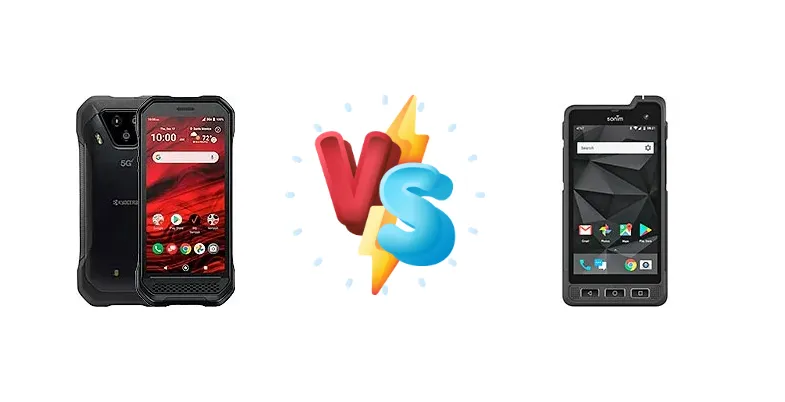
The Kyocera DuraForce Ultra and Sonim XP8 represent two distinct approaches to the rugged smartphone market. The DuraForce Ultra aims for a balance of modern features, including 5G connectivity, while the XP8 prioritizes extreme durability and reliable communication. This comparison dissects their core components to determine which device best suits demanding professional environments.
🏆 Quick Verdict
For users needing 5G speeds and a more responsive experience, the Kyocera DuraForce Ultra is the clear winner. Its Snapdragon 765G chipset offers significantly better performance than the Sonim XP8’s aging Snapdragon 630. However, the XP8’s focus on robust build quality and potentially longer software support makes it a viable option for those prioritizing ultimate resilience over raw power.
| Network |
|---|
| 2G bands | GSM 850 / 900 / 1800 / 1900 | GSM 850 / 900 / 1800 / 1900 |
| 3G bands | HSDPA 850 / 900 / 1900 / 2100 | HSDPA 850 / 900 / 1700(AWS) / 1900 / 2100 |
| 4G bands | 1, 2, 3, 4, 5, 7, 12, 13, 48, 66 | 1, 2, 3, 4, 5, 7, 8, 12, 13, 14, 20, 25, 26, 28, 29, 30, 38, 40, 41, 66 |
| 5G bands | 2, 5, 66, 260, 261 SA/NSA/Sub6/mmWave | - |
| Speed | HSPA, LTE, 5G | HSPA 42.2/5.76 Mbps, LTE (3CA) Cat12 600/150 Mbps |
| Technology | GSM / HSPA / LTE / 5G | GSM / CDMA / HSPA / EVDO / LTE |
| | - | CDMA2000 1xEV-DO |
| Launch |
|---|
| Announced | 2021, March 11 | 2018, April. Released 2018, May |
| Status | Available. Released 2021, May | Discontinued |
| Body |
|---|
| Dimensions | 165.1 x 74.9 x 16 mm (6.5 x 2.95 x 0.63 in) | 152 x 79.5 x 18 mm (5.98 x 3.13 x 0.71 in) |
| SIM | Nano SIM | Nano-SIM + Nano-SIM |
| Weight | 278 g (9.81 oz) | 335 g (11.82 oz) |
| | - | IP69 dust proof and water resistant over 1 meter and 30 minutes
MIL-STD-810G |
| Display |
|---|
| Protection | Sapphire Shield | Corning Gorilla Glass 3 |
| Resolution | 1080 x 2160 pixels, 18:9 ratio (~443 ppi density) | 1080 x 1920 pixels, 16:9 ratio (~441 ppi density) |
| Size | 5.45 inches, 76.7 cm2 (~62.0% screen-to-body ratio) | 5.0 inches, 68.9 cm2 (~57.0% screen-to-body ratio) |
| Type | IPS LCD | IPS LCD |
| Platform |
|---|
| CPU | Octa-core (1x2.4 GHz Kryo 475 Prime & 1x2.2 GHz Kryo 475 Gold & 6x1.8 GHz Kryo 475 Silver) | Octa-core 2.2 GHz Cortex-A53 |
| Chipset | Qualcomm SM7250 Snapdragon 765G 5G (7 nm) | Qualcomm SDM630 Snapdragon 630 (14 nm) |
| GPU | Adreno 620 | Adreno 508 |
| OS | Android 10, upgradable to Android 12 | Android 7.0 (Nougat) |
| Memory |
|---|
| Card slot | microSDXC (dedicated slot) | microSDXC |
| Internal | 128GB 6GB RAM | 64GB 4GB RAM |
| Main Camera |
|---|
| Dual | 24 MP, f/1.8, 27mm (wide), 0.9µm, PDAF
16 MP, f/2.0, 16mm, 117˚ (ultrawide), 1.0µm | - |
| Features | Dual-LED flash, HDR, panorama | LED flash, HDR, panorama |
| Single | - | 12 MP, PDAF |
| Video | 1080p@30fps | 1080p@30fps |
| Selfie camera |
|---|
| Single | 8 MP, f/2.0, 23mm (wide), 1/4.0", 1.12µm | 8 MP |
| Video | 1080p@30fps | 1080p@30fps |
| Sound |
|---|
| 3.5mm jack | - | No |
| 35mm jack | Unspecified | No |
| Loudspeaker | Yes, with stereo speakers | Yes |
| Comms |
|---|
| Bluetooth | 5.0, A2DP, LE | 5.0, A2DP, EDR, LE |
| NFC | Yes | Yes |
| Positioning | GPS (L1+L5) | GPS, GLONASS |
| Radio | No | FM radio |
| USB | USB Type-C 3.1 | USB Type-C 2.0, magnetic connector |
| WLAN | Wi-Fi 802.11 a/b/g/n/ac/e/i/k/r/v, dual-band, Wi-Fi Direct | Wi-Fi 802.11 a/b/g/n/ac, dual-band, Wi-Fi Direct |
| Features |
|---|
| Sensors | Fingerprint (side-mounted); unspecified sensors | Accelerometer, gyro, proximity, compass, barometer |
| Battery |
|---|
| Charging | Wired
Wireless (Qi) | 18W wired, QC4 |
| Music play | - | Up to 70 h |
| Stand-by | - | Up to 720 h |
| Talk time | - | Up to 30 h |
| Type | Li-Po 4500 mAh | Li-Ion 4900 mAh, removable |
| Misc |
|---|
| Colors | Black | Black |
| Models | - | XP8800 |
| Price | About 860 EUR | About 700 EUR |
Kyocera DuraForce Ultra
- 5G Connectivity for faster data speeds
- More Powerful Snapdragon 765G processor
- Qi Wireless Charging for added convenience
- Potentially shorter battery life due to 5G and processor
- May be more expensive than the Sonim XP8
Sonim XP8
- Extremely Durable Build Quality
- Fast Charging with QC4
- Potentially longer software support due to simpler hardware
- Outdated Snapdragon 630 processor
- Lacks 5G connectivity
Display Comparison
Display specifications are not provided, but given the market segment, both likely utilize LCD panels optimized for outdoor visibility. The DuraForce Ultra, being a newer device, may benefit from a higher peak brightness and potentially better color accuracy. The XP8, however, likely prioritizes screen protection with thicker glass. The absence of high refresh rate technology on either device suggests a focus on power efficiency rather than fluid visuals.
Camera Comparison
Camera details are limited, but the chipset difference suggests a clear advantage for the DuraForce Ultra. The Snapdragon 765G includes a more capable image signal processor (ISP) enabling better image processing, noise reduction, and potentially more advanced features like improved HDR. While both phones likely feature basic camera setups geared towards documentation rather than photography, the DuraForce Ultra will likely produce sharper, more detailed images, especially in low-light conditions. The absence of specific sensor information makes a definitive comparison difficult, but the processing power advantage is undeniable.
Performance
The core difference lies in the chipsets. The Kyocera DuraForce Ultra’s Qualcomm SM7250 Snapdragon 765G (7nm) is a substantial upgrade over the Sonim XP8’s Snapdragon 630 (14nm). The 765G’s octa-core CPU, with its Kryo 475 architecture, delivers significantly faster processing speeds and improved efficiency. The 7nm process node allows for greater transistor density, resulting in better performance per watt. The XP8’s Cortex-A53 cores, while adequate for basic tasks, will struggle with demanding applications and multitasking. This translates to a noticeably snappier experience on the DuraForce Ultra, particularly when running multiple apps or using 5G connectivity.
Battery Life
Battery capacity isn’t specified for either device. However, the Snapdragon 630 in the XP8 is known for its relatively efficient power consumption. The DuraForce Ultra’s 5G connectivity and more powerful processor will likely draw more power. The XP8’s 18W wired charging with Quick Charge 4 (QC4) offers faster charging speeds than the DuraForce Ultra’s unspecified wired and Qi wireless charging. While the DuraForce Ultra offers the convenience of wireless charging, the XP8’s QC4 support could result in quicker top-ups when a wired connection is available.
Buying Guide
Buy the Kyocera DuraForce Ultra if you need 5G connectivity for remote work, rely on data-intensive applications, or appreciate the convenience of wireless charging. It’s ideal for field technicians, inspectors, and anyone requiring a modern smartphone experience in a rugged package. Buy the Sonim XP8 if you prioritize maximum drop protection, operate in extremely harsh environments, or need a device with a proven track record of long-term reliability, even if it means sacrificing processing speed and modern features.
Frequently Asked Questions
❓ Does the Kyocera DuraForce Ultra's 5G connectivity significantly impact battery life compared to the Sonim XP8?
Yes, 5G connectivity is inherently more power-hungry than 4G LTE. While the Snapdragon 765G is relatively efficient, actively using 5G on the DuraForce Ultra will noticeably reduce battery life compared to the Sonim XP8, which is limited to 4G. However, the DuraForce Ultra’s processor can also dynamically adjust power consumption based on usage.
❓ Is the Snapdragon 630 in the Sonim XP8 sufficient for running modern work apps like Microsoft Teams or Slack?
The Snapdragon 630 can run these apps, but performance will be noticeably slower than on the DuraForce Ultra. Expect longer loading times, occasional lag, and potential difficulties with multitasking. The XP8 is best suited for basic communication and data collection, rather than intensive application usage.
❓ How does the build quality of the Sonim XP8 compare to the Kyocera DuraForce Ultra in terms of drop resistance?
The Sonim XP8 is renowned for its exceptional durability, exceeding many industry standards for drop and shock resistance. While the DuraForce Ultra is also ruggedized, the XP8 is generally considered to be more robust, particularly in extreme conditions. Sonim specifically designs its phones for harsh environments and often includes features like reinforced corners and a sealed design.