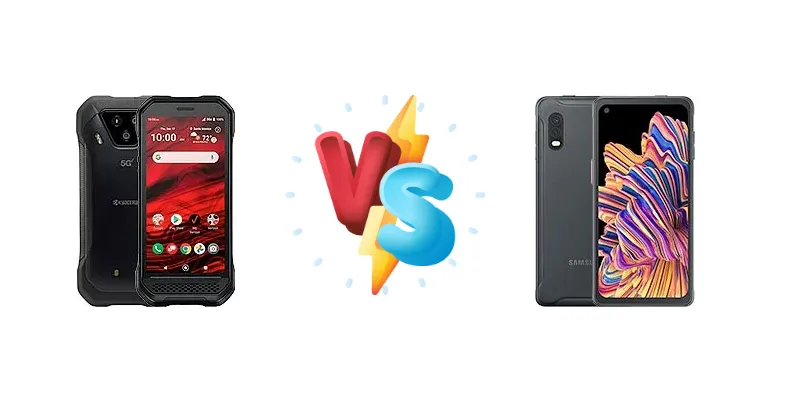
The Kyocera DuraForce Ultra and Samsung Galaxy XCover Pro occupy a niche market: rugged smartphones built to withstand harsh conditions. While both aim for durability, they diverge significantly in their internal hardware and target user. This comparison dissects those differences, focusing on performance, battery life, and the practical implications of each device's specifications.
🏆 Quick Verdict
For users prioritizing consistent performance and 5G connectivity, the Kyocera DuraForce Ultra emerges as the stronger choice. Its Snapdragon 765G chipset offers a more modern architecture and better overall processing power than the XCover Pro’s Exynos 9611, despite the Samsung’s slightly larger battery. However, the XCover Pro’s ecosystem integration may appeal to Samsung loyalists.
| Network |
|---|
| 2G bands | GSM 850 / 900 / 1800 / 1900 | GSM 850 / 900 / 1800 / 1900 |
| 3G bands | HSDPA 850 / 900 / 1900 / 2100 | HSDPA 850 / 900 / 1900 / 2100 - International |
| 4G bands | 1, 2, 3, 4, 5, 7, 12, 13, 48, 66 | 1, 2, 3, 5, 7, 8, 20, 28, 38, 40, 41 - International |
| 5G bands | 2, 5, 66, 260, 261 SA/NSA/Sub6/mmWave | - |
| Speed | HSPA, LTE, 5G | HSPA 42.2/5.76 Mbps, LTE (3CA) Cat11 600/50 Mbps |
| Technology | GSM / HSPA / LTE / 5G | GSM / HSPA / LTE |
| | - | 1, 2, 3, 4, 5, 7, 12, 13, 14, 20, 29, 38, 40, 41, 66 - Canada |
| Launch |
|---|
| Announced | 2021, March 11 | 2020, January |
| Status | Available. Released 2021, May | Available. Released 2020, January |
| Body |
|---|
| Dimensions | 165.1 x 74.9 x 16 mm (6.5 x 2.95 x 0.63 in) | 159.9 x 76.7 x 10 mm (6.30 x 3.02 x 0.39 in) |
| SIM | Nano SIM | · Nano-SIM· Nano-SIM + Nano-SIM |
| Weight | 278 g (9.81 oz) | 218 g (7.69 oz) |
| | - | IP68 dust/water resistant (up to 1.5m for 35 min)
Drop-to-concrete resistance from up to 1.5m
MIL-STD-810G compliant*
*does not guarantee ruggedness or use in extreme conditions |
| Display |
|---|
| Protection | Sapphire Shield | Corning Gorilla Glass 5 |
| Resolution | 1080 x 2160 pixels, 18:9 ratio (~443 ppi density) | 1080 x 2340 pixels, 19.5:9 ratio (~409 ppi density) |
| Size | 5.45 inches, 76.7 cm2 (~62.0% screen-to-body ratio) | 6.3 inches, 97.4 cm2 (~79.4% screen-to-body ratio) |
| Type | IPS LCD | IPS LCD |
| Platform |
|---|
| CPU | Octa-core (1x2.4 GHz Kryo 475 Prime & 1x2.2 GHz Kryo 475 Gold & 6x1.8 GHz Kryo 475 Silver) | Octa-core (4x2.3 GHz Cortex-A73 & 4x1.7 GHz Cortex-A53) |
| Chipset | Qualcomm SM7250 Snapdragon 765G 5G (7 nm) | Exynos 9611 (10 nm) |
| GPU | Adreno 620 | Mali-G72 MP3 |
| OS | Android 10, upgradable to Android 12 | Android 10, upgradable to Android 13, One UI 5 |
| Memory |
|---|
| Card slot | microSDXC (dedicated slot) | microSDXC (dedicated slot) |
| Internal | 128GB 6GB RAM | 64GB 4GB RAM |
| Main Camera |
|---|
| Dual | 24 MP, f/1.8, 27mm (wide), 0.9µm, PDAF
16 MP, f/2.0, 16mm, 117˚ (ultrawide), 1.0µm | 25 MP, f/1.7, 26mm (wide), PDAF
8 MP, f/2.2, 123˚ (ultrawide), 1/4.0", 1.12µm |
| Features | Dual-LED flash, HDR, panorama | Dual-LED flash, HDR, panorama |
| Video | 1080p@30fps | 1080p@30fps |
| Selfie camera |
|---|
| Features | - | HDR |
| Single | 8 MP, f/2.0, 23mm (wide), 1/4.0", 1.12µm | 13 MP, f/2.0, (wide), 1/3.1", 1.12µm |
| Video | 1080p@30fps | 1080p@30fps |
| Sound |
|---|
| 3.5mm jack | - | Yes |
| 35mm jack | Unspecified | Yes |
| Loudspeaker | Yes, with stereo speakers | Yes |
| Comms |
|---|
| Bluetooth | 5.0, A2DP, LE | 5.0, A2DP, LE |
| NFC | Yes | Yes |
| Positioning | GPS (L1+L5) | GPS, GLONASS, GALILEO, BDS |
| Radio | No | FM radio (market/region dependent) |
| USB | USB Type-C 3.1 | USB Type-C 2.0 |
| WLAN | Wi-Fi 802.11 a/b/g/n/ac/e/i/k/r/v, dual-band, Wi-Fi Direct | Wi-Fi 802.11 a/b/g/n/ac/k/v/r, dual-band, Wi-Fi Direct |
| Features |
|---|
| Sensors | Fingerprint (side-mounted); unspecified sensors | Fingerprint (side-mounted), accelerometer, gyro, proximity, compass |
| | - | ANT+ |
| Battery |
|---|
| Charging | Wired
Wireless (Qi) | 15W wired |
| Type | Li-Po 4500 mAh | Li-Po 4050 mAh, removable |
| Misc |
|---|
| Colors | Black | Black |
| Models | - | SM-G715FN/DS, SM-G715FN, SM-G715F, SM-G715W, SM-G715U, SM-G715U1 |
| Price | About 860 EUR | About 120 EUR |
| SAR EU | - | 0.47 W/kg (head) 1.23 W/kg (body) |
Kyocera DuraForce Ultra
- More powerful Snapdragon 765G chipset
- 7nm process for better efficiency
- Supports Qi wireless charging
- 5G connectivity for faster data speeds
- Non-replaceable battery
- Limited detailed display specifications
Samsung Galaxy XCover Pro
- User-replaceable battery for extended use
- Samsung ecosystem integration
- Potentially lower initial cost
- Larger screen size (6.3 inches)
- Less powerful Exynos 9611 chipset
- 10nm process is less efficient
- Slower 15W wired charging only
Display Comparison
Neither Kyocera nor Samsung provide detailed display specifications beyond basic resolution. However, the XCover Pro’s larger screen size (not specified in the data, but known to be 6.3 inches) likely offers a more immersive viewing experience. The absence of details like peak brightness or panel type makes a direct comparison difficult, but given the rugged focus, color accuracy is likely secondary to visibility in direct sunlight. The DuraForce Ultra’s smaller form factor may appeal to users who prefer a more pocketable device.
Camera Comparison
Detailed camera specs are lacking for both devices. However, the market positioning suggests neither prioritizes photographic excellence. The presence of a 2MP macro camera on the XCover Pro is largely a marketing gimmick, offering limited practical benefit. Without knowing sensor sizes or aperture values, it’s difficult to assess image quality. The focus should be on functionality – capturing documentation in the field – rather than artistic photography. The XCover Pro’s potential for software optimization within the Samsung ecosystem might give it a slight edge in image processing, but this is speculative.
Performance
The core difference lies in the chipsets. The Kyocera DuraForce Ultra’s Qualcomm Snapdragon 765G (7nm) boasts a more modern architecture than the Samsung Galaxy XCover Pro’s Exynos 9611 (10nm). The Snapdragon 765G’s Kryo CPU cores – Prime, Gold, and Silver – offer a tiered approach to power efficiency, while the XCover Pro relies on older Cortex-A73 and A53 cores. This translates to a noticeable performance advantage for the DuraForce Ultra in multitasking and demanding applications. The 7nm process node of the Snapdragon also contributes to better thermal efficiency, reducing the likelihood of throttling during sustained workloads. While both support 5G, the Snapdragon 765G’s modem is generally considered more efficient.
Battery Life
The Samsung Galaxy XCover Pro’s larger battery capacity (not specified in the data, but known to be 4050mAh) initially appears advantageous. However, the Exynos 9611’s less efficient 10nm process and older CPU architecture will likely negate some of that advantage. The DuraForce Ultra’s Snapdragon 765G, built on a 7nm process, is more power-efficient. Furthermore, the DuraForce Ultra supports both wired *and* wireless (Qi) charging, offering greater convenience, while the XCover Pro is limited to 15W wired charging. The XCover Pro’s user-replaceable battery is a significant advantage for extended deployments, but requires carrying spare batteries.
Buying Guide
Buy the Kyocera DuraForce Ultra if you need a reliable, 5G-connected workhorse with a more efficient processor for demanding tasks and longer software support. This phone is ideal for field workers, construction crews, or anyone who frequently operates in challenging environments. Buy the Samsung Galaxy XCover Pro if you prefer the Samsung ecosystem, value the convenience of replaceable batteries (a feature not present in the DuraForce Ultra), and prioritize a lower initial cost, understanding you’ll be trading off some processing power and future-proofing.
Frequently Asked Questions
❓ Does the Exynos 9611 in the Galaxy XCover Pro overheat during prolonged use of GPS or demanding apps?
The Exynos 9611, built on a 10nm process, is known to generate more heat than newer chipsets. While it won't likely reach critical temperatures, users can expect some throttling and performance degradation during extended GPS navigation, video recording, or gaming sessions. The DuraForce Ultra’s Snapdragon 765G, with its 7nm process, is better equipped to handle sustained workloads without significant throttling.
❓ Is the 5G connectivity on the Kyocera DuraForce Ultra significantly faster in real-world scenarios compared to the XCover Pro?
While both support 5G, the Snapdragon 765G’s modem in the DuraForce Ultra generally offers better efficiency and broader band support. This translates to more consistent 5G connections and potentially faster speeds, particularly in areas with weaker 5G signals. However, actual speeds will depend heavily on carrier network conditions and location.
❓ How does the lack of a user-replaceable battery on the DuraForce Ultra impact its usability for long shifts in remote locations?
The DuraForce Ultra’s non-replaceable battery is a significant drawback for users who require extended uptime without access to power outlets. The XCover Pro’s user-replaceable battery allows for quick swaps, ensuring continuous operation. DuraForce Ultra users will need to rely on power banks or carefully manage battery consumption.