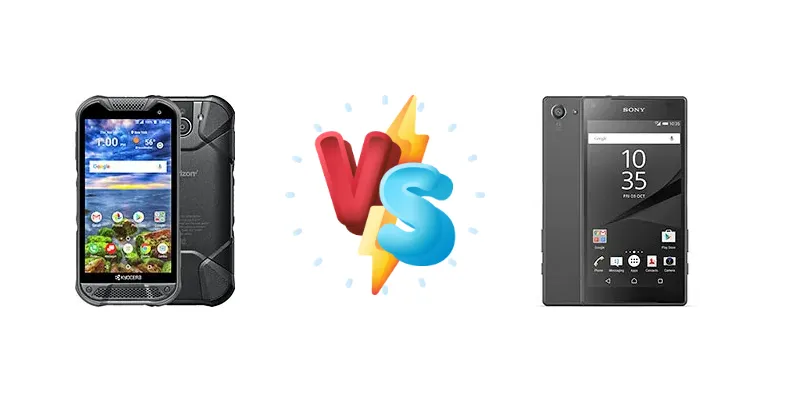
The Kyocera DuraForce Pro 2 and Sony Xperia Z5 Compact represent distinct approaches to the smartphone market. The DuraForce Pro 2 prioritizes extreme durability for demanding work environments, while the Xperia Z5 Compact aimed to deliver flagship performance in a remarkably compact form factor. This comparison dissects their core differences, helping you determine which device best suits your needs.
🏆 Quick Verdict
For the average user prioritizing performance and a more refined experience, the Sony Xperia Z5 Compact is the better choice. Its Snapdragon 810, despite its age, offers a significant performance advantage over the DuraForce Pro 2’s Snapdragon 630. However, if absolute ruggedness and drop protection are paramount, the DuraForce Pro 2 is the clear winner.
| Network |
|---|
| 2G bands | GSM 850 / 900 / 1800 / 1900 | GSM 850 / 900 / 1800 / 1900 |
| 3G bands | HSDPA 850 / 900 / 1900 / 2100 | HSDPA 850 / 900 / 1900 / 2100 - E5803, E5823 |
| 4G bands | 1, 2, 3, 4, 5, 7, 13, 66 | 1, 2, 3, 4, 5, 7, 8, 12, 17, 20, 28, 38, 40 - E5803, E5823 |
| Speed | HSPA 42.2/5.76 Mbps, LTE (3CA) Cat9 450/50 Mbps | HSPA 42.2/5.76 Mbps, LTE Cat4 150/50 Mbps (E5803), LTE Cat6 300/50 Mbps (E5823) |
| Technology | GSM / HSPA / LTE | GSM / HSPA / LTE |
| Launch |
|---|
| Announced | 2018, November. Released 2018, November | 2015, September. Released 2015, October |
| Status | Discontinued | Discontinued |
| Body |
|---|
| Build | - | Glass front, glass back, plastic frame |
| Dimensions | 150.2 x 73.4 x 13.5 mm (5.91 x 2.89 x 0.53 in) | 127 x 65 x 8.9 mm (5.0 x 2.56 x 0.35 in) |
| SIM | Nano-SIM | Nano-SIM |
| Weight | 243 g (8.25 oz) | 138 g (4.87 oz) |
| | IP68 dust/water resistant (up to 2m for 30 mins)
MIL-STD-810G compliant
Push-to-talk button | IP68 dust/water resistant (up to 1.5m for 30 mins) |
| Display |
|---|
| Protection | Sapphire crystal glass | Scratch-resistant glass, oleophobic coating |
| Resolution | 1080 x 1920 pixels, 16:9 ratio (~441 ppi density) | 720 x 1280 pixels, 16:9 ratio (~323 ppi density) |
| Size | 5.0 inches, 68.9 cm2 (~62.5% screen-to-body ratio) | 4.6 inches, 56.9 cm2 (~68.9% screen-to-body ratio) |
| Type | IPS LCD | IPS LCD |
| | - | Triluminos display
X-Reality Engine |
| Platform |
|---|
| CPU | Octa-core 2.2 GHz Cortex-A53 | Octa-core (4x1.5 GHz Cortex-A53 & 4x2.0 GHz Cortex-A57) |
| Chipset | Qualcomm SDM630 Snapdragon 630 (14 nm) | Qualcomm MSM8994 Snapdragon 810 (20 nm) |
| GPU | Adreno 508 | Adreno 430 |
| OS | Android 8.0 (Oreo) | Android 5.1.1 (Lollipop), upgradable to 7.1.1 (Nougat) |
| Memory |
|---|
| Card slot | microSDXC (dedicated slot) | microSDXC (dedicated slot) |
| Internal | 64GB 4GB RAM | 32GB 2GB RAM |
| | - | eMMC 5.0 |
| Main Camera |
|---|
| Features | LED flash, HDR, panorama | LED flash, HDR, panorama |
| Single | 13 MP, AF
8 MP (ultra wide; dedicated video camera) | 23 MP, f/2.0, 24mm (wide), 1/2.3", PDAF |
| Video | 4K@30fps, 1080p@30fps | 4K@30fps, 1080p@60fps, 720p@120fps, HDR |
| Selfie camera |
|---|
| Features | - | HDR |
| Single | 5 MP | 5.1 MP, f/2.4 |
| Video | - | 1080p@30fps |
| Sound |
|---|
| 3.5mm jack | Yes | Yes |
| 35mm jack | Yes | Yes |
| Loudspeaker | Yes, with stereo speakers | Yes, with stereo speakers |
| | - | 24-bit/192kHz audio
|
| Comms |
|---|
| Bluetooth | 5.0, A2DP, LE | 4.1, A2DP, aptX |
| NFC | Yes | Yes |
| Positioning | GPS | GPS, GLONASS/ BDS (market dependant) |
| Radio | No | FM radio, RDS |
| USB | USB Type-C 3.1 | microUSB 2.0 (MHL 3 TV-out), OTG |
| WLAN | Wi-Fi 802.11 a/b/g/n/ac/i/r/k, dual-band, Wi-Fi Direct | Wi-Fi 802.11 a/b/g/n/ac, dual-band, Wi-Fi Direct, DLNA, hotspot |
| Features |
|---|
| Sensors | Fingerprint (side-mounted), accelerometer, gyro, proximity, compass, barometer | Fingerprint (side-mounted; EU model only), accelerometer, gyro, proximity, compass, barometer |
| | - | ANT+ |
| Battery |
|---|
| Charging | 10W wired
Wireless (Qi) | 18W wired, QC2 |
| Music play | - | Up to 77 h |
| Stand-by | Up to 312 h (3G) | Up to 520 h (2G) / Up to 520 h (3G) |
| Talk time | Up to 21 h (3G) | Up to 11 h 30 min (2G) / Up to 14 h 50 min (3G) |
| Type | Li-Ion 3240 mAh, non-removable | Li-Ion 2700 mAh, non-removable |
| Misc |
|---|
| Colors | Black | White, Graphite Black, Yellow, Coral |
| Models | - | SO-02H, E5823, E5803 |
| Price | About 400 EUR | About 200 EUR |
| SAR | - | 0.97 W/kg (head) 0.72 W/kg (body) |
| SAR EU | - | 1.07 W/kg (head) 0.71 W/kg (body) |
| Tests |
|---|
| Audio quality | - |
Noise -95.9dB / Crosstalk -94.4dB |
| Battery life | - |
Endurance rating 86h
|
| Camera | - |
Photo / Video |
| Display | - |
Contrast ratio: 1053 (nominal), 2.78(sunlight) |
| Loudspeaker | - |
Voice 66dB / Noise 65dB / Ring 70dB
|
| Performance | - |
Basemark OS II 2.0: 1440Basemark X: 23703 |
Kyocera DuraForce Pro 2
- Extremely rugged and durable design
- Qi wireless charging support
- Potentially longer software support due to ruggedized focus
- Significantly weaker processor performance
- Slower charging speeds (10W)
- Likely lower quality display
Sony Xperia Z5 Compact
- More powerful Snapdragon 810 processor
- Faster 18W Quick Charge 2.0 wired charging
- Compact and pocketable design
- Less durable and prone to damage
- Potential for thermal throttling under heavy load
- Older device with potentially limited software updates
Display Comparison
Both devices share a contrast ratio of 1053:1 (nominal) and 2.78 (sunlight), suggesting similar outdoor visibility. However, the Z5 Compact’s smaller 4.6-inch display likely contributes to a higher pixel density, resulting in a sharper image. The DuraForce Pro 2’s display size isn’t specified, but rugged phones often prioritize durability over display quality. The lack of information on panel technology (IPS, OLED) for either device makes a detailed color accuracy comparison impossible, but Sony historically favored accurate color reproduction in its flagships.
Camera Comparison
Both phones offer photo and video capabilities, but detailed camera specifications are limited. The Xperia Z5 Compact was known for its excellent camera performance at the time of release, likely featuring a larger sensor and more advanced image processing than the DuraForce Pro 2. Without specific sensor size or aperture information for the DuraForce Pro 2, it’s difficult to assess its camera capabilities. The Z5 Compact’s image processing would likely prioritize detail and dynamic range, while the DuraForce Pro 2’s camera is likely geared towards functional image capture.
Performance
The Sony Xperia Z5 Compact’s Qualcomm MSM8994 Snapdragon 810, built on a 20nm process, significantly outperforms the Kyocera DuraForce Pro 2’s Qualcomm SDM630 Snapdragon 630 (14nm). The 810 features a combination of Cortex-A53 and Cortex-A57 cores, offering a more powerful CPU architecture. While the 630 is an octa-core processor, its Cortex-A53 cores are less efficient than the A57s in the 810. The 20nm process of the 810 is less efficient than the 14nm of the 630, potentially leading to thermal throttling under sustained load, a known issue with the 810. However, even with potential throttling, the Z5 Compact will likely deliver a smoother experience for demanding tasks.
Battery Life
Both devices boast an endurance rating of 86 hours, indicating comparable battery life despite differing charging capabilities. The Xperia Z5 Compact supports 18W wired charging with Quick Charge 2.0, allowing for significantly faster charging times than the DuraForce Pro 2’s 10W wired charging. The DuraForce Pro 2 adds the convenience of Qi wireless charging, a feature absent on the Z5 Compact. While both offer similar endurance, the Z5 Compact’s faster charging is a practical advantage for users who need to quickly top up their battery.
Buying Guide
Buy the Kyocera DuraForce Pro 2 if you need a phone that can withstand harsh conditions – construction sites, outdoor work, or simply a life prone to drops and spills. Its ruggedized design and Qi wireless charging are key benefits. Buy the Sony Xperia Z5 Compact if you prefer a powerful, compact phone with a more responsive user experience and faster charging, ideal for everyday use and media consumption.
Frequently Asked Questions
❓ Is the Snapdragon 810 in the Xperia Z5 Compact prone to overheating and throttling?
The Snapdragon 810 was known to experience thermal throttling under sustained heavy load due to its 20nm process. While the Z5 Compact included thermal management solutions, demanding tasks like prolonged gaming or video recording could still lead to performance drops. However, for typical daily use, throttling is unlikely to be a significant issue.
❓ How does the ruggedization of the DuraForce Pro 2 affect its size and weight?
The DuraForce Pro 2’s ruggedized design adds significant bulk and weight compared to the Xperia Z5 Compact. The reinforced chassis, port covers, and shock-absorbing materials contribute to a thicker and heavier device. This is a trade-off for the increased durability and protection it offers.
❓ Does the Kyocera DuraForce Pro 2 receive regular software updates?
Kyocera typically provides longer software support for its ruggedized devices, focusing on security patches and bug fixes. However, major Android version updates may be less frequent compared to flagship devices like the Xperia Z5 Compact, which, being an older device, may have reached its end-of-life for updates.
❓ Is the Qi wireless charging on the DuraForce Pro 2 particularly fast?
The DuraForce Pro 2 supports Qi wireless charging, but at a maximum of 5W. This is considerably slower than the 18W Quick Charge 2.0 supported by the Xperia Z5 Compact. Qi wireless charging on the DuraForce Pro 2 is primarily a convenience feature rather than a fast charging solution.