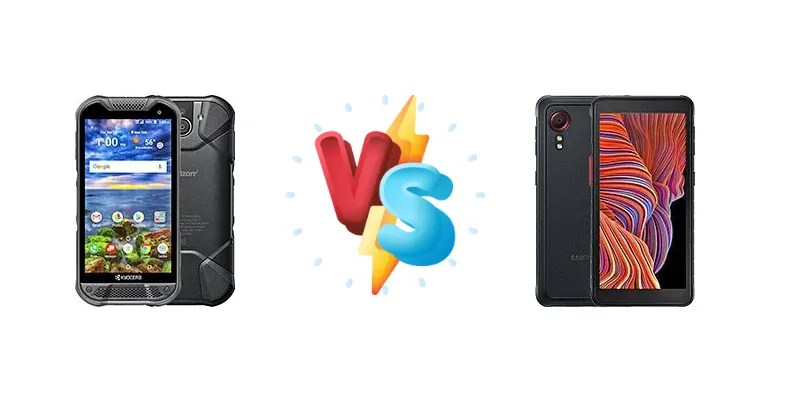
The Kyocera DuraForce Pro 2 and Samsung Galaxy XCover 5 represent two distinct approaches to the rugged smartphone market. The DuraForce Pro 2, a veteran, focuses on extreme durability and a familiar form factor. The XCover 5, a more recent entrant, aims to balance ruggedness with a more modern chipset and user experience. This comparison dives deep into the specifications to determine which device best suits demanding users.
🏆 Quick Verdict
For the average user prioritizing a smoother, more responsive experience and slightly faster charging, the Samsung Galaxy XCover 5 is the better choice. Its Exynos 850 chipset, built on an 8nm process, offers a noticeable performance advantage over the DuraForce Pro 2’s Snapdragon 630. However, the DuraForce Pro 2’s Qi wireless charging provides added convenience.
| Network |
|---|
| 2G bands | GSM 850 / 900 / 1800 / 1900 | GSM 850 / 900 / 1800 / 1900 |
| 3G bands | HSDPA 850 / 900 / 1900 / 2100 | HSDPA 850 / 900 / 1700(AWS) / 1900 / 2100 |
| 4G bands | 1, 2, 3, 4, 5, 7, 13, 66 | 1, 2, 3, 4, 5, 7, 8, 12, 17, 20, 26, 28, 38, 40, 41, 66 |
| Speed | HSPA 42.2/5.76 Mbps, LTE (3CA) Cat9 450/50 Mbps | HSPA, LTE |
| Technology | GSM / HSPA / LTE | GSM / HSPA / LTE |
| Launch |
|---|
| Announced | 2018, November. Released 2018, November | 2021, March 04 |
| Status | Discontinued | Available. Released 2021, March 12 |
| Body |
|---|
| Dimensions | 150.2 x 73.4 x 13.5 mm (5.91 x 2.89 x 0.53 in) | 147.1 x 71.6 x 9.2 mm (5.79 x 2.82 x 0.36 in) |
| SIM | Nano-SIM | · Nano-SIM· Nano-SIM + Nano-SIM |
| Weight | 243 g (8.25 oz) | 172 g (6.07 oz) |
| | IP68 dust/water resistant (up to 2m for 30 mins)
MIL-STD-810G compliant
Push-to-talk button | IP68 dust/water resistant (up to 1.5m for 30 min)
MIL-STD-810H compliant |
| Display |
|---|
| Protection | Sapphire crystal glass | - |
| Resolution | 1080 x 1920 pixels, 16:9 ratio (~441 ppi density) | 720 x 1480 pixels, 18.5:9 ratio (~311 ppi density) |
| Size | 5.0 inches, 68.9 cm2 (~62.5% screen-to-body ratio) | 5.3 inches, 71.3 cm2 (~67.7% screen-to-body ratio) |
| Type | IPS LCD | PLS LCD |
| Platform |
|---|
| CPU | Octa-core 2.2 GHz Cortex-A53 | Octa-core (4x2.0 GHz Cortex-A55 & 4x2.0 GHz Cortex-A55) |
| Chipset | Qualcomm SDM630 Snapdragon 630 (14 nm) | Exynos 850 (8 nm) |
| GPU | Adreno 508 | Mali-G52 |
| OS | Android 8.0 (Oreo) | Android 11, upgradable to Android 14, One UI 6.1 |
| Memory |
|---|
| Card slot | microSDXC (dedicated slot) | microSDXC (dedicated slot) |
| Internal | 64GB 4GB RAM | 64GB 4GB RAM |
| | - | eMMC 5.1 |
| Main Camera |
|---|
| Features | LED flash, HDR, panorama | Dual LED flash, HDR, panorama |
| Single | 13 MP, AF
8 MP (ultra wide; dedicated video camera) | 16 MP, f/1.8, PDAF |
| Video | 4K@30fps, 1080p@30fps | 1080p@30fps |
| Selfie camera |
|---|
| Single | 5 MP | 5 MP, f/2.2 |
| Sound |
|---|
| 3.5mm jack | Yes | Yes |
| 35mm jack | Yes | Yes |
| Loudspeaker | Yes, with stereo speakers | Yes |
| Comms |
|---|
| Bluetooth | 5.0, A2DP, LE | 5.0, A2DP, LE |
| NFC | Yes | Yes |
| Positioning | GPS | GPS, GLONASS, GALILEO, BDS |
| Radio | No | Unspecified |
| USB | USB Type-C 3.1 | USB Type-C 2.0, charging connector pins |
| WLAN | Wi-Fi 802.11 a/b/g/n/ac/i/r/k, dual-band, Wi-Fi Direct | Wi-Fi 802.11 a/b/g/n/ac, dual-band, Wi-Fi Direct |
| Features |
|---|
| Sensors | Fingerprint (side-mounted), accelerometer, gyro, proximity, compass, barometer | Accelerometer, gyro, proximity, compass |
| Battery |
|---|
| Charging | 10W wired
Wireless (Qi) | 15W wired |
| Stand-by | Up to 312 h (3G) | - |
| Talk time | Up to 21 h (3G) | - |
| Type | Li-Ion 3240 mAh, non-removable | Li-Ion 3000 mAh, removable |
| Misc |
|---|
| Colors | Black | Black |
| Models | - | SM-G525F, SM-G525F/DS, SM-G525N |
| Price | About 400 EUR | £ 61.49 / € 74.89 |
| SAR EU | - | 0.70 W/kg (head) 1.27 W/kg (body) |
Kyocera DuraForce Pro 2
- Qi Wireless Charging: Offers convenient charging options.
- Proven Ruggedness: Kyocera has a long history in durable devices.
- Familiar Form Factor: May appeal to users accustomed to older rugged designs.
- Older Chipset: Snapdragon 630 struggles with demanding tasks.
- Slower Charging: 10W wired charging is comparatively slow.
- Less Efficient: 14nm process leads to higher power consumption.
Samsung Galaxy XCover 5
- More Powerful Chipset: Exynos 850 provides smoother performance.
- Faster Charging: 15W wired charging reduces charging time.
- More Efficient: 8nm process improves battery life.
- No Wireless Charging: Lacks the convenience of Qi wireless charging.
- Less Established Brand: Samsung's XCover line is newer to the rugged market.
- Potentially Less Extreme Durability: May not match the DuraForce Pro 2's extreme ruggedness.
Display Comparison
Neither device boasts a cutting-edge display. Details regarding panel type (IPS vs AMOLED) and resolution are missing, but both are likely 720p or 1080p. The focus here is on practicality and visibility in bright sunlight. The lack of high refresh rates is expected in this segment. The XCover 5’s advantage lies in its newer chipset potentially enabling better image processing for color accuracy, though this is speculative without direct testing. Bezels are likely substantial on both to contribute to shock absorption.
Camera Comparison
Detailed camera specifications are unavailable, but it’s safe to assume both phones prioritize functionality over photographic excellence. The absence of high-resolution sensors or advanced features suggests a focus on capturing documentation rather than artistic images. The XCover 5’s newer image signal processor (ISP) within the Exynos 850 likely provides better noise reduction and dynamic range, even with similar sensor sizes. Any macro camera (likely 2MP on both) will be of limited utility, serving primarily as a marketing feature.
Performance
The core difference lies in the chipsets. The Samsung Galaxy XCover 5’s Exynos 850 (8nm) is a significant upgrade over the Kyocera DuraForce Pro 2’s Snapdragon 630 (14nm). The 8nm process allows for greater transistor density and improved power efficiency, translating to better sustained performance and less thermal throttling. While both CPUs are octa-core, the Cortex-A55 cores in the Exynos 850 are more efficient than the Cortex-A53 cores in the Snapdragon 630. This means the XCover 5 will handle multitasking and demanding applications more smoothly. The Snapdragon 630 is adequate for basic tasks, but will struggle with graphically intensive games or prolonged use.
Battery Life
Battery capacity is not specified, but the real-world impact is heavily influenced by chipset efficiency. The Exynos 850’s 8nm process gives the XCover 5 a clear advantage in battery life, despite the DuraForce Pro 2 offering Qi wireless charging. The XCover 5’s 15W wired charging is faster than the DuraForce Pro 2’s 10W charging, reducing the time spent tethered to an outlet. Wireless charging is convenient, but significantly slower than wired charging, making the XCover 5’s faster wired option more practical for most users.
Buying Guide
Buy the Kyocera DuraForce Pro 2 if you absolutely require Qi wireless charging in a rugged device and prioritize a proven track record of extreme durability, even at the cost of processing power. Buy the Samsung Galaxy XCover 5 if you value a more modern chipset for smoother multitasking, faster app loading, and slightly quicker wired charging, and are comfortable with a less established rugged phone brand.
Frequently Asked Questions
❓ Does the Exynos 850 chip in the Galaxy XCover 5 overheat during prolonged use, like extended navigation or video recording?
The Exynos 850, built on an 8nm process, is generally efficient and well-managed. While it will generate heat under sustained load, it’s unlikely to experience significant throttling like the Snapdragon 630 in the DuraForce Pro 2, which is built on a larger 14nm node. The XCover 5’s thermal design should handle typical field work tasks without issue.
❓ Is the lack of a high-resolution camera a significant drawback for the Galaxy XCover 5, considering its intended use case?
For the target audience – field workers, construction crews, etc. – a high-resolution camera isn’t the primary concern. These phones are designed for documenting work, not for professional photography. The image quality will be sufficient for capturing clear photos of job sites, equipment, or documentation, and the newer ISP in the XCover 5 will likely improve image clarity compared to the DuraForce Pro 2.
❓ How does the build quality of the Kyocera DuraForce Pro 2 compare to the Samsung Galaxy XCover 5 in terms of drop resistance and water/dust ingress protection?
Kyocera has a long-standing reputation for exceptionally rugged devices. While the XCover 5 meets MIL-STD-810H standards, the DuraForce Pro 2 likely exceeds these standards in terms of drop resistance and overall durability. However, both phones offer IP68 water and dust resistance, providing a high level of protection against the elements.