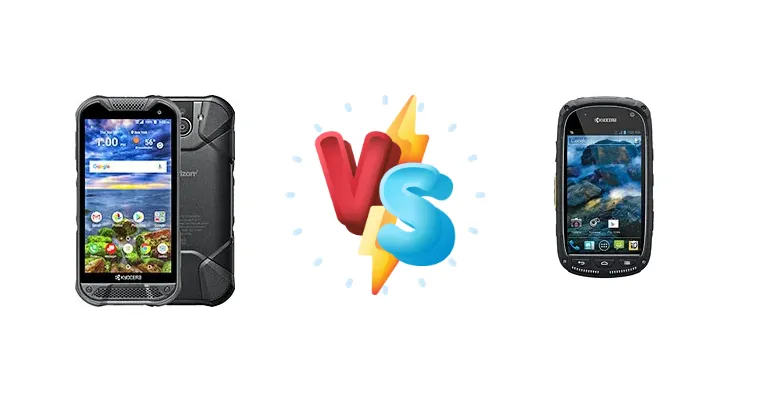
Kyocera has long been a stalwart in the rugged phone market, catering to professionals and outdoor enthusiasts. The DuraForce Pro 2 and Torque E6710 represent different eras of this commitment, with a significant gap in processing power. This comparison dissects their capabilities to determine which device offers the best balance of durability, performance, and value for today's user.
🏆 Quick Verdict
For the vast majority of users, the Kyocera DuraForce Pro 2 is the clear winner. Its Snapdragon 630 chipset provides a dramatically improved user experience compared to the Torque E6710’s aging Snapdragon S4 Plus, offering smoother multitasking and app performance. While the Torque E6710 may appeal to those on a very tight budget, the Pro 2’s modern features justify the price difference.
| Network |
|---|
| 2G bands | GSM 850 / 900 / 1800 / 1900 | CDMA 800 / 1900 |
| 3G bands | HSDPA 850 / 900 / 1900 / 2100 | CDMA2000 1xEV-DO |
| 4G bands | 1, 2, 3, 4, 5, 7, 13, 66 | 25 |
| Speed | HSPA 42.2/5.76 Mbps, LTE (3CA) Cat9 450/50 Mbps | LTE Cat3 100/50 Mbps, EV-DO Rev.A 3.1 Mbps |
| Technology | GSM / HSPA / LTE | CDMA / EVDO / LTE |
| Launch |
|---|
| Announced | 2018, November. Released 2018, November | 2013, January. Released 2013, March |
| Status | Discontinued | Discontinued |
| Body |
|---|
| Dimensions | 150.2 x 73.4 x 13.5 mm (5.91 x 2.89 x 0.53 in) | 128.5 x 68.4 x 12.9 mm (5.06 x 2.69 x 0.51 in) |
| SIM | Nano-SIM | Non-removable |
| Weight | 243 g (8.25 oz) | 168.5 g (5.93 oz) |
| | IP68 dust/water resistant (up to 2m for 30 mins)
MIL-STD-810G compliant
Push-to-talk button | IP67 dust/water resistant (up to 1m for 30 mins)
MIL-STD-810G compliant
IPX5, IPX7 certified
Flashlight |
| Display |
|---|
| Protection | Sapphire crystal glass | - Corning Gorilla Glass 2 |
| Resolution | 1080 x 1920 pixels, 16:9 ratio (~441 ppi density) | 480 x 800 pixels, 5:3 ratio (~233 ppi density) |
| Size | 5.0 inches, 68.9 cm2 (~62.5% screen-to-body ratio) | 4.0 inches, 45.5 cm2 (~51.8% screen-to-body ratio) |
| Type | IPS LCD | IPS LCD |
| Platform |
|---|
| CPU | Octa-core 2.2 GHz Cortex-A53 | Dual-core 1.2 GHz Krait |
| Chipset | Qualcomm SDM630 Snapdragon 630 (14 nm) | Qualcomm MSM8960 Snapdragon S4 Plus |
| GPU | Adreno 508 | Adreno 225 |
| OS | Android 8.0 (Oreo) | Android 4.0.4 (Ice Cream Sandwich) |
| Memory |
|---|
| Card slot | microSDXC (dedicated slot) | microSDHC (dedicated slot) |
| Internal | 64GB 4GB RAM | 4GB (1GB user available), 1GB RAM |
| Main Camera |
|---|
| Features | LED flash, HDR, panorama | LED flash, HDR |
| Single | 13 MP, AF
8 MP (ultra wide; dedicated video camera) | 5 MP, AF |
| Video | 4K@30fps, 1080p@30fps | 1080p@30fps |
| Selfie camera |
|---|
| Single | 5 MP | 1.3 MP |
| Sound |
|---|
| 3.5mm jack | Yes | Yes |
| 35mm jack | Yes | Yes |
| Loudspeaker | Yes, with stereo speakers | Yes |
| Comms |
|---|
| Bluetooth | 5.0, A2DP, LE | 4.0, A2DP, EDR, LE |
| NFC | Yes | Yes |
| Positioning | GPS | GPS |
| Radio | No | No |
| USB | USB Type-C 3.1 | microUSB 2.0 |
| WLAN | Wi-Fi 802.11 a/b/g/n/ac/i/r/k, dual-band, Wi-Fi Direct | Wi-Fi 802.11 b/g/n, hotspot |
| Features |
|---|
| Sensors | Fingerprint (side-mounted), accelerometer, gyro, proximity, compass, barometer | Accelerometer, proximity, compass |
| Battery |
|---|
| Charging | 10W wired
Wireless (Qi) | - |
| Stand-by | Up to 312 h (3G) | - |
| Talk time | Up to 21 h (3G) | Up to 19 h |
| Type | Li-Ion 3240 mAh, non-removable | Li-Ion 2500 mAh, removable |
| Misc |
|---|
| Colors | Black | Black |
| Price | About 400 EUR | About 270 EUR |
Kyocera DuraForce Pro 2
- Significantly faster processor for smoother performance
- Wireless charging (Qi) for added convenience
- More modern software and potentially longer software support
- Potentially higher price point
- May not offer significantly improved durability over the Torque E6710
Kyocera Torque E6710
- Extremely affordable
- Rugged design for durability
- Simple and easy to use
- Outdated processor resulting in slow performance
- Limited app compatibility
- Lack of modern features like wireless charging
Display Comparison
Neither Kyocera provides detailed display specifications beyond basic resolution. However, the age difference suggests the DuraForce Pro 2 likely benefits from improved color accuracy and viewing angles. The Torque E6710, with its older panel technology, will likely exhibit washed-out colors and narrower viewing angles. While both prioritize durability over display quality, the Pro 2’s newer technology offers a more pleasant visual experience, even if neither are aiming for flagship-level brightness.
Camera Comparison
Detailed camera specifications are unavailable for either device. However, given the market positioning, it’s safe to assume both prioritize functionality over photographic excellence. The DuraForce Pro 2, being a newer device, likely benefits from improved image processing algorithms and potentially a larger sensor, resulting in better low-light performance and overall image quality. The Torque E6710’s camera will likely struggle in challenging lighting conditions and produce less detailed images. It's unlikely either phone will compete with modern smartphone cameras.
Performance
The performance disparity is the most significant difference between these two devices. The DuraForce Pro 2’s Qualcomm SDM630 Snapdragon 630, featuring an octa-core 2.2 GHz Cortex-A53 CPU, represents a substantial leap over the Torque E6710’s dual-core 1.2 GHz Krait processor based on the MSM8960 Snapdragon S4 Plus. The Cortex-A53 architecture, while not high-end, is far more efficient and capable than the older Krait cores. This translates to significantly faster app loading times, smoother multitasking, and the ability to run more demanding applications on the Pro 2. The 14nm process node of the Snapdragon 630 also contributes to better thermal management compared to the S4 Plus, reducing the likelihood of performance throttling under sustained load.
Battery Life
Battery capacity isn’t specified for either device. However, the DuraForce Pro 2’s 10W wired charging and Qi wireless charging capabilities offer a significant convenience advantage over the Torque E6710, which likely only supports wired charging. While a larger battery capacity on the Torque E6710 could offset the slower charging, the Snapdragon 630’s improved power efficiency in the Pro 2 means it will likely achieve comparable or even better battery life despite potentially having a smaller capacity. The addition of Qi wireless charging on the Pro 2 is a modern convenience the Torque E6710 lacks.
Buying Guide
Buy the Kyocera DuraForce Pro 2 if you need a phone capable of handling modern applications, require wireless charging, and value a responsive user experience. It’s ideal for field workers, construction professionals, or anyone who demands a reliable device that won’t slow down with daily use. Buy the Kyocera Torque E6710 if you prioritize extreme affordability and only need basic functionality like calls, texts, and limited app usage. It’s best suited for users who primarily need a durable communication device and aren’t concerned with performance.
Frequently Asked Questions
❓ Will the Kyocera Torque E6710 struggle with modern apps like WhatsApp or Facebook?
Yes, the Torque E6710’s Snapdragon S4 Plus processor and limited RAM will likely result in slow loading times, frequent crashes, and a generally frustrating experience with modern apps. These apps are designed for more powerful hardware, and the Torque E6710 simply lacks the processing power to handle them effectively.
❓ Is the 10W charging on the DuraForce Pro 2 slow compared to other smartphones?
Yes, 10W charging is relatively slow by today’s standards. However, the addition of Qi wireless charging provides a convenient alternative, even if it’s also slower than faster wired charging solutions. The slower charging speed is a trade-off for the rugged design and durability.
❓ Can I expect regular software updates on the Kyocera Torque E6710?
Given the age of the Torque E6710 and its underlying hardware, it’s unlikely to receive any further software updates. This means you’ll be stuck with the original operating system and any associated security vulnerabilities.