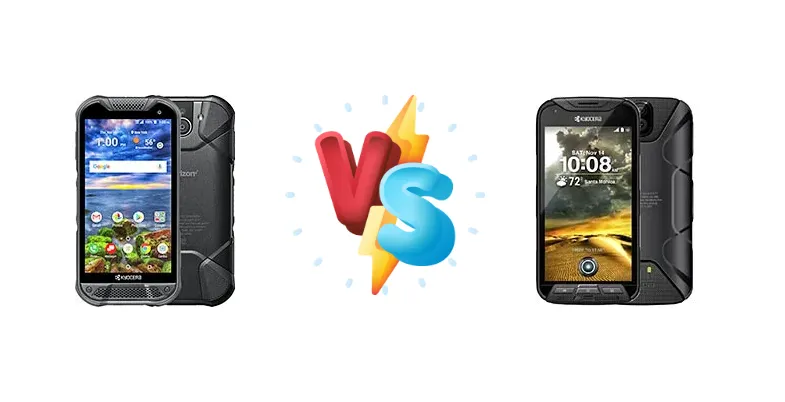
Kyocera's DuraForce line has long been a staple for professionals needing a truly rugged smartphone. The DuraForce Pro 2 arrived as an incremental update to the original Pro, but the devil is in the details. This comparison dissects the key differences – from chipset architecture to charging capabilities – to determine which DuraForce best suits your needs.
🏆 Quick Verdict
For most users, the Kyocera DuraForce Pro 2 is the better choice. Its newer Snapdragon 630 chipset, built on a smaller 14nm process, offers improved performance and efficiency compared to the older 28nm Snapdragon 617 in the original Pro. While the Pro boasts faster 18W charging, the Pro 2 adds Qi wireless charging, a significant convenience factor.
| Network |
|---|
| 2G bands | GSM 850 / 900 / 1800 / 1900 | GSM 850 / 900 / 1800 / 1900 |
| 3G bands | HSDPA 850 / 900 / 1900 / 2100 | HSDPA 850 / 900 / 1700(AWS) / 1900 / 2100 |
| 4G bands | 1, 2, 3, 4, 5, 7, 13, 66 | 2, 4, 5, 12, 25, 26, 41 |
| Speed | HSPA 42.2/5.76 Mbps, LTE (3CA) Cat9 450/50 Mbps | HSPA 42.2/5.76 Mbps, LTE (2CA) Cat6 300/50 Mbps |
| Technology | GSM / HSPA / LTE | GSM / HSPA / LTE |
| Launch |
|---|
| Announced | 2018, November. Released 2018, November | 2016, August. Released 2016, October |
| Status | Discontinued | Discontinued |
| Body |
|---|
| Dimensions | 150.2 x 73.4 x 13.5 mm (5.91 x 2.89 x 0.53 in) | 148.4 x 73.4 x 12.9 mm (5.84 x 2.89 x 0.51 in) |
| SIM | Nano-SIM | Nano-SIM |
| Weight | 243 g (8.25 oz) | 230 g (8.11 oz) |
| | IP68 dust/water resistant (up to 2m for 30 mins)
MIL-STD-810G compliant
Push-to-talk button | IP68 dust/water resistant (up to 1.5m for 30 mins)
MIL-STD-810G compliant
Push-to-talk button |
| Display |
|---|
| Protection | Sapphire crystal glass | Yes |
| Resolution | 1080 x 1920 pixels, 16:9 ratio (~441 ppi density) | 1080 x 1920 pixels, 16:9 ratio (~441 ppi density) |
| Size | 5.0 inches, 68.9 cm2 (~62.5% screen-to-body ratio) | 5.0 inches, 68.9 cm2 (~63.3% screen-to-body ratio) |
| Type | IPS LCD | IPS LCD |
| Platform |
|---|
| CPU | Octa-core 2.2 GHz Cortex-A53 | Octa-core (4x1.5 GHz Cortex-A53 & 4x1.2 GHz Cortex-A53) |
| Chipset | Qualcomm SDM630 Snapdragon 630 (14 nm) | Qualcomm MSM8952 Snapdragon 617 (28 nm) |
| GPU | Adreno 508 | Adreno 405 |
| OS | Android 8.0 (Oreo) | Android 6.0 (Marshmallow) |
| Memory |
|---|
| Card slot | microSDXC (dedicated slot) | microSDXC (dedicated slot) |
| Internal | 64GB 4GB RAM | 32GB 3GB RAM |
| | - | eMMC 5.1 |
| Main Camera |
|---|
| Features | LED flash, HDR, panorama | LED flash, HDR, panorama |
| Single | 13 MP, AF
8 MP (ultra wide; dedicated video camera) | 13 MP, AF
2 MP |
| Video | 4K@30fps, 1080p@30fps | 1080p@30fps |
| Selfie camera |
|---|
| Single | 5 MP | 5 MP |
| Sound |
|---|
| 3.5mm jack | Yes | Yes |
| 35mm jack | Yes | Yes |
| Loudspeaker | Yes, with stereo speakers | Yes, with stereo speakers |
| Comms |
|---|
| Bluetooth | 5.0, A2DP, LE | 4.2, A2DP, LE |
| NFC | Yes | Yes |
| Positioning | GPS | GPS |
| Radio | No | No |
| USB | USB Type-C 3.1 | microUSB 2.0 |
| WLAN | Wi-Fi 802.11 a/b/g/n/ac/i/r/k, dual-band, Wi-Fi Direct | Wi-Fi 802.11 a/b/g/n/ac/i/r/k, dual-band, Wi-Fi Direct |
| Features |
|---|
| Sensors | Fingerprint (side-mounted), accelerometer, gyro, proximity, compass, barometer | Fingerprint (front-mounted), accelerometer, gyro, proximity, compass, barometer |
| Battery |
|---|
| Charging | 10W wired
Wireless (Qi) | 18W wired, QC2 |
| Stand-by | Up to 312 h (3G) | Up to 480 h (3G) |
| Talk time | Up to 21 h (3G) | Up to 19 h (3G) |
| Type | Li-Ion 3240 mAh, non-removable | Li-Ion 3240 mAh, non-removable |
| Misc |
|---|
| Colors | Black | Black |
| Models | - | E6810 |
| Price | About 400 EUR | - |
Kyocera DuraForce Pro 2
- More efficient Snapdragon 630 chipset
- Qi Wireless Charging support
- Improved overall performance
- Slower 10W wired charging
- Potentially higher price point
Kyocera DuraForce Pro
- Faster 18W wired charging with QC2
- Potentially lower price point
- Established rugged reliability
- Older, less efficient Snapdragon 617 chipset
- No wireless charging support
- Lower overall performance
Display Comparison
Both devices share a similar ruggedized display design, prioritizing durability over cutting-edge features. Specifics like screen resolution and panel type aren't provided, but both are likely IPS LCDs optimized for outdoor visibility. The lack of information prevents a direct comparison of brightness or color accuracy, but the focus here is clearly on robustness, not visual fidelity.
Camera Comparison
Without detailed camera specifications, a direct comparison is difficult. Both phones likely feature cameras geared towards functional documentation rather than high-end photography. The absence of sensor size or aperture information suggests a focus on practicality over image quality. It's reasonable to assume both offer adequate performance for capturing job site photos or quick documentation, but neither is likely to compete with flagship smartphone cameras.
Performance
The core difference lies in the chipsets. The DuraForce Pro 2’s Snapdragon 630 (14nm) represents a significant architectural leap over the DuraForce Pro’s Snapdragon 617 (28nm). The 630 utilizes a more efficient manufacturing process, resulting in lower power consumption and reduced heat generation. While both are octa-core CPUs using Cortex-A53 cores, the 630’s higher clock speed (2.2 GHz vs. 1.5/1.2 GHz) and improved architecture translate to noticeably snappier performance in everyday tasks and more demanding applications. The 617’s split core configuration (4x1.5GHz + 4x1.2GHz) suggests a big.LITTLE architecture, but the older process and lower peak speeds limit its overall capability.
Battery Life
Battery capacity isn't specified for either device, making a direct mAh comparison impossible. However, the charging capabilities reveal a key difference. The DuraForce Pro supports 18W wired charging with Quick Charge 2.0, promising faster top-ups. The DuraForce Pro 2, while limited to 10W wired charging, gains the convenience of Qi wireless charging. This trade-off favors the Pro for speed, but the Pro 2 offers a more versatile charging experience, particularly for users who frequently use wireless charging pads in vehicles or offices. The 14nm process of the SDM630 in the Pro 2 should also contribute to better battery life under sustained load.
Buying Guide
Buy the Kyocera DuraForce Pro 2 if you prioritize sustained performance for tasks like data logging, remote access, or using demanding field apps, and value the convenience of wireless charging. Buy the Kyocera DuraForce Pro if you absolutely need the fastest possible wired charging speeds and are on a tighter budget, accepting the performance trade-offs of an older chipset.
Frequently Asked Questions
❓ Will the Snapdragon 630 in the DuraForce Pro 2 handle demanding apps like CAD viewers or remote desktop connections better than the 617?
Yes, the Snapdragon 630’s more modern architecture and higher clock speed will provide a noticeably smoother experience with resource-intensive applications. The 630’s improved GPU will also contribute to better performance in graphically demanding tasks.
❓ I frequently work in direct sunlight. Does either phone offer a specific advantage in terms of screen visibility?
While specific brightness data isn't available, both DuraForce models are designed with outdoor visibility in mind. Kyocera typically employs display technologies to maximize readability in bright conditions, but without detailed specs, it's impossible to say which performs better.
❓ Is the lack of Quick Charge support on the DuraForce Pro 2 a significant drawback, considering the 10W charging?
It depends on your charging habits. If you frequently need to quickly top up your phone, the 18W Quick Charge on the Pro is advantageous. However, if you typically charge overnight or have opportunities for extended charging periods, the slower 10W charging combined with the convenience of Qi wireless charging on the Pro 2 may be sufficient.