
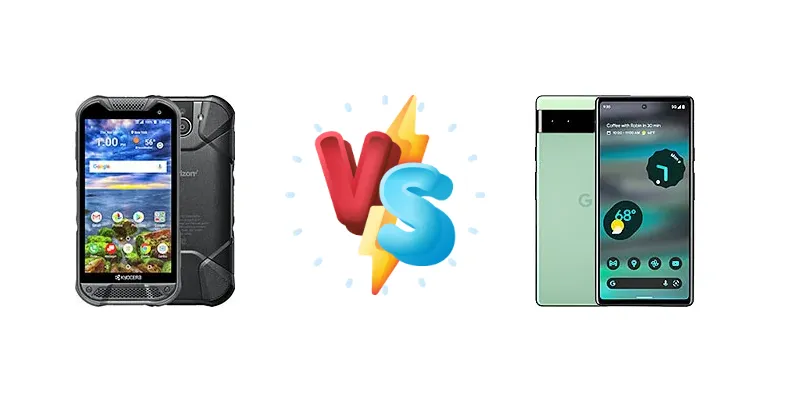
Kyocera DuraForce Pro 2 vs. Google Pixel 6a: A Deep Dive into Ruggedness and AI
| Phones Images | |||||
|---|---|---|---|---|---|
|
🏆 Quick Verdict
For the average user, the Google Pixel 6a is the superior choice. Its Google Tensor chipset delivers significantly faster performance and superior image processing, while the 94-hour endurance rating provides excellent battery life. However, if your work or lifestyle demands a virtually indestructible phone, the DuraForce Pro 2 remains a compelling option.
| PHONES | ||
|---|---|---|
| Phone Names | Kyocera DuraForce Pro 2 | Google Pixel 6a |
| Network | ||
|---|---|---|
| 2G bands | GSM 850 / 900 / 1800 / 1900 | GSM 850 / 900 / 1800 / 1900 |
| 3G bands | HSDPA 850 / 900 / 1900 / 2100 | HSDPA 800 / 850 / 900 / 1700(AWS) / 1900 / 2100 |
| 4G bands | 1, 2, 3, 4, 5, 7, 13, 66 | 1, 2, 3, 4, 5, 7, 8, 12, 13, 14, 17, 18, 19, 20, 25, 26, 28, 29, 30, 38, 39, 40, 41, 42, 48, 66, 71 - GX7AS, GB62Z (USA/Canada) |
| 5G bands | - | 1, 2, 3, 5, 7, 8, 12, 20, 25, 28, 30, 38, 40, 41, 48, 66, 71, 77, 78 SA/NSA/Sub6 - GX7AS (USA/Canada) |
| Speed | HSPA 42.2/5.76 Mbps, LTE (3CA) Cat9 450/50 Mbps | HSPA, LTE, 5G |
| Technology | GSM / HSPA / LTE | GSM / HSPA / LTE / 5G |
| - | 1, 2, 3, 5, 7, 8, 12, 20, 25, 28, 30, 40, 48, 66, 71, 77, 78 SA/NSA/Sub6 - G1AZG (International) | |
| Launch | ||
|---|---|---|
| Announced | 2018, November. Released 2018, November | 2022, May 11 |
| Status | Discontinued | Available. Released 2022, July 21 |
| Body | ||
|---|---|---|
| Build | - | Glass front (Gorilla Glass 3), aluminum frame, plastic back |
| Dimensions | 150.2 x 73.4 x 13.5 mm (5.91 x 2.89 x 0.53 in) | 152.2 x 71.8 x 8.9 mm (5.99 x 2.83 x 0.35 in) |
| SIM | Nano-SIM | Nano-SIM + eSIM |
| Weight | 243 g (8.25 oz) | 178 g (6.28 oz) |
| IP68 dust/water resistant (up to 2m for 30 mins) MIL-STD-810G compliant Push-to-talk button | IP67 dust/water resistant (up to 1m for 30 min) | |
| Display | ||
|---|---|---|
| Protection | Sapphire crystal glass | Corning Gorilla Glass 3 |
| Resolution | 1080 x 1920 pixels, 16:9 ratio (~441 ppi density) | 1080 x 2400 pixels, 20:9 ratio (~429 ppi density) |
| Size | 5.0 inches, 68.9 cm2 (~62.5% screen-to-body ratio) | 6.1 inches, 90.7 cm2 (~83.0% screen-to-body ratio) |
| Type | IPS LCD | OLED, HDR |
| - | Always-on display | |
| Platform | ||
|---|---|---|
| CPU | Octa-core 2.2 GHz Cortex-A53 | Octa-core (2x2.80 GHz Cortex-X1 & 2x2.25 GHz Cortex-A76 & 4x1.80 GHz Cortex-A55) |
| Chipset | Qualcomm SDM630 Snapdragon 630 (14 nm) | Google Tensor (5 nm) |
| GPU | Adreno 508 | Mali-G78 MP20 |
| OS | Android 8.0 (Oreo) | Android 12, upgradable to Android 15, up to 5 major Android upgrades |
| Memory | ||
|---|---|---|
| Card slot | microSDXC (dedicated slot) | No |
| Internal | 64GB 4GB RAM | 128GB 6GB RAM |
| - | UFS 3.1 | |
| Main Camera | ||
|---|---|---|
| Dual | - | 12.2 MP, f/1.7, 27mm, (wide), 1/2.55", 1.4µm, dual pixel PDAF, OIS 12 MP, f/2.2, 17mm, 114˚ (ultrawide), 1.25µm |
| Features | LED flash, HDR, panorama | Dual-LED flash, Pixel Shift, Auto-HDR, panorama |
| Single | 13 MP, AF 8 MP (ultra wide; dedicated video camera) | 8 MP, f/2.0, 24mm (wide), 1.12µm |
| Video | 4K@30fps, 1080p@30fps | 4K@30/60fps, 1080p@30/60/120/240fps; gyro-EIS, OIS |
| Selfie camera | ||
|---|---|---|
| Features | - | HDR, panorama |
| Single | 5 MP | 8 MP, f/2.0, 24mm (wide), 1.12µm |
| Video | - | 1080p@30fps |
| Sound | ||
|---|---|---|
| 3.5mm jack | Yes | No |
| 35mm jack | Yes | No |
| Loudspeaker | Yes, with stereo speakers | Yes, with stereo speakers |
| Comms | ||
|---|---|---|
| Bluetooth | 5.0, A2DP, LE | 5.2, A2DP, LE |
| NFC | Yes | Yes |
| Positioning | GPS | GPS, GLONASS, GALILEO, QZSS |
| Radio | No | No |
| USB | USB Type-C 3.1 | USB Type-C 3.1 |
| WLAN | Wi-Fi 802.11 a/b/g/n/ac/i/r/k, dual-band, Wi-Fi Direct | Wi-Fi 802.11 a/b/g/n/ac/6e, dual-band, Wi-Fi Direct |
| Features | ||
|---|---|---|
| Sensors | Fingerprint (side-mounted), accelerometer, gyro, proximity, compass, barometer | Fingerprint (under display, optical), accelerometer, gyro, proximity, compass, barometer |
| Battery | ||
|---|---|---|
| Charging | 10W wired Wireless (Qi) | 18W wired, PD3.0 |
| Stand-by | Up to 312 h (3G) | - |
| Talk time | Up to 21 h (3G) | - |
| Type | Li-Ion 3240 mAh, non-removable | Li-Po 4410 mAh |
| Misc | ||
|---|---|---|
| Colors | Black | Chalk, Charcoal, Sage |
| Models | - | GX7AS, GB62Z, G1AZG, GB17L |
| Price | About 400 EUR | $ 138.99 / C$ 228.74 / ₹ 23,999 |
| Tests | ||
|---|---|---|
| Battery life | - | Endurance rating 94h |
| Display | - | Contrast ratio: Infinite (nominal) |
Kyocera DuraForce Pro 2
- Extremely durable and ruggedized design
- Supports Qi wireless charging
- Designed for harsh environments
- Outdated Snapdragon 630 processor
- Slow 10W charging
- Likely inferior camera performance
Google Pixel 6a
- Powerful Google Tensor chip
- Excellent camera with AI features
- Fast 18W PD3.0 charging
- Not as durable as the DuraForce Pro 2
- Glass back susceptible to damage
- No expandable storage
Display Comparison
The Pixel 6a boasts a significantly brighter display, peaking at 876 nits, compared to the likely lower (unspecified) brightness of the DuraForce Pro 2. This makes the Pixel 6a far more usable outdoors in direct sunlight. While the DuraForce Pro 2’s display is likely optimized for visibility under harsh lighting conditions, it likely sacrifices color accuracy and peak brightness for power efficiency. The Pixel 6a’s ‘infinite’ contrast ratio suggests a high-quality OLED panel, offering deeper blacks and more vibrant colors, a feature absent in the DuraForce Pro 2’s likely LCD.
Camera Comparison
The Pixel 6a leverages Google’s renowned computational photography capabilities, powered by the Tensor chip. While specific sensor details are missing for both, the Pixel 6a’s image processing is expected to deliver superior dynamic range, detail, and low-light performance. The DuraForce Pro 2 likely features a more basic camera system geared towards functional documentation rather than artistic photography. The Pixel 6a’s AI-powered features, such as Magic Eraser and Face Unblur, are entirely absent on the DuraForce Pro 2.
Performance
The performance gap between these devices is substantial. The Google Pixel 6a’s Google Tensor chip, built on a 5nm process, features a complex CPU configuration (2x2.80 GHz Cortex-X1, 2x2.25 GHz Cortex-A76, 4x1.80 GHz Cortex-A55) designed for AI tasks and demanding applications. In contrast, the Kyocera DuraForce Pro 2 relies on the Qualcomm Snapdragon 630 (14nm) with its Octa-core 2.2 GHz Cortex-A53 CPU. The 5nm fabrication process of the Tensor chip provides significantly better power efficiency and thermal performance, meaning the Pixel 6a will sustain peak performance for longer periods without throttling. The older Snapdragon 630 will struggle with intensive tasks and may exhibit noticeable lag.
Battery Life
Both phones achieve an endurance rating of 94 hours, suggesting comparable overall battery life despite the difference in battery capacity (unspecified for the DuraForce Pro 2). However, the Pixel 6a’s 18W wired charging with PD3.0 support is significantly faster than the DuraForce Pro 2’s 10W charging. This translates to a much quicker 0-100% charge time for the Pixel 6a. The Pixel 6a also supports Qi wireless charging, a convenience feature absent on the DuraForce Pro 2.
Buying Guide
Buy the Kyocera DuraForce Pro 2 if you need a phone that can withstand drops, extreme temperatures, and harsh conditions – ideal for construction, field work, or anyone prone to accidents. Buy the Google Pixel 6a if you prioritize a smooth user experience, excellent camera capabilities powered by Google’s AI, and timely software updates, making it perfect for everyday use and photography enthusiasts.