
Kyocera DuraForce Pro 2 vs. Google Pixel 6: A Deep Dive into Ruggedness and AI
| Phones Images | |||||
|---|---|---|---|---|---|
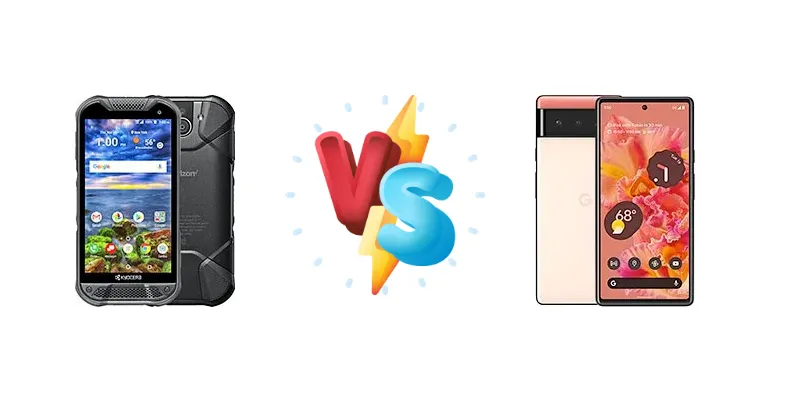
|
🏆 Quick Verdict
For the average user prioritizing camera quality, software experience, and future updates, the Google Pixel 6 is the clear winner. However, if your work or lifestyle demands a virtually indestructible phone, the Kyocera DuraForce Pro 2 remains a compelling, albeit compromised, choice.
| PHONES | ||
|---|---|---|
| Phone Names | Kyocera DuraForce Pro 2 | Google Pixel 6 |
| Network | ||
|---|---|---|
| 2G bands | GSM 850 / 900 / 1800 / 1900 | GSM 850 / 900 / 1800 / 1900 |
| 3G bands | HSDPA 850 / 900 / 1900 / 2100 | HSDPA 800 / 850 / 900 / 1700(AWS) / 1900 / 2100 |
| 4G bands | 1, 2, 3, 4, 5, 7, 13, 66 | 1, 2, 3, 4, 5, 7, 8, 12, 13, 14, 17, 18, 19, 20, 25, 26, 28, 29, 30, 32, 38, 39, 40, 41, 42, 46, 48, 66, 71 - GB7N6, G9S9B16 |
| 5G bands | - | 1, 2, 3, 5, 7, 8, 12, 14, 20, 25, 28, 30, 38, 40, 41, 48, 66, 71, 77, 78, 257, 258, 260, 261 SA/NSA/Sub6/mmWave - G9S9B |
| Speed | HSPA 42.2/5.76 Mbps, LTE (3CA) Cat9 450/50 Mbps | HSPA, LTE, 5G |
| Technology | GSM / HSPA / LTE | GSM / CDMA / HSPA / EVDO / LTE / 5G |
| - | 1, 2, 3, 5, 7, 8, 12, 14, 20, 25, 28, 30, 38, 40, 41, 48, 66, 71, 77, 78 SA/NSA/Sub6 - GB7N6 | |
| Launch | ||
|---|---|---|
| Announced | 2018, November. Released 2018, November | 2021, October 19 |
| Status | Discontinued | Available. Released 2021, October 28 |
| Body | ||
|---|---|---|
| Build | - | Glass front (Gorilla Glass Victus), glass back (Gorilla Glass 6), aluminum frame |
| Dimensions | 150.2 x 73.4 x 13.5 mm (5.91 x 2.89 x 0.53 in) | 158.6 x 74.8 x 8.9 mm (6.24 x 2.94 x 0.35 in) |
| SIM | Nano-SIM | Nano-SIM + eSIM |
| Weight | 243 g (8.25 oz) | 207 g (7.30 oz) |
| IP68 dust/water resistant (up to 2m for 30 mins) MIL-STD-810G compliant Push-to-talk button | IP68 dust/water resistant (up to 1.5m for 30 min) | |
| Display | ||
|---|---|---|
| Protection | Sapphire crystal glass | Corning Gorilla Glass Victus |
| Resolution | 1080 x 1920 pixels, 16:9 ratio (~441 ppi density) | 1080 x 2400 pixels, 20:9 ratio (~411 ppi density) |
| Size | 5.0 inches, 68.9 cm2 (~62.5% screen-to-body ratio) | 6.4 inches, 98.9 cm2 (~83.4% screen-to-body ratio) |
| Type | IPS LCD | AMOLED, 90Hz, HDR10+ |
| - | Always-on display | |
| Platform | ||
|---|---|---|
| CPU | Octa-core 2.2 GHz Cortex-A53 | Octa-core (2x2.80 GHz Cortex-X1 & 2x2.25 GHz Cortex-A76 & 4x1.80 GHz Cortex-A55) |
| Chipset | Qualcomm SDM630 Snapdragon 630 (14 nm) | Google Tensor (5 nm) |
| GPU | Adreno 508 | Mali-G78 MP20 |
| OS | Android 8.0 (Oreo) | Android 12, upgradable to Android 15, up to 5 major Android upgrades |
| Memory | ||
|---|---|---|
| Card slot | microSDXC (dedicated slot) | No |
| Internal | 64GB 4GB RAM | 128GB 8GB RAM, 256GB 8GB RAM |
| - | UFS 3.1 | |
| Main Camera | ||
|---|---|---|
| Dual | - | 50 MP, f/1.9, 25mm (wide), 1/1.31", 1.2µm, dual pixel PDAF, OIS 12 MP, f/2.2, 17mm, 114˚ (ultrawide), 1.25µm |
| Features | LED flash, HDR, panorama | Laser AF, Dual-LED flash, Pixel Shift, Auto-HDR, panorama |
| Single | 13 MP, AF 8 MP (ultra wide; dedicated video camera) | 8 MP, f/2.0, 24mm (wide), 1.12µm |
| Video | 4K@30fps, 1080p@30fps | 4K@30/60fps, 1080p@30/60/120/240fps; gyro-EIS, OIS |
| Selfie camera | ||
|---|---|---|
| Features | - | HDR, panorama |
| Single | 5 MP | 8 MP, f/2.0, 24mm (wide), 1.12µm |
| Video | - | 1080p@30fps |
| Sound | ||
|---|---|---|
| 3.5mm jack | Yes | No |
| 35mm jack | Yes | No |
| Loudspeaker | Yes, with stereo speakers | Yes, with stereo speakers |
| Comms | ||
|---|---|---|
| Bluetooth | 5.0, A2DP, LE | 5.2, A2DP, LE, aptX HD |
| NFC | Yes | Yes |
| Positioning | GPS | GPS (L1+L5), GLONASS (G1), BDS (B1I+B1c+B2a), GALILEO (E1+E5a), QZSS (L1+L5) |
| Radio | No | No |
| USB | USB Type-C 3.1 | USB Type-C 3.1 |
| WLAN | Wi-Fi 802.11 a/b/g/n/ac/i/r/k, dual-band, Wi-Fi Direct | Wi-Fi 802.11 a/b/g/n/ac/6e, dual-band, Wi-Fi Direct |
| Features | ||
|---|---|---|
| Sensors | Fingerprint (side-mounted), accelerometer, gyro, proximity, compass, barometer | Fingerprint (under display, optical), accelerometer, gyro, proximity, compass, barometer |
| Battery | ||
|---|---|---|
| Charging | 10W wired Wireless (Qi) | Wired (based on 30W charger), PD3.0, 50% in 30 min 21W wireless Reverse wireless |
| Stand-by | Up to 312 h (3G) | - |
| Talk time | Up to 21 h (3G) | - |
| Type | Li-Ion 3240 mAh, non-removable | Li-Ion 4614 mAh |
| Misc | ||
|---|---|---|
| Colors | Black | Sorta Seafoam, Kinda Coral, Stormy Black |
| Models | - | GB7N6, G9S9B16, G9S9B, GR1YH |
| Price | About 400 EUR | $ 172.48 / C$ 238.84 / £ 169.99 / € 191.89 / ₹ 23,719 |
| Tests | ||
|---|---|---|
| Battery life | - | Endurance rating 86h |
| Camera | - | Photo / Video |
| Display | - | Contrast ratio: Infinite (nominal) |
| Loudspeaker | - | -26.9 LUFS (Good) |
| Performance | - | AnTuTu: 676831 (v9) GeekBench: 2899 (v5.1) GFXBench: 57fps (ES 3.1 onscreen) |
Kyocera DuraForce Pro 2
- Extremely durable and ruggedized design
- Waterproof and dustproof (IP68)
- Programmable keys for quick access to functions
- Outdated Snapdragon 630 processor
- Slow 10W charging
- Likely inferior camera performance
Google Pixel 6
- Powerful Google Tensor chip
- Excellent camera with advanced features
- Fast 30W wired and 21W wireless charging
- Less durable than the DuraForce Pro 2
- May require a case for protection
- Software updates may eventually cease
Display Comparison
Both devices feature displays with an 'Infinite' contrast ratio, suggesting deep blacks, but details beyond this are sparse for the DuraForce Pro 2. The Pixel 6’s display benefits from Google’s image processing, likely offering superior color accuracy and brightness. The lack of detailed display specs for the DuraForce Pro 2 suggests a focus on functionality over visual fidelity, prioritizing visibility in bright sunlight over vibrant colors.
Camera Comparison
The Pixel 6’s camera system is a major strength, leveraging Google’s computational photography expertise. While specific sensor details are missing, the Pixel 6’s image processing is renowned for its dynamic range and detail. The DuraForce Pro 2’s camera specs are not provided, but given its target market, it likely prioritizes functionality over image quality. The Pixel 6’s advanced features, such as Night Sight and Portrait Mode, are unlikely to be matched by the DuraForce Pro 2.
Performance
The performance gap is significant. The Google Pixel 6’s Google Tensor chip, fabricated on a 5nm process, boasts a complex octa-core configuration (2x2.80 GHz Cortex-X1, 2x2.25 GHz Cortex-A76, 4x1.80 GHz Cortex-A55) designed for AI and machine learning tasks. This contrasts sharply with the Kyocera DuraForce Pro 2’s Qualcomm Snapdragon 630 (14nm) and its octa-core 2.2 GHz Cortex-A53 CPU. The 5nm process of the Tensor chip delivers superior power efficiency and thermal performance, allowing for sustained high performance, while the 14nm Snapdragon 630 will likely struggle with demanding applications and multitasking. The Tensor’s architecture also includes dedicated AI cores, enabling features like Magic Eraser and Live Translate, absent on the DuraForce Pro 2.
Battery Life
Both phones achieve an endurance rating of 86 hours, suggesting comparable battery life under similar usage scenarios. However, the Pixel 6 offers significantly faster charging: 30W wired with PD3.0 (50% in 30 minutes) and 21W wireless with reverse wireless charging. The DuraForce Pro 2 is limited to 10W wired charging and Qi wireless charging, meaning considerably longer recharge times. While both have similar endurance, the Pixel 6’s charging speed provides greater convenience.
Buying Guide
Buy the Kyocera DuraForce Pro 2 if you need a phone that can withstand drops, extreme temperatures, and harsh conditions – a true tool for construction, field work, or anyone prone to accidents. Buy the Google Pixel 6 if you prioritize a smooth, intelligent user experience, exceptional camera capabilities, and access to the latest Android features and security updates.