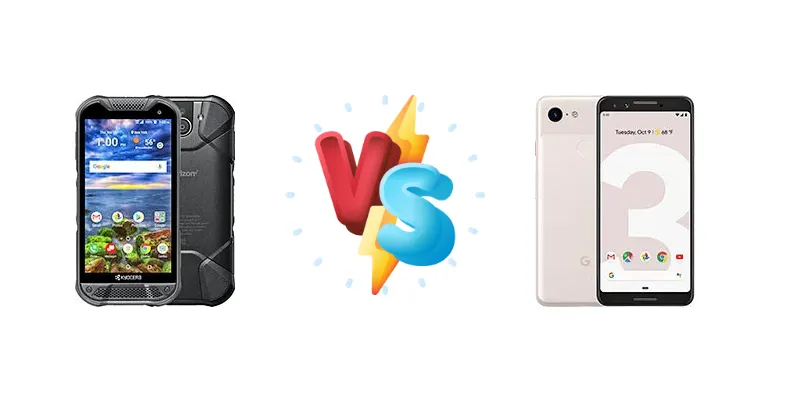
The Kyocera DuraForce Pro 2 and Google Pixel 3 represent vastly different priorities in the smartphone market. The DuraForce Pro 2 targets users needing extreme durability, while the Pixel 3 aimed for a premium experience centered around computational photography and a clean Android interface. This comparison dissects their core differences to determine which device delivers the best value for specific user needs.
🏆 Quick Verdict
For the average user prioritizing camera quality and overall performance, the Google Pixel 3 is the clear winner. Its Snapdragon 845 chipset provides significantly faster processing speeds, and its camera capabilities are superior. However, if your work or lifestyle demands a virtually indestructible phone, the DuraForce Pro 2 is the only viable option.
| Network |
|---|
| 2G bands | GSM 850 / 900 / 1800 / 1900 | GSM 850 / 900 / 1800 / 1900 |
| 3G bands | HSDPA 850 / 900 / 1900 / 2100 | HSDPA 850 / 900 / 1700(AWS) / 1900 / 2100 |
| 4G bands | 1, 2, 3, 4, 5, 7, 13, 66 | 1, 2, 3, 4, 5, 7, 8, 12, 13, 17, 18, 19, 20, 25, 26, 28, 29, 32, 38, 39, 40, 41, 42, 46, 66, 71 |
| Speed | HSPA 42.2/5.76 Mbps, LTE (3CA) Cat9 450/50 Mbps | HSPA 42.2/5.76 Mbps, LTE (5CA) Cat16 1024/75 Mbps |
| Technology | GSM / HSPA / LTE | GSM / CDMA / HSPA / EVDO / LTE |
| Launch |
|---|
| Announced | 2018, November. Released 2018, November | 2018, October 09. Released 2018, October 18 |
| Status | Discontinued | Discontinued |
| Body |
|---|
| Build | - | Glass front (Gorilla Glass 5), glass back (Gorilla Glass 5), aluminum frame |
| Dimensions | 150.2 x 73.4 x 13.5 mm (5.91 x 2.89 x 0.53 in) | 145.6 x 68.2 x 7.9 mm (5.73 x 2.69 x 0.31 in) |
| SIM | Nano-SIM | Nano-SIM + eSIM |
| Weight | 243 g (8.25 oz) | 148 g (5.22 oz) |
| | IP68 dust/water resistant (up to 2m for 30 mins)
MIL-STD-810G compliant
Push-to-talk button | - |
| Display |
|---|
| Protection | Sapphire crystal glass | Corning Gorilla Glass 5 |
| Resolution | 1080 x 1920 pixels, 16:9 ratio (~441 ppi density) | 1080 x 2160 pixels, 18:9 ratio (~443 ppi density) |
| Size | 5.0 inches, 68.9 cm2 (~62.5% screen-to-body ratio) | 5.5 inches, 76.7 cm2 (~77.2% screen-to-body ratio) |
| Type | IPS LCD | P-OLED, HDR |
| Platform |
|---|
| CPU | Octa-core 2.2 GHz Cortex-A53 | Octa-core (4x2.5 GHz Kryo 385 Gold & 4x1.6 GHz Kryo 385 Silver) |
| Chipset | Qualcomm SDM630 Snapdragon 630 (14 nm) | Qualcomm SDM845 Snapdragon 845 (10 nm) |
| GPU | Adreno 508 | Adreno 630 |
| OS | Android 8.0 (Oreo) | Android 9.0 (Pie), upgradable to Android 12 |
| Memory |
|---|
| Card slot | microSDXC (dedicated slot) | No |
| Internal | 64GB 4GB RAM | 64GB 4GB RAM, 128GB 4GB RAM |
| Main Camera |
|---|
| Features | LED flash, HDR, panorama | Dual-LED flash, Pixel Shift, Auto-HDR, panorama |
| Single | 13 MP, AF
8 MP (ultra wide; dedicated video camera) | 12.2 MP, f/1.8, 28mm (wide), 1/2.55", 1.4µm, dual pixel PDAF, OIS |
| Video | 4K@30fps, 1080p@30fps | 4K@30fps, 1080p@30/60/120fps, 1080p@30fps (gyro-EIS) |
| Selfie camera |
|---|
| Dual | - | 8 MP, f/1.8, 28mm (wide), PDAF
8 MP, f/2.2, 19mm (ultrawide), no AF |
| Features | - | HDR |
| Single | 5 MP | - |
| Video | - | 1080p@30fps |
| Sound |
|---|
| 3.5mm jack | Yes | No |
| 35mm jack | Yes | No |
| Loudspeaker | Yes, with stereo speakers | Yes, with stereo speakers |
| Comms |
|---|
| Bluetooth | 5.0, A2DP, LE | 5.0, A2DP, LE, aptX HD |
| NFC | Yes | Yes |
| Positioning | GPS | GPS, GLONASS, BDS, GALILEO |
| Radio | No | No |
| USB | USB Type-C 3.1 | USB Type-C 3.1 |
| WLAN | Wi-Fi 802.11 a/b/g/n/ac/i/r/k, dual-band, Wi-Fi Direct | Wi-Fi 802.11 a/b/g/n/ac, dual-band, Wi-Fi Direct, DLNA |
| Features |
|---|
| Sensors | Fingerprint (side-mounted), accelerometer, gyro, proximity, compass, barometer | Fingerprint (rear-mounted), accelerometer, gyro, proximity, compass, barometer |
| Battery |
|---|
| Charging | 10W wired
Wireless (Qi) | 18W wired, PD2.0
Wireless |
| Stand-by | Up to 312 h (3G) | - |
| Talk time | Up to 21 h (3G) | - |
| Type | Li-Ion 3240 mAh, non-removable | Li-Po 2915 mAh, non-removable |
| Misc |
|---|
| Colors | Black | Clearly White, Just Black, Not Pink |
| Models | - | G013A |
| Price | About 400 EUR | About 450 EUR |
| Tests |
|---|
| Audio quality | - |
Noise -71.7dB / Crosstalk -70.1dB |
| Battery life | - | Endurance rating 69h |
| Camera | - |
Photo / Video |
| Display | - |
Contrast ratio: Infinite (nominal), 4.350 (sunlight) |
| Loudspeaker | - |
Voice 77dB / Noise 71dB / Ring 81dB |
| Performance | - |
AnTuTu: 285044 (v7)
GeekBench: 8337 (v4.4)
GFXBench: 33fps (ES 3.1 onscreen) |
Kyocera DuraForce Pro 2
- Extremely durable and ruggedized design
- Waterproof and dustproof (IP68 or similar)
- Qi wireless charging support
- Significantly slower processor
- Inferior camera performance
- Slower charging speeds
Google Pixel 3
- Powerful Snapdragon 845 processor
- Exceptional camera quality
- Fast charging with PD2.0 and wireless charging
- Not ruggedized; susceptible to damage from drops
- Battery life, while rated similarly, may be impacted by heavy usage
- Older device; software updates may be limited
Display Comparison
Both devices share a similar contrast ratio of infinite (nominal) and 4350 in sunlight, suggesting comparable visibility in bright conditions. However, the Pixel 3’s display technology is likely superior, benefiting from Google’s image processing and calibration. The DuraForce Pro 2’s display, while functional, is likely optimized for durability rather than color accuracy or peak brightness. The Pixel 3’s smaller screen size (assumed, based on market positioning) may appeal to users preferring a more compact device.
Camera Comparison
While both phones offer photo and video capabilities, the Pixel 3’s camera is in a different league. Google’s computational photography prowess, combined with the SDM845’s image signal processor, delivers superior image quality, particularly in low-light conditions. The DuraForce Pro 2’s camera is likely adequate for basic documentation, but it won’t compete with the Pixel 3’s detail, dynamic range, or overall image processing. The Pixel 3’s camera features, such as Night Sight, were industry-leading at its release.
Performance
The performance gap between these phones is substantial. The Google Pixel 3’s Snapdragon 845 (10nm) boasts a significantly more powerful octa-core CPU (4x2.5 GHz Kryo 385 Gold & 4x1.6 GHz Kryo 385 Silver) compared to the Kyocera DuraForce Pro 2’s Snapdragon 630 (14nm) with its octa-core 2.2 GHz Cortex-A53 configuration. The 10nm fabrication process of the SDM845 also contributes to better thermal efficiency, reducing throttling during sustained workloads. This translates to faster app loading times, smoother multitasking, and a more responsive user experience on the Pixel 3.
Battery Life
Both devices have an endurance rating of 69 hours, which is surprising given the chipset differences. This suggests the DuraForce Pro 2 compensates for its less efficient processor with a larger battery capacity (spec not provided). However, the Pixel 3 benefits from 18W wired charging with PD2.0, allowing for significantly faster charging speeds compared to the DuraForce Pro 2’s 10W wired charging. The Pixel 3 also supports wireless charging, a feature the DuraForce Pro 2 offers via Qi, but likely at a slower rate.
Buying Guide
Buy the Kyocera DuraForce Pro 2 if you need a phone that can withstand drops, extreme temperatures, and harsh environments – ideal for construction workers, first responders, or outdoor enthusiasts. Buy the Google Pixel 3 if you prioritize a smooth user experience, exceptional camera performance, and fast processing speeds for everyday tasks and media consumption.
Frequently Asked Questions
❓ Is the Kyocera DuraForce Pro 2 a good choice for someone working in construction or a similar field?
Absolutely. The DuraForce Pro 2 is specifically designed for harsh environments. Its ruggedized construction can withstand drops, dust, water, and extreme temperatures, making it ideal for construction workers, first responders, and anyone who needs a phone that can survive demanding conditions.
❓ Will the Google Pixel 3 still receive software updates in 2024?
Official software updates from Google have ended for the Pixel 3. However, the active Android community means custom ROMs are available, allowing users to continue running newer versions of Android. Be aware that installing a custom ROM voids the warranty and requires technical expertise.
❓ How does the Snapdragon 630 in the DuraForce Pro 2 handle demanding apps like video editing or gaming?
The Snapdragon 630 is a mid-range processor and will struggle with demanding tasks like video editing or graphically intensive games. Expect noticeable lag and reduced frame rates. The Pixel 3’s Snapdragon 845 provides a far smoother experience for these applications.
❓ Does the wireless charging on the DuraForce Pro 2 support fast wireless charging speeds?
No, the DuraForce Pro 2 supports standard Qi wireless charging, which is significantly slower than the fast wireless charging supported by some other devices. Expect longer charging times compared to wired charging or fast wireless charging.