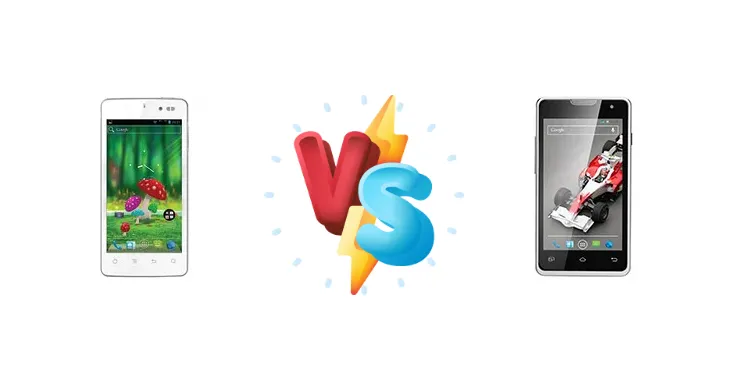
In the fiercely competitive sub-$150 smartphone market, the Karbonn S1 Titanium and XOLO Q500 represent attempts to deliver a functional Android experience without breaking the bank. While both devices feature a quad-core processor, the XOLO Q500 distinguishes itself with Qualcomm’s Snapdragon S4 Play chipset, a significant architectural difference compared to the Karbonn’s unspecified quad-core implementation. This comparison will dissect these differences and determine which device offers the best value.
🏆 Quick Verdict
For the average user prioritizing responsiveness and a more refined software experience, the XOLO Q500 is the superior choice. The Qualcomm Snapdragon S4 Play chipset, built on a more efficient architecture, provides a noticeable performance edge over the Karbonn S1 Titanium’s generic quad-core processor, despite both running at 1.2 GHz.
| Network |
|---|
| 2G bands | GSM 900 / 1800 / 1900 - SIM 1 & SIM 2 | GSM 850 / 900 / 1800 / 1900 - SIM 1 & SIM 2 |
| 3G bands | HSDPA 2100 | HSDPA 2100 |
| EDGE | - | Class 10 |
| GPRS | - | Class 10 |
| Speed | HSPA | HSPA 7.2/5.76 Mbps |
| Technology | GSM / HSPA | GSM / HSPA |
| Launch |
|---|
| Announced | 2013, January. Released 2013, January | 2013, November. Released 2013, November |
| Status | Discontinued | Discontinued |
| Body |
|---|
| Dimensions | 134.6 x 66 x 9.3 mm (5.30 x 2.60 x 0.37 in) | 118.5 x 63 x 10.7 mm (4.67 x 2.48 x 0.42 in) |
| Keyboard | - | QWERTY |
| SIM | Dual SIM (Mini-SIM) | Dual SIM |
| Weight | - | 116 g (4.09 oz) |
| Display |
|---|
| Resolution | 540 x 960 pixels, 16:9 ratio (~245 ppi density) | 480 x 800 pixels, 5:3 ratio (~233 ppi density) |
| Size | 4.5 inches, 55.8 cm2 (~62.8% screen-to-body ratio) | 4.0 inches, 45.5 cm2 (~61.0% screen-to-body ratio) |
| Type | IPS LCD | TFT |
| Platform |
|---|
| CPU | Quad-core 1.2 GHz | Quad-core 1.2 GHz Cortex-A5 |
| Chipset | - | Qualcomm MSM8225Q Snapdragon S4 Play |
| GPU | - | Adreno 203 |
| OS | Android 4.1 (Jelly Bean) | Android 4.1 (Jelly Bean) |
| Memory |
|---|
| Call records | - | Yes |
| Card slot | microSDHC (dedicated slot) | microSDHC (dedicated slot) |
| Internal | 4GB 1GB RAM | 4GB 1GB RAM |
| Phonebook | - | 1000 entries, Photocall |
| Main Camera |
|---|
| Features | LED flash | LED flash, panorama, HDR |
| Single | 5 MP, AF | 5 MP, AF |
| Video | Yes | 720p |
| Selfie camera |
|---|
| Single | Yes | VGA |
| Sound |
|---|
| 3.5mm jack | Yes | Yes |
| 35mm jack | Yes | Yes |
| Loudspeaker | Yes | Yes |
| Comms |
|---|
| Bluetooth | Yes | 3.0 |
| NFC | No | No |
| Positioning | GPS | GPS |
| Radio | FM radio | FM radio |
| USB | microUSB 2.0 | microUSB 2.0 |
| WLAN | Wi-Fi 802.11 b/g/n, hotspot | Wi-Fi 802.11 b/g/n, hotspot |
| Features |
|---|
| Browser | - | WAP 2.0/xHTML (Opera Mini) |
| Games | - | Downloadable |
| Java | - | Yes, MIDP 2.0 |
| Messaging | - | SMS, MMS |
| Sensors | Accelerometer, proximity | Accelerometer, proximity |
| Battery |
|---|
| Stand-by | Up to 200 h | Up to 333 h (2G) / Up to 242 h (3G) |
| Talk time | Up to 4 h | Up to 13 h 20 min (2G) / Up to 10 h (3G) |
| Type | Li-Ion 1600 mAh battery | Li-Ion 1450 mAh, removable |
| Misc |
|---|
| Colors | Black, White | White |
| Price | About 150 EUR | About 90 EUR |
Karbonn S1 Titanium
- Potentially lower price point
- Basic functionality for essential tasks
- Simple and straightforward user interface
- Inferior processor architecture
- Likely slower performance
- Limited software support
XOLO Q500
- Qualcomm Snapdragon S4 Play chipset
- More efficient processor architecture
- Potentially smoother user experience
- May be slightly more expensive
- Limited RAM capacity (likely)
- Basic camera performance
Display Comparison
Neither Karbonn nor XOLO provided detailed display specifications. Given the price point, both likely utilize TFT LCD panels with resolutions around 480x800. The absence of information regarding brightness, color gamut coverage, or viewing angles suggests neither device prioritizes display quality. Expect washed-out colors and limited visibility in direct sunlight on both models. Bezels are likely substantial on both, maximizing screen real estate at the expense of a modern aesthetic.
Camera Comparison
Camera details are sparse for both devices. It’s safe to assume both feature basic camera sensors, likely around 5MP or 8MP, capable of capturing acceptable photos in ideal lighting conditions. Image quality will suffer in low light due to the lack of optical image stabilization (OIS) and potentially small sensor sizes. The inclusion of a 2MP or similar low-resolution secondary camera on both devices is likely for marketing purposes and offers minimal practical benefit. Expect significant noise and lack of detail in photos taken with either phone.
Performance
The core difference lies in the chipset. The XOLO Q500’s Qualcomm MSM8225Q Snapdragon S4 Play, featuring Cortex-A5 cores, benefits from Qualcomm’s optimizations in power management and GPU performance. While both CPUs clock in at 1.2 GHz, the Snapdragon’s architecture is more efficient, translating to better sustained performance and reduced thermal throttling. The Karbonn S1 Titanium’s unspecified quad-core processor likely lacks these optimizations, resulting in a less fluid user experience, particularly during multitasking or demanding applications. RAM capacity is not specified for either device, but it's likely limited, further impacting performance.
Battery Life
Battery capacity is not specified for either device. Given the budget nature of these phones, expect capacities around 1500-2000 mAh. The Snapdragon S4 Play in the XOLO Q500, being more power-efficient, may offer slightly better battery life despite potentially having a similar capacity to the Karbonn S1 Titanium. Charging wattage is also unknown, but likely slow, requiring several hours for a full charge. Real-world battery life will heavily depend on usage patterns, but both phones will likely require daily charging.
Buying Guide
Buy the Karbonn S1 Titanium if your primary need is a basic, functional smartphone for essential tasks like calls, texts, and light social media use, and you are operating on an extremely tight budget. Buy the XOLO Q500 if you value a smoother user experience, slightly better performance for multitasking, and the benefits of Qualcomm’s optimized chipset, even if it means spending a little more.
Frequently Asked Questions
❓ Will the XOLO Q500 handle basic games like Candy Crush or Subway Surfers without significant lag?
Yes, the Qualcomm Snapdragon S4 Play chipset in the XOLO Q500 is capable of running less demanding games like Candy Crush and Subway Surfers with acceptable performance. However, don't expect to play graphically intensive 3D games smoothly. The Karbonn S1 Titanium may struggle even with these simpler titles.
❓ Is the XOLO Q500 likely to receive any software updates after purchase?
Given the age and price point of both devices, the likelihood of significant software updates is low. Both the Karbonn S1 Titanium and XOLO Q500 likely shipped with an older version of Android and may not receive updates beyond minor security patches, if any. Don't expect to see the latest Android features on either phone.
❓ How much storage space is realistically available on the XOLO Q500 for apps and photos?
Storage capacity is not specified, but it's likely around 4GB. After accounting for the operating system and pre-installed apps, realistically, you'll have approximately 2-3GB of usable storage. A microSD card slot is essential for expanding storage on the XOLO Q500.