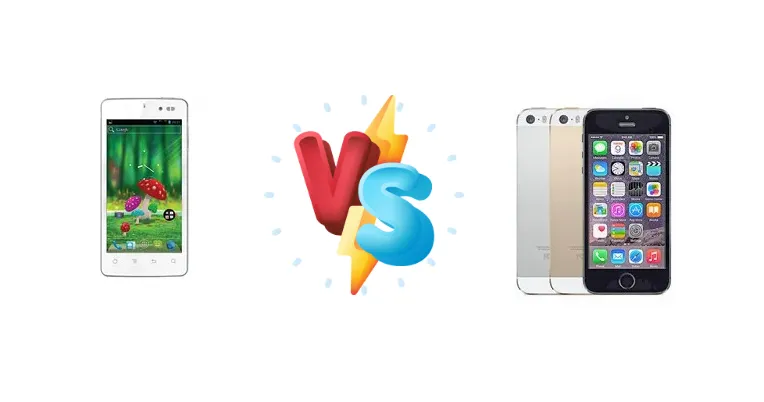
The Karbonn S1 Titanium and the Apple iPhone 5s represent vastly different eras of mobile technology. The iPhone 5s, released in 2013, was a flagship, while the Karbonn S1 Titanium aimed for affordability. Today, we revisit this pairing to determine if Apple’s legacy device still holds value against a budget-focused Android offering, particularly for users seeking a functional, inexpensive smartphone.
🏆 Quick Verdict
For the average user in 2024, the Apple iPhone 5s is the better choice, despite its age. Its optimized A7 chipset and enduring software support (though limited) provide a smoother, more secure experience than the Karbonn S1 Titanium, which suffers from a less efficient processor and likely outdated software. However, the Karbonn offers a larger screen and potentially more storage options.
| Network |
|---|
| 2G bands | GSM 900 / 1800 / 1900 - SIM 1 & SIM 2 | GSM 850 / 900 / 1800 / 1900 - all models |
| 3G bands | HSDPA 2100 | HSDPA 850 / 900 / 1700 / 1900 / 2100 - A1533 (GSM), A1453 |
| 4G bands | - | 1, 2, 3, 4, 5, 8, 13, 17, 19, 20, 25 - A1533 GSM, A1533 CDMA |
| Speed | HSPA | HSPA 42.2/5.76 Mbps, LTE Cat3 100/50 Mbps, EV-DO Rev.A 3.1 Mbps |
| Technology | GSM / HSPA | GSM / CDMA / HSPA / EVDO / LTE |
| | - | 1, 2, 3, 5, 7, 8, 20, 38, 39, 40 - A1530 |
| Launch |
|---|
| Announced | 2013, January. Released 2013, January | 2013, September 10. Released 2013, September 20 |
| Status | Discontinued | Discontinued |
| Body |
|---|
| Build | - | Glass front (Corning-made glass), aluminum back, aluminum frame |
| Dimensions | 134.6 x 66 x 9.3 mm (5.30 x 2.60 x 0.37 in) | 123.8 x 58.6 x 7.6 mm (4.87 x 2.31 x 0.30 in) |
| SIM | Dual SIM (Mini-SIM) | Nano-SIM |
| Weight | - | 112 g (3.95 oz) |
| Display |
|---|
| Protection | - | Corning Gorilla Glass, oleophobic coating |
| Resolution | 540 x 960 pixels, 16:9 ratio (~245 ppi density) | 640 x 1136 pixels, 16:9 ratio (~326 ppi density) |
| Size | 4.5 inches, 55.8 cm2 (~62.8% screen-to-body ratio) | 4.0 inches, 44.1 cm2 (~60.8% screen-to-body ratio) |
| Type | IPS LCD | IPS LCD |
| Platform |
|---|
| CPU | Quad-core 1.2 GHz | Dual-core 1.3 GHz Cyclone (ARM v8-based) |
| Chipset | - | Apple A7 (28 nm) |
| GPU | - | PowerVR G6430 (quad-core graphics) |
| OS | Android 4.1 (Jelly Bean) | iOS 7, upgradable to iOS 12.5.7 |
| Memory |
|---|
| Card slot | microSDHC (dedicated slot) | No |
| Internal | 4GB 1GB RAM | 16GB 1GB RAM, 32GB 1GB RAM, 64GB 1GB RAM |
| Main Camera |
|---|
| Features | LED flash | Dual-LED dual-tone flash, HDR |
| Single | 5 MP, AF | 8 MP, f/2.2, 29mm (standard), 1/3.0", 1.5µm, AF |
| Video | Yes | 1080p@30fps, 720p@120fps |
| Selfie camera |
|---|
| Features | - | face detection, HDR, FaceTime over Wi-Fi or Cellular |
| Single | Yes | 1.2 MP, f/2.4, 31mm (standard) |
| Video | - | 720p@30fps |
| Sound |
|---|
| 3.5mm jack | Yes | Yes |
| 35mm jack | Yes | Yes |
| Loudspeaker | Yes | Yes |
| | - | 16-bit/44.1kHz audio
|
| Comms |
|---|
| Bluetooth | Yes | 4.0, A2DP |
| NFC | No | No |
| Positioning | GPS | GPS, GLONASS |
| Radio | FM radio | No |
| USB | microUSB 2.0 | Lightning, USB 2.0 |
| WLAN | Wi-Fi 802.11 b/g/n, hotspot | Wi-Fi 802.11 a/b/g/n, dual-band, hotspot |
| Features |
|---|
| Sensors | Accelerometer, proximity | Fingerprint (front-mounted), accelerometer, gyro, proximity, compass |
| Battery |
|---|
| Stand-by | Up to 200 h | Up to 250 h (3G) |
| Talk time | Up to 4 h | Up to 10 h (3G) |
| Type | Li-Ion 1600 mAh battery | Li-Po 1560 mAh, non-removable (5.92 Wh) |
| Misc |
|---|
| Colors | Black, White | Space Gray, White/Silver, Gold |
| Models | - | A1453, A1457, A1518, A1528, A1530, A1533, iPhone6,1, iPhone6,2 |
| Price | About 150 EUR | About 330 EUR |
| SAR | - | 1.12 W/kg (head) 1.18 W/kg (body) |
| SAR EU | - | 1.00 W/kg (head) 0.80 W/kg (body) |
| Tests |
|---|
| Audio quality | - |
Noise -93.6dB / Crosstalk -90.3dB |
| Battery life | - |
Endurance rating 54h
|
| Camera | - |
Photo / Video |
| Display | - |
Contrast ratio: 1219:1 (nominal) / 3.565:1 (sunlight) |
| Loudspeaker | - |
Voice 68dB / Noise 66dB / Ring 69dB
|
| Performance | - |
Basemark X: 14341 |
Karbonn S1 Titanium
- Potentially larger screen size
- Lower price point
- May offer expandable storage
- Less efficient processor
- Outdated software and security
- Likely lower build quality
Apple iPhone 5s
- More powerful and efficient A7 chipset
- Optimized iOS software (though limited updates)
- Better camera quality and image processing
- Smaller screen size
- Higher price (even used)
- Limited battery life due to age
Display Comparison
Both devices share a similar contrast ratio of 1219:1 (nominal) and 3.565:1 (sunlight), suggesting comparable visibility in bright conditions. However, the Karbonn S1 Titanium’s screen size is not specified, while the iPhone 5s featured a 4-inch display. This difference in size significantly impacts usability for media consumption and general navigation. The iPhone 5s’s display, while smaller, benefited from Apple’s color management, offering accurate and vibrant visuals. The Karbonn’s display quality is likely more basic, given its price point.
Camera Comparison
Both devices offer photo and video capabilities, but details are scarce for the Karbonn S1 Titanium. The iPhone 5s featured an 8MP rear camera with f/2.2 aperture and image stabilization, delivering respectable image quality for its time. The Karbonn’s camera specifications are unknown, but it’s reasonable to assume a lower-resolution sensor and less sophisticated image processing. The iPhone 5s’s camera benefits from Apple’s computational photography algorithms, enhancing detail and reducing noise. The absence of detailed camera specs for the Karbonn suggests it’s not a primary selling point.
Performance
The Apple A7 chipset, built on a 28nm process, represents a significant architectural advantage over the Karbonn S1 Titanium’s quad-core 1.2 GHz processor. The A7’s dual-core Cyclone architecture (ARM v8-based) is designed for efficient performance, excelling in single-core tasks and offering superior graphics capabilities. While the Karbonn boasts four cores, the lower clock speed and likely less efficient architecture will result in slower app loading times and a less responsive user interface. The A7’s 64-bit architecture also provides a future-proofing element, even if software support is limited.
Battery Life
The iPhone 5s boasts an endurance rating of 54 hours, indicating solid battery life for its capacity. This rating reflects Apple’s optimization of hardware and software to maximize efficiency. The Karbonn S1 Titanium’s battery capacity is not specified, making a direct comparison difficult. However, given the less efficient processor and potentially larger screen, it’s likely the Karbonn will require more frequent charging. The iPhone 5s’s battery life, while diminished with age, still offers a reliable experience for moderate usage.
Buying Guide
Buy the Karbonn S1 Titanium if you need a very basic smartphone for essential tasks like calls, texts, and light web browsing, and prioritize a larger screen size on a tight budget. Buy the Apple iPhone 5s if you prefer a more refined user experience, value Apple’s ecosystem (even with limited updates), and prioritize performance and security, even in an older device. The iPhone 5s is also a better choice for users who appreciate a more compact form factor.
Frequently Asked Questions
❓ Is the iPhone 5s still secure in 2024, given its age and limited software updates?
While Apple no longer provides security updates for the iPhone 5s, it's still relatively secure compared to many older Android devices. However, it's crucial to avoid installing untrusted apps and be cautious about online activities. The Karbonn S1 Titanium, running an older version of Android, is likely more vulnerable to security threats due to a lack of updates.
❓ Can I still use modern apps like WhatsApp and Facebook on the iPhone 5s?
Many popular apps, including WhatsApp and Facebook, still offer versions compatible with iOS 7, the last operating system supported by the iPhone 5s. However, these versions may lack the latest features and optimizations found in newer app iterations. The Karbonn S1 Titanium may struggle to run the latest versions of these apps due to its limited processing power and outdated Android version.
❓ What kind of storage options are available on each device?
The iPhone 5s was available in 16GB, 32GB, and 64GB configurations. The Karbonn S1 Titanium’s storage options are not specified, but budget Android phones often include microSD card slots for expandable storage, a feature the iPhone 5s lacks. This could be a significant advantage for users who need to store a large number of photos, videos, or apps.