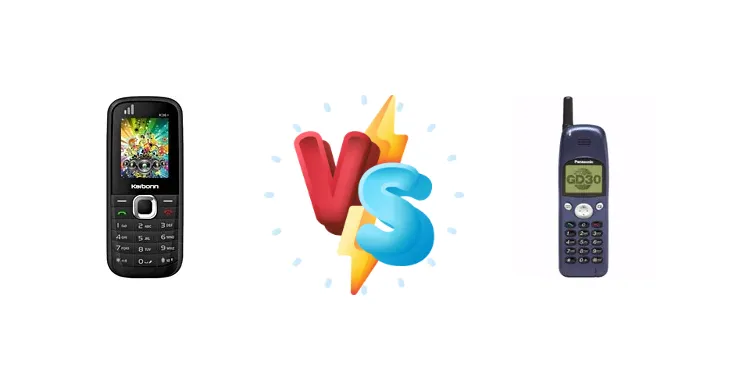
In a market saturated with smartphones, the feature phone stubbornly persists, offering unparalleled simplicity and battery life. We pit the Karbonn K36+ Jumbo Mini against the Panasonic GD30, two contenders vying for the attention of users prioritizing core communication over complex apps and features. This comparison focuses on the practical aspects of ownership for those seeking a reliable, no-frills mobile experience.
🏆 Quick Verdict
For the average user needing a dependable, long-lasting phone for calls and texts, the Panasonic GD30 likely offers a more robust build quality and established brand reputation. However, the Karbonn K36+ Jumbo Mini may appeal to those seeking the absolute lowest price point, assuming comparable functionality.
| Network |
|---|
| 2G bands | GSM 900 / 1800 - SIM 1 & SIM 2 | GSM 900 / 1800 |
| EDGE | No | No |
| GPRS | No | No |
| Technology | GSM | GSM |
| Launch |
|---|
| Announced | 2012 | 1999 |
| Status | Discontinued | Discontinued |
| Body |
|---|
| Dimensions | 111 x 47 x 16.5 mm (4.37 x 1.85 x 0.65 in) | 135 x 45 x 20 mm (5.31 x 1.77 x 0.79 in) |
| SIM | Dual SIM (Mini-SIM) | Mini-SIM |
| Weight | 92 g (3.25 oz) | 135 g (4.76 oz) |
| Display |
|---|
| Resolution | 128 x 160 pixels (~114 ppi density) | 4 x 16 chars |
| Size | 1.8 inches, 10.2 cm2 (~19.5% screen-to-body ratio) | - |
| Type | TFT, 65K colors | Monochrome graphic |
| Memory |
|---|
| Call records | Yes | - |
| Card slot | microSDHC (dedicated slot) | No |
| Phonebook | 500 entries | 50 |
| | - | Message templates |
| Main Camera |
|---|
| Single | VGA | - |
| Video | Yes | - |
| Sound |
|---|
| 3.5mm jack | - | No |
| 35mm jack | No | No |
| Alert types | - | Vibration; Monophonic ringtones |
| Loudspeaker | Yes | No |
| Comms |
|---|
| Bluetooth | 2.0 | No |
| NFC | No | - |
| Positioning | No | No |
| Radio | FM radio, recording | No |
| USB | microUSB | - |
| WLAN | No | No |
| Features |
|---|
| Alarm | - | Yes |
| Clock | - | Yes |
| Games | Yes | No |
| Java | Yes | No |
| Messaging | SMS | SMS |
| | - | On/off timers |
| Battery |
|---|
| Stand-by | Up to 400 h | 90 h |
| Talk time | Up to 8 h | 180 min |
| Type | Li-Ion 1800 mAh battery | Removable NiMH 700 mAh battery |
| Misc |
|---|
| Colors | Black | - |
| Price | About 20 EUR | - |
Karbonn K36+ Jumbo Mini
- Potentially lower price point
- May offer a larger screen size ('Jumbo Mini')
- Dual SIM capability (likely)
- Unknown brand reliability
- Potentially lower build quality
- Limited software support
Panasonic GD30
- Established brand reputation (Panasonic)
- Potentially more durable construction
- Optimized software experience
- May be slightly more expensive
- Potentially smaller screen size
- Basic feature set
Display Comparison
Given the lack of specific display data, we can infer both devices utilize low-resolution color displays typical of feature phones. The 'Jumbo Mini' in the Karbonn's name suggests a potentially larger screen size, which could benefit users who consume more text or prefer larger buttons. However, without knowing the panel technology (TFT, LCD) or resolution, it's difficult to assess image quality. The Panasonic GD30, historically, has focused on readability, suggesting a well-optimized display for basic tasks.
Camera Comparison
Both the Karbonn K36+ Jumbo Mini and Panasonic GD30 likely feature very basic cameras, primarily for capturing simple snapshots. Image quality will be limited by low resolution sensors and a lack of advanced features like autofocus or image stabilization. These cameras are best suited for documenting basic information, not for serious photography. Expect significant noise and limited detail in all lighting conditions.
Performance
Both phones will rely on basic MediaTek or Qualcomm chipsets designed for feature phone functionality. Performance differences will be negligible, limited to call handling, SMS messaging, and potentially basic FM radio. RAM capacity will be minimal (likely under 64MB), sufficient for the intended use case. The absence of a complex operating system means neither device will experience significant performance bottlenecks. The key differentiator will be software optimization and the responsiveness of the user interface.
Battery Life
Feature phones excel in battery life, and both devices should offer several days of standby time and hours of talk time on a single charge. The Karbonn K36+ Jumbo Mini's name implies a larger battery capacity, potentially extending its usage between charges. However, battery life is also heavily influenced by network conditions and usage patterns. The Panasonic GD30, benefiting from efficient power management, may offer comparable longevity despite a potentially smaller battery.
Buying Guide
Buy the Karbonn K36+ Jumbo Mini if you need a secondary phone for emergencies or travel, prioritizing minimal cost above all else. Buy the Panasonic GD30 if you prefer a device from a more established brand with a potentially more durable construction and a slightly more refined user experience, even within the feature phone category.
Frequently Asked Questions
❓ Is the Panasonic GD30 compatible with modern 4G networks?
The Panasonic GD30 is primarily a 2G feature phone. While some variants may support limited 3G connectivity, 4G support is unlikely. This means data speeds will be significantly slower than modern smartphones, suitable only for basic text-based communication.
❓ Can I use WhatsApp or Facebook on either the Karbonn K36+ Jumbo Mini or the Panasonic GD30?
No. These phones lack the processing power, RAM, and operating system required to run applications like WhatsApp or Facebook. They are designed for basic calling and texting functionality only.
❓ How durable is the Karbonn K36+ Jumbo Mini compared to the Panasonic GD30?
Panasonic generally has a reputation for building more robust devices. Without drop test data, it's difficult to say definitively, but the GD30 likely benefits from a more solid construction and potentially better materials.
❓ Does either phone support MP3 ringtones?
Yes, both the Karbonn K36+ Jumbo Mini and the Panasonic GD30 almost certainly support MP3 ringtones via microSD card or USB transfer, a standard feature for feature phones.