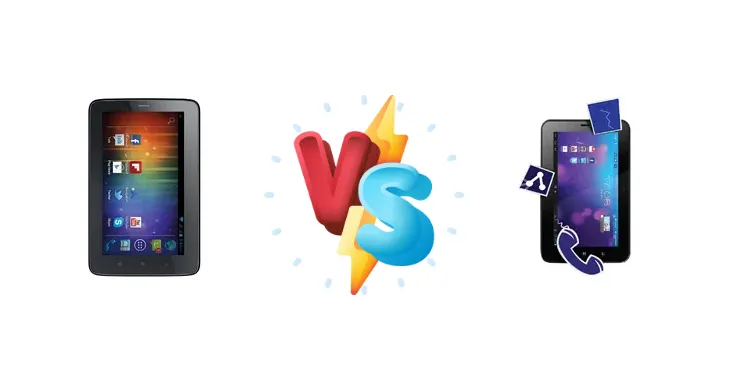
The Karbonn A37 and A34 represent Karbonn's entry into the ultra-budget smartphone market. While both aim to deliver basic smartphone functionality at a low price point, they differ significantly in their core processing power. This comparison dissects those differences, focusing on the A37’s dual-core CPU versus the A34’s Mediatek MT6515, and determines which device offers the better user experience.
🏆 Quick Verdict
For the average user prioritizing responsiveness and multitasking, the Karbonn A34 is the superior choice. Its Mediatek MT6515 chipset, featuring a Cortex-A9 CPU, provides a noticeable performance advantage over the A37’s dual-core 1.0 GHz processor, despite both operating at the same clock speed.
| Network |
|---|
| 2G bands | GSM 900 / 1800 / 1900 - SIM 1 & SIM 2 | GSM 900 / 1800 / 1900 - SIM 1 & SIM 2 |
| 3G bands | HSDPA 2100 | - |
| EDGE | - | Yes |
| GPRS | - | Yes |
| Speed | HSPA 7.2/0.384 Mbps | - |
| Technology | GSM / HSPA | GSM |
| Launch |
|---|
| Announced | 2013. Released 2013 | 2013. Released 2013 |
| Status | Discontinued | Discontinued |
| Body |
|---|
| Dimensions | 197 x 124 x 12.3 mm (7.76 x 4.88 x 0.48 in) | 197 x 124 x 12.3 mm (7.76 x 4.88 x 0.48 in) |
| SIM | Dual SIM | Dual SIM |
| Weight | 335 g (11.82 oz) | 335 g (11.82 oz) |
| Display |
|---|
| Resolution | 480 x 800 pixels, 5:3 ratio (~133 ppi density) | 480 x 800 pixels, 5:3 ratio (~133 ppi density) |
| Size | 7.0 inches, 139.5 cm2 (~57.1% screen-to-body ratio) | 7.0 inches, 139.5 cm2 (~57.1% screen-to-body ratio) |
| Type | TFT | TFT |
| Platform |
|---|
| CPU | Dual-core 1.0 GHz | 1.0 GHz Cortex-A9 |
| Chipset | - | Mediatek MT6515 |
| GPU | - | PowerVR SGX531 |
| OS | Android 4.1 (Ice Cream Sandwich) | Android 4.0 (Ice Cream Sandwich) |
| Memory |
|---|
| Card slot | microSDHC (dedicated slot) | microSDHC (dedicated slot) |
| Internal | 4GB 512MB RAM | 4GB 512MB RAM |
| Main Camera |
|---|
| Single | 2 MP | 2 MP |
| Video | Yes | Yes |
| Selfie camera |
|---|
| Single | Yes | Yes |
| Sound |
|---|
| 3.5mm jack | Yes | Yes |
| 35mm jack | Yes | Yes |
| Loudspeaker | Yes | Yes |
| Comms |
|---|
| Bluetooth | Yes | Yes |
| NFC | No | No |
| Positioning | GPS | GPS |
| Radio | FM radio | FM radio |
| USB | Proprietary | Proprietary |
| WLAN | Wi-Fi 802.11 b/g/n, hotspot | Wi-Fi 802.11 b/g/n, hotspot |
| Features |
|---|
| Sensors | Accelerometer | Accelerometer |
| Battery |
|---|
| Stand-by | Up to 240 h | Up to 240 h |
| Talk time | Up to 8 h | Up to 8 h |
| Type | Li-Ion 3000 mAh battery | Li-Ion 3000 mAh battery |
| Misc |
|---|
| Colors | Black/White | Gray/White |
| Price | About 100 EUR | About 90 EUR |
Karbonn A37
- Potentially lower price point (depending on retailer)
- Simple and straightforward user experience
- May be lighter due to simpler chipset
- Significantly slower performance compared to the A34
- Likely struggles with multitasking
- Older CPU architecture
Karbonn A34
- Faster and more responsive performance thanks to the Cortex-A9 CPU
- Better multitasking capabilities
- More efficient CPU architecture
- May be slightly more expensive than the A37
- Potentially slightly heavier due to the more complex chipset
- Still limited in overall performance compared to modern smartphones
Display Comparison
Information regarding display specifications (resolution, panel type, brightness) is unavailable for either device. Given their market segment, it’s reasonable to assume both utilize low-cost TFT LCD panels with modest resolutions. The user experience will likely be similar in terms of visual quality, with neither device expected to offer vibrant colors or high brightness levels.
Camera Comparison
Camera specifications are not provided beyond the existence of cameras on both devices. Given the price point, image quality will likely be subpar on both. Expect low-resolution sensors and limited dynamic range. Any differences in camera performance will likely be attributable to software processing rather than hardware capabilities.
Performance
The core difference lies in the CPU architecture. The Karbonn A37 utilizes a generic dual-core 1.0 GHz processor, lacking specific architectural details. In contrast, the Karbonn A34 is powered by the Mediatek MT6515, featuring a 1.0 GHz Cortex-A9 CPU. The Cortex-A9 is a significantly more advanced architecture than the likely older core design in the A37. This translates to better instructions-per-clock (IPC), meaning the A34 can process more data with each clock cycle. While both CPUs are clocked at 1.0 GHz, the A34 will demonstrably outperform the A37 in most tasks. The MT6515 also benefits from integrated graphics, likely offering a better, though still limited, gaming experience.
Battery Life
Battery capacity and charging wattage are not specified for either device. However, considering the low-end nature of these phones, battery life will likely be adequate for a day of light use. Charging times will likely be lengthy due to the probable use of a standard 5W charger. The more efficient Cortex-A9 CPU in the A34 *may* contribute to slightly longer battery life under moderate load, but this difference will likely be minimal.
Buying Guide
Buy the Karbonn A37 if your primary needs are limited to basic calling, texting, and extremely light app usage, and you are on the absolute tightest budget. Buy the Karbonn A34 if you anticipate using multiple apps simultaneously, browsing the web with more than a few tabs open, or engaging in any form of light gaming – the MT6515 chipset will provide a significantly smoother experience.
Frequently Asked Questions
❓ Will the Karbonn A34 handle popular social media apps like Facebook and WhatsApp smoothly?
Yes, the Mediatek MT6515 chipset in the A34 should provide a reasonably smooth experience with Facebook and WhatsApp. While not a high-end processor, the Cortex-A9 architecture is capable of handling these apps without significant lag, unlike the A37 which may struggle.
❓ Can the Karbonn A37 run basic games like Candy Crush or Subway Surfers?
The Karbonn A37 *may* be able to run very simple games like Candy Crush or Subway Surfers, but performance will likely be choppy and inconsistent. The dual-core processor lacks the graphical power for a fluid gaming experience. The A34, with its integrated graphics, will offer a slightly better, though still limited, gaming experience.
❓ Is the Mediatek MT6515 chipset in the A34 known for overheating?
The Mediatek MT6515 is a low-power chipset and is not generally known for overheating issues. Given the limited processing demands of these devices, thermal throttling is unlikely to be a significant concern with either the A37 or the A34.