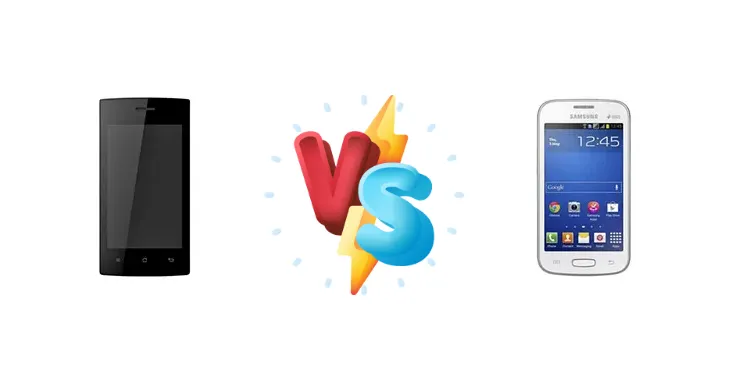
The Karbonn A16 and Samsung Galaxy Star Pro represent a segment of the market increasingly focused on affordability. Both devices aim to provide essential smartphone functionality at a minimal cost, but differ in their approach to processing power. This comparison dissects their specifications to determine which offers the better user experience for those seeking a basic, reliable device.
🏆 Quick Verdict
For the average user prioritizing responsiveness in basic tasks, the Karbonn A16 emerges as the slightly better choice. Its 1.3 GHz dual-core processor offers a tangible performance advantage over the Galaxy Star Pro’s 1.0 GHz Cortex-A5, making everyday operations feel smoother.
| Network |
|---|
| 2G bands | GSM 900 / 1800 - SIM 1 & SIM 2 | GSM 850 / 900 / 1800 / 1900 - S7260 |
| 3G bands | HSDPA 2100 | - |
| EDGE | - | Yes |
| GPRS | - | Yes |
| Speed | HSPA | No |
| Technology | GSM / HSPA | GSM |
| | - | GSM 850 / 900 / 1800 / 1900 - SIM 1 & SIM 2 - S7262 |
| Launch |
|---|
| Announced | 2014, January. Released 2014, January | 2013, October. Released 2013, October |
| Status | Discontinued | Discontinued |
| Body |
|---|
| Dimensions | - | 121.2 x 62.7 x 10.6 mm (4.77 x 2.47 x 0.42 in) |
| SIM | Dual SIM | Single SIM (Micro-SIM) or Dual SIM (Micro-SIM, dual stand-by) |
| Weight | - | 121 g (4.27 oz) |
| Display |
|---|
| Resolution | 480 x 800 pixels, 5:3 ratio (~239 ppi density) | 480 x 800 pixels, 5:3 ratio (~233 ppi density) |
| Size | 3.9 inches, 43.3 cm2 | 4.0 inches, 45.5 cm2 (~59.9% screen-to-body ratio) |
| Type | TFT | TFT |
| Platform |
|---|
| CPU | Dual-core 1.3 GHz | 1.0 GHz Cortex-A5 |
| OS | Android 4.2 (Jelly Bean) | Android 4.1.2 (Jelly Bean) |
| Memory |
|---|
| Card slot | microSDHC | microSDHC (dedicated slot) |
| Internal | 4GB 512MB RAM | 4GB 512MB RAM |
| Main Camera |
|---|
| Single | 5 MP | 2 MP |
| Video | Yes | 240p@15fps |
| Selfie camera |
|---|
| Single | Yes | - |
| | - | No |
| Sound |
|---|
| 3.5mm jack | Yes | Yes |
| 35mm jack | Yes | Yes |
| Loudspeaker | Yes | Yes |
| Comms |
|---|
| Bluetooth | 2.0 | 4.0, A2DP |
| NFC | No | No |
| Positioning | GPS | No |
| Radio | FM radio | Stereo FM radio, RDS, recording |
| USB | microUSB 2.0 | microUSB 2.0 |
| WLAN | Wi-Fi 802.11 b/g/n, hotspot | Wi-Fi 802.11 b/g/n, Wi-Fi Direct, hotspot |
| Features |
|---|
| Sensors | Accelerometer, proximity | Accelerometer |
| Battery |
|---|
| Music play | - | Up to 26 h |
| Stand-by | - | Up to 370 h |
| Talk time | - | Up to 15 h |
| Type | Li-Ion 1350 mAh, removable | Li-Ion 1500 mAh, removable |
| Misc |
|---|
| Colors | Black | Black, White, Green, Orange, Red |
| Models | - | GT-S7262 |
| Price | About 60 EUR | About 90 EUR |
| SAR EU | - | 0.50 W/kg (head) 0.31 W/kg (body) |
Karbonn A16
- Faster processor for smoother performance
- Potentially better multitasking capability
- More responsive user interface
- Brand recognition is lower than Samsung
- Software updates are less likely
Samsung Galaxy Star Pro S7260
- Established brand reputation
- Potentially more refined software experience
- Slightly better battery efficiency (potentially)
- Slower processor limits performance
- Less responsive user interface
- Limited multitasking capabilities
Display Comparison
Neither device provides detailed display specifications. However, given their market positioning, both likely utilize TFT LCD panels with resolutions around 480x800. The Galaxy Star Pro’s brand reputation suggests a potentially slightly better color calibration, but the A16’s larger processor might allow for smoother UI rendering on the display. Bezels are expected to be substantial on both models, typical of this price bracket.
Camera Comparison
Camera details are sparse for both devices. It’s safe to assume both feature basic rear cameras, likely around 3-5 megapixels. Image quality will be limited by the sensor size and lack of advanced features like optical image stabilization. The absence of detailed specifications makes a direct comparison impossible, but the A16’s slightly more powerful processor could potentially handle image processing marginally faster.
Performance
The core difference lies in the CPU. The Karbonn A16’s dual-core 1.3 GHz processor offers a 30% clock speed increase over the Samsung Galaxy Star Pro’s 1.0 GHz Cortex-A5. While both are based on older ARM architectures, the higher clock speed translates to faster application loading and smoother multitasking. The Cortex-A5 is a relatively efficient architecture, but its single-core performance is significantly lower. RAM specifications are not provided, but both likely feature 512MB or 1GB, limiting multitasking capabilities on both devices.
Battery Life
Battery capacity is not specified for either device. Given their basic functionality and lower-powered processors, both should offer at least a full day of standby time and several hours of talk time. Charging times will likely be slow, as neither device is expected to support fast charging technologies. The Cortex-A5’s efficiency might give the Star Pro a slight edge in battery life under light usage, but the difference is unlikely to be substantial.
Buying Guide
Buy the Karbonn A16 if you need a phone for essential tasks like calling, texting, and light social media browsing, and value a slightly more responsive experience. Buy the Samsung Galaxy Star Pro S7260 if you prioritize brand recognition and a potentially more refined software experience, understanding that performance will be comparatively limited.
Frequently Asked Questions
❓ Will the Samsung Galaxy Star Pro struggle with modern apps?
Yes, the 1.0 GHz Cortex-A5 processor and limited RAM (likely 512MB or 1GB) will result in slow loading times and potential crashes when running more demanding applications. It's best suited for basic tasks like calling, texting, and light web browsing.
❓ Is the Karbonn A16 likely to receive Android updates?
Unfortunately, it's highly unlikely. Karbonn, like many budget brands, typically provides limited software support for its devices. Expect the A16 to remain on the version of Android it shipped with.
❓ Can either phone run WhatsApp effectively?
Both phones *can* run WhatsApp, but the experience will be basic. Expect slower loading times for media and potential lag when scrolling through chats. The Karbonn A16's slightly faster processor will likely provide a marginally smoother experience.